Business Strategy

5 Elements Your Business Needs to Survive

Nearly 50% of businesses fail within five years. Learn the proven elements that separate thriving Swiss entrepreneurs from the statistics.

Swiss entrepreneur building a successful business

Why Most Businesses Fail

Research shows the top reasons for startup failure aren't about having a bad product—they're about fundamentals entrepreneurs overlook before they even launch.

🎯
42% No Market NeedBuilding solutions nobody wants
💸
29% Run Out of CashPoor financial planning
👥
23% Wrong TeamSkills and culture mismatch
📊
82% Leadership IssuesManagement and vision problems
Element 1

Solve a Problem People Already Know They Have

When someone is hungry, they walk into a restaurant. No sales pitch required. Your business needs that same clarity.

The Restaurant Test

Many entrepreneurs build products for problems that need explaining. That's a red flag.

A restaurant doesn't need to convince customers they're hungry—they already know. Compare that to a "contact management tool" where you'd need to:

  1. Convince someone they have a contact management problem
  2. Explain why your solution beats spreadsheets
  3. Justify the price

That's three hurdles instead of one.

Magic Heidi's Approach

The invoicing problem is crystal clear: "I need to send an invoice to get paid."

No explanation needed. No education required. The customer already knows they have this problem and wants it solved.

How to Test Your Problem Clarity

Ask yourself:

  • Can a customer describe this problem without your help?
  • Are people actively searching for solutions?
  • Would someone feel embarrassed to admit they don't have this problem?

If you answered "no" to any of these, you might be building a solution looking for a problem.

Swiss Market Insight: The Swiss Federal Statistics Office notes that businesses solving clear administrative pain points—accounting, invoicing, compliance—have higher survival rates than those in discretionary categories.

Element 2

Build a Reliable Customer Acquisition Channel

You could have the best restaurant in the world. If it's in the middle of a desert, you'll have zero customers. Discovery is everything.

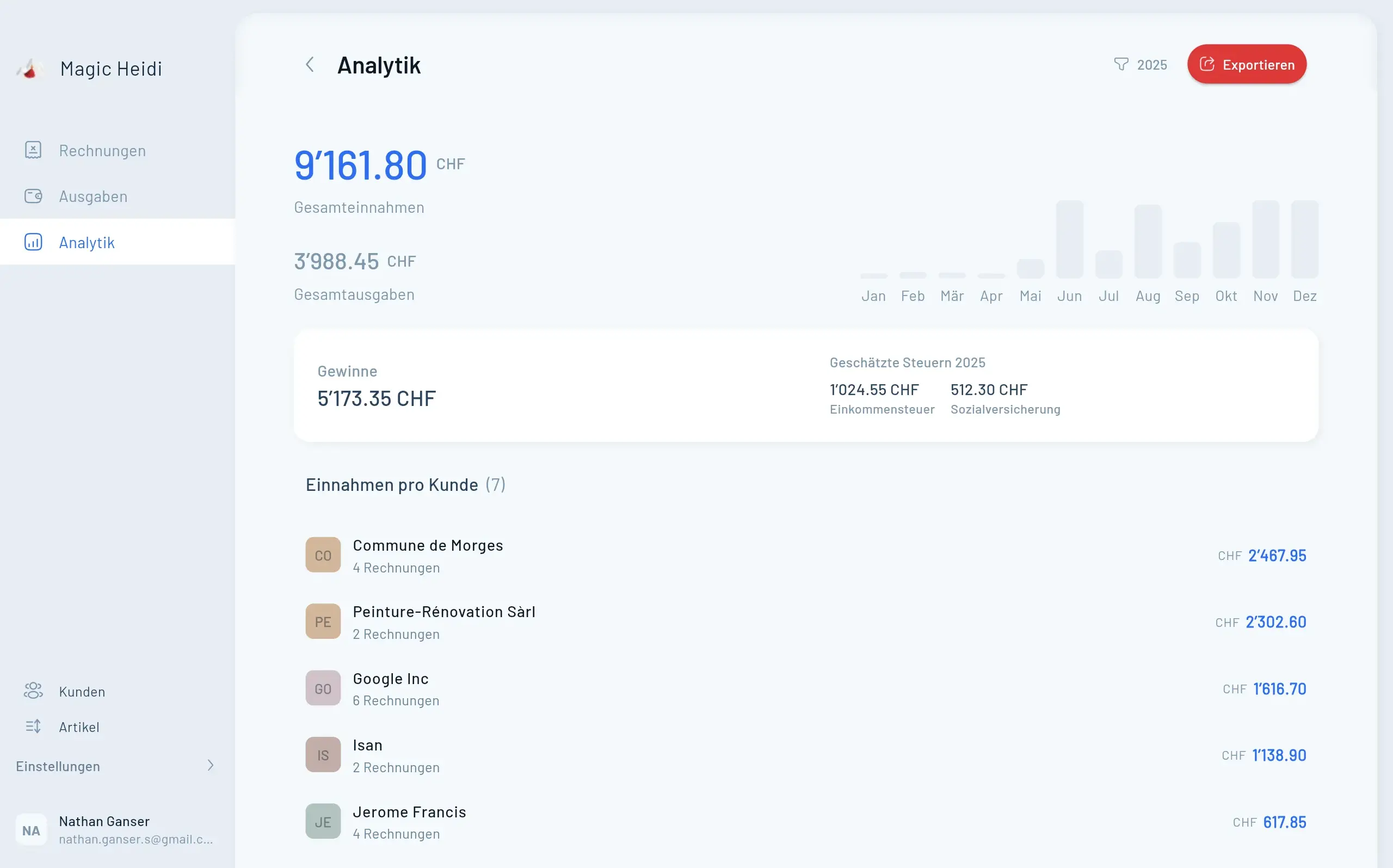
Magic Heidi Analytics showing customer acquisition

The Low-Cost Validation Method

Before spending months building, test demand:

  1. Create a simple landing page
  2. Run small ads (CHF 100-200) targeting your ideal customer
  3. Measure click-through and sign-up rates

If people won't click an ad, they won't buy your product.

Multilingual Advantage

Switzerland's four language regions create natural niches. A German-language invoicing app competes with everyone. A French-language app built specifically for Suisse Romande freelancers competes with far fewer options.

How to Test Willingness to Pay

Before building anything:

  1. Describe your solution to 10 potential customers
  2. Quote your planned price
  3. Ask: "Would you buy this today?"

Not "is this interesting?" Not "would you consider it?" Would they buy it today, at that price?

Watch for hesitation. Enthusiasm without commitment means nothing.

Swiss Pricing Psychology

Swiss customers expect quality and will pay for it. Underpricing signals low quality.

  • A CHF 29/month invoicing app feels professional
  • A CHF 5/month app feels like a hobby project

Price reflects perceived value. Price accordingly.

Element 4

Pick a Specific Niche

'Our product is for everyone' is another way of saying 'our product is for no one.' In a competitive market, undifferentiated businesses get crushed.

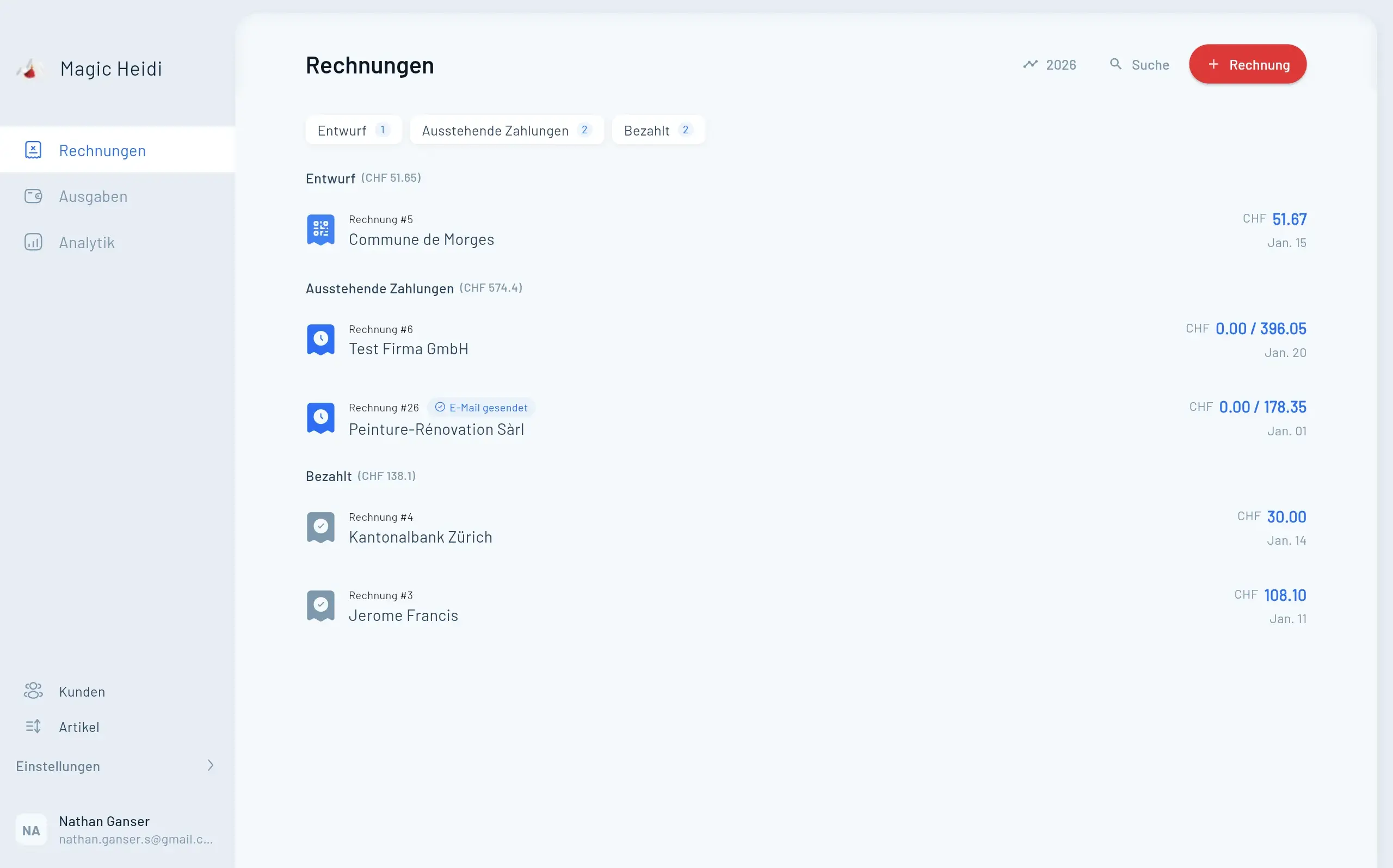
Magic Heidi invoice list for Swiss freelancers

Magic Heidi's
Niche Decision

Instead of competing with global invoicing giants, Magic Heidi focused exclusively on the Swiss market. Global competitors like FreshBooks or QuickBooks don't prioritize these features. For Swiss freelancers, Magic Heidi isn't just an option—it's the obvious choice.

🇨🇭 Swiss-Made
QR-Compliant
🔒 Secure
Specialized
🧾
Swiss QR-Invoices

Legally required since 2022

📋
Swiss Compliance

Local accounting standards

🏦
Bank Integrations

Swiss bank connections

🌐
Multilingual

French, German, Italian

The Niche Expansion Path

Start narrow. Dominate. Then expand.

Amazon started with books. Facebook started with Harvard students. You can start with Geneva-based IT consultants and expand from there.

"Invoicing for Swiss photographers" is a clearer message than "invoicing for everyone."

Element 5

Maintain High Margins

Large corporations can survive on 2% margins. They make it up in volume. You can't.

The Math of Small Business Survival

ScenarioPriceCostsProfitCustomers needed for CHF 5,000/month
Low MarginCHF 50CHF 45CHF 51,000 customers
High MarginCHF 50CHF 10CHF 40125 customers

Which is easier to achieve?

Why SaaS Margins Work

Software businesses like Magic Heidi have a structural advantage:

  • ✅ Development cost is mostly upfront
  • ✅ Each additional customer costs almost nothing to serve
  • ✅ Recurring subscriptions create predictable revenue
  • ✅ Margins can exceed 80-90%

Compare that to a consulting business where every franc of revenue requires an hour of work.

Common Mistakes

Swiss Entrepreneur Pitfalls to Avoid

Beyond the five elements, these Swiss-specific mistakes catch many new business owners

Legal Structure

Choosing the Wrong Business Structure

The right choice depends on your risk tolerance, growth plans, and funding needs.

  • Raison individuelle: Simplest, but personal liability for all debts
  • Sàrl (LLC): 41% of entrepreneurs choose this, requires CHF 20,000
  • SA (Corporation): CHF 100,000 capital, more administrative burden
Swiss business legal structure
Administration

Underestimating Administrative Requirements

Switzerland rewards rule-followers. Ensure proper setup from day one.

  • Register with cantonal commercial registry
  • Obtain required professional authorizations
  • Set up proper bookkeeping immediately
  • Understand your VAT obligations
Swiss business paperwork
Regional Differences

Ignoring Cantonal Differences

What works in Zurich may not work in Geneva.

  • Tax rates vary significantly by canton
  • Business support programs differ
  • Regulations change across borders
  • Research your specific canton's requirements
Swiss cantonal differences
Readiness Check

Your Business Readiness Checklist

Before launching, confirm you can answer 'yes' to each question. Score 4-5? You're ready. Below 3? Revisit your fundamentals.

ElementKey QuestionYour Answer
Problem ClarityCan customers describe this problem without prompting?☐ Yes / ☐ No
AcquisitionDo you have 2+ channels to reach customers?☐ Yes / ☐ No
Willingness to PayHave potential customers confirmed they'd pay your price?☐ Yes / ☐ No
Niche FocusCan you describe your ideal customer specifically?☐ Yes / ☐ No
Healthy MarginsDoes your pricing cover all costs plus profit?☐ Yes / ☐ No
FAQ

Frequently Asked Questions

How much money do I need to start a business in Switzerland?

It depends on your legal structure. A sole proprietorship (raison individuelle) has no minimum capital requirement. An Sàrl requires CHF 20,000, and an SA requires CHF 100,000. Beyond legal minimums, statistics show businesses starting with more capital have significantly higher survival rates.

What percentage of new businesses fail in Switzerland?

Approximately 25% of Swiss businesses fail within their first two years, and nearly 30% don't reach five years. This is actually better than the global average, where nearly 50% fail within five years.

What's the most common reason businesses fail?

Research indicates 42% of startups fail because there's no market need for their product. This is why validating that you're solving a clear, acknowledged problem is the most critical first step.

Should I quit my job to start a business?

Most successful entrepreneurs recommend starting part-time while employed, validating your business model, then transitioning once you have paying customers and predictable revenue. The 78% self-funding statistic means your salary is probably your startup's primary funding source.

Do I need to register my business in Switzerland?

Requirements vary by canton and legal structure. Sole proprietorships generating under CHF 100,000 annually don't always require commercial registry entry, but other registrations (AVS, professional associations, VAT) may still apply. Consult EasyGov.swiss for your specific situation.

How do I know if my business idea is good?

A good idea solves a clear problem, has customers willing to pay, can be reached through viable channels, targets a specific niche, and generates healthy margins. If your idea checks all five boxes, it's worth pursuing.

Ready to Simplify Your Invoicing?

Magic Heidi handles Swiss QR-invoices, works across all your devices, and lets you focus on what matters—building your business.