 Magic Heidi
 Florist Rechnung Schweiz: Complete Guide for Flower Shops
Article 26 of the VAT Act (MWSTG) sets out the required VAT invoice details. The Swiss invoice template helps organise them.
Florist Rechnung Schweiz: The Complete Guide to Invoicing for Flower Shops
Article 26 of the VAT Act (MWSTG) sets out the required VAT invoice details. The Swiss invoice template helps organise them.
In this guide, we'll walk through every part of creating a proper florist invoice Switzerland florists can rely on, from the legal minimum fields to VAT rates, QR bills, wedding deposits, seasonal pricing, product vs. service billing, and the best software to handle it all from your phone.
Key Takeaways
- Article 26 of the VAT Act (MWSTG) sets out the required VAT invoice details. The Swiss invoice template helps organise them.
- The MWST standard rate is 8.1% as of January 1, 2024; it applies to both cut flowers and florist services (no reduced rate for florists).
- The QR-Rechnung replaced the old ESR payment slip fully on October 1, 2022; every invoice should include one.
- Wedding and event florists commonly send an Akontorechnung (deposit invoice) followed by a Schlussrechnung (final invoice).
- Compare the features your business needs and consult bexio pricing for current prices. Magic Heidi Free includes 3 invoices and 3 expenses. Pro costs CHF 24.99 a month billed annually (CHF 299.00 a year), or CHF 39.00 billed monthly. See pricing. Key takeaways For consistent invoice details and records, use the Swiss invoice template or bookkeeping software. Hypothetical example: amounts illustrate the calculation only. They do not describe a real customer or a guaranteed outcome.
What Must Be on a Swiss Florist Invoice (Art. 26 MWSTG)
Article 26 of the VAT Act (MWSTG) sets out the required VAT invoice details. The Swiss invoice template helps organise them.
Here's what must appear on every invoice:
- Name and address of the invoicing party (you). Your full business name and registered address. If you're self-employed, your name as registered with the commercial register goes here.
- Name and address of the recipient (your client). For private clients, their home address. For corporate clients, the business name and address.
- Date of the invoice. The day you issue it. Simple.
- Description of the service or product. Specific enough that the client knows what they're paying for. "Bridal bouquet, 5 bridesmaid bouquets, 10 table arrangements" is good. "Flowers" is not.
- Amount due. The total, broken down by line item if you have multiple arrangements or products.
- MWST rate and MWST amount, if you're MWST-liable (which you are if your annual revenue exceeds CHF 100'000.00). Show both the rate (8.1%) and the actual MWST amount in CHF.
A few practical items go beyond the legal minimum but make a big difference:
- Article 26 of the VAT Act (MWSTG) sets out the required VAT invoice details. The Swiss invoice template helps organise them.
- Payment deadline. Typically 10 or 30 days. State it clearly on the invoice.
- QR-bills replaced red and orange payment slips in October 2022. A regular IBAN works with a Creditor Reference or no reference; a QR-IBAN must be paired with a QR reference. This change does not make a QR code mandatory on every invoice.
- Contact information. Phone number and email, in case the client has questions.
A common mistake: forgetting to list the recipient's address when invoicing a private client. Even if it's a walk-in customer, collect and include their name and address for your records. If the invoice is for a business, include their UID (Unternehmens-Identifikationsnummer) for B2B transactions.
You can find the official requirements on the Swiss Federal Tax Administration website.
When Clara opened her flower shop in Lucerne, she sent her first dozen invoices with just her name, the amount, and a handwritten IBAN. Three clients paid late, one typed the IBAN wrong, and her accountant couldn't match payments to jobs. After she switched to a proper florist rechnungsvorlage with sequential numbers and a QR-Rechnung, her payment times dropped from 18 days to 4. You can create your first QR-Rechnung in 30 seconds.
MWST/VAT for Florists: The 8.1% Standard Rate
Here's the part that trips up a lot of new florists: the MWST rate changed.
Floristry falls under the standard rate. There's no reduced rate for flowers or florist services. The 2.6% reduced rate applies to things like food, books, and newspapers, not bouquets or arrangements. So whether you're charging for a single rose, a CHF 300.00 wedding arrangement, or a delivery fee, you apply 8.1%.
When Does MWST Apply to You?
You're MWST-liable if your annual taxable revenue exceeds CHF 100'000.00. Below that threshold, MWST registration is optional. Many self-employed florists choose to register voluntarily because:
- It lets you reclaim input tax (Vorsteuer) on business purchases (coolers, wholesale flowers, vases, delivery van).
- Some corporate clients prefer or require MWST-registered vendors.
- It creates a cleaner paper trail.
If you do register, you'll file MWST returns, either quarterly or semi-annually, depending on your revenue and the FTA's assessment. The FTA portal handles this, and good invoicing software (like Magic Heidi's invoicing tools) generates the reports you need.
How to Calculate MWST on a Florist Invoice
Let's say you charge CHF 150.00 for a bridal bouquet. Here's the math:
- Net amount: CHF 150.00 ÷ 1.081 = CHF 138.76 (net)
- MWST (8.1%): CHF 11.24
- Gross amount (what the client pays): CHF 150.00
Or, if you price net (common for B2B):
- Net: CHF 138.76
- MWST (8.1%): CHF 11.24
- Gross: CHF 150.00
Most florists price gross (the price the client sees is the price they pay). But your invoice needs to show both the net and the MWST amount separately.
MWST Florist: A Quick Reference
| Service/Product | MWST Rate | Notes |
|---|---|---|
| Wedding and event floristry (design + labor) | 8.1% | Same rate, services and products treated equally |
| Delivery fee | 8.1% | Part of the taxable service |
| Gift cards / vouchers | No MWST at sale | MWST applies when the voucher is redeemed |
QR-Rechnung: The Mandatory Payment Part for Florists
The QR-Rechnung is the standard payment method in Switzerland. It fully replaced the old Einzahlungsschein (ESR) on October 1, 2022. If you're still using old ESR slips, stop. Swiss banks no longer accept them.
The QR-Rechnung consists of two parts:
- QR-bills replaced red and orange payment slips in October 2022. A regular IBAN works with a Creditor Reference or no reference; a QR-IBAN must be paired with a QR reference. This change does not make a QR code mandatory on every invoice.
- The receipt (Empfangsschein) — the left portion that the payer detaches and keeps as proof of payment.
What You Need to Generate a QR-Rechnung
To include a QR payment part on your florist rechnung schweiz, you need:
- QR-bills replaced red and orange payment slips in October 2022. A regular IBAN works with a Creditor Reference or no reference; a QR-IBAN must be paired with a QR reference. This change does not make a QR code mandatory on every invoice.
- A creditor address — your name/business name and Swiss address.
- The invoice amount and currency (CHF or EUR).
- An optional reference number (QR-Reference, 27 characters). This links the payment to your invoice automatically.
You can generate QR-Rechnungen manually using the Swiss QR Bill generator on paymentstandards.ch or, much easier, use invoicing software that does it automatically. Magic Heidi generates the QR payment part on every invoice with one tap. No separate tool, no formatting headaches. Try it here.
Why the QR-Rechnung Matters for Florists
Most retail flower customers pay by Twint, card, or cash. But wedding clients, corporate accounts, and anyone paying by bank transfer expect a QR-Rechnung. Without it, you're making them type in your IBAN manually, which leads to typos, delayed payments, and awkward follow-up conversations.
Including a QR-Rechnung also gives you a structured creditor reference (the 27-digit QR-Reference). When the payment lands in your account, you can match it to the invoice automatically. No more guessing which bride paid for which bouquet.
Wedding and Event Floristry Billing: Akonto, Deposits, and Final Invoices
Wedding floristry is where invoicing gets interesting. You're not selling a single bouquet off the shelf; you're designing, sourcing, and installing a full floral concept that might cost CHF 3'000.00 to CHF 15'000.00. That changes how you bill.
The Akontorechnung (Deposit Invoice)
Most Swiss wedding florists take a deposit (Akonto) when the couple books. Typically 30 to 50% of the total quote, due 2 to 4 weeks after signing. This secures the date, covers wholesale flower orders, and protects you against last-minute cancellations.
You issue an Akontorechnung for the deposit amount. It should include:
- The full scope of work (so the couple sees what the deposit covers).
- The deposit percentage and amount.
- Your cancellation policy (what happens to the deposit if they cancel).
- A QR-Rechnung for the deposit amount.
The Schlussrechnung (Final Invoice)
After the wedding, you send the Schlussrechnung for the remaining balance. This is where precision matters. The final invoice should itemize:
- All arrangements delivered. Bridal bouquet, bridesmaid bouquets, boutonnieres, ceremony arch, centerpieces, etc.
- Any changes from the original quote. If the couple added 3 extra centerpieces or upgraded from peonies to garden roses, those show as line items.
- Delivery and setup fees. Often a flat fee or hourly rate for installation.
- The deposit credited. Show the Akonto already paid and subtract it from the total.
- MWST at 8.1% on the full amount.
Here's what a simplified wedding Schlussrechnung might look like:
| Position | Description | Amount (CHF) |
|---|---|---|
| 1 | Bridal bouquet (garden roses, eucalyptus) | 180.00 |
| 2 | 5 bridesmaid bouquets | 350.00 |
| 3 | 10 table centerpieces | 750.00 |
| 4 | Ceremony arch installation | 600.00 |
| 5 | Delivery and setup (3 hrs) | 240.00 |
| Net total | 2,120.00 | |
| MWST (8.1%) | 171.72 | |
| Gross total | 2,291.72 | |
| Less Akonto paid | -800.00 | |
| Balance due | 1,491.72 |
Contracts and Quotes
Before any deposit invoice goes out, you should have a signed quote (Offerte) or contract. This protects both sides. The quote should specify: flower types and quantities, arrangement sizes, delivery and setup details, total price, deposit amount and due date, final payment due date (often 14 days after the wedding), and cancellation terms.
A clear quote prevents the most common wedding florist dispute: "I thought the ceremony arch was included."
Delivery Fees, Seasonal Pricing, and Peak Demand
Floristry has intense seasonal swings. Valentine's Day, Mother's Day, and wedding season (May to September) can double or triple your normal volume. Your invoicing needs to handle this.
Delivery Fees
Delivery is part of your taxable service, so the 8.1% MWST applies to delivery fees. Common approaches:
- Flat delivery fee (e.g., CHF 15.00 within the city, CHF 25.00 outside). Simple and predictable for clients.
- Distance-based fee (e.g., CHF 2.00 per km from your shop). Fairer for you on long drives.
- Free delivery above a threshold (e.g., free over CHF 100.00). Encourages larger orders.
List the delivery fee as a separate line item on the invoice. Don't bury it in the bouquet price, clients like transparency and you can track delivery revenue separately.
Seasonal Pricing
Flower wholesale prices spike around Valentine's Day and Mother's Day. Roses can double in cost the week of February 14. You have two options:
- Raise prices during peak periods. Many Swiss florists add a seasonal surcharge (e.g., +15% during Valentine's week). State this clearly on your quote and invoice.
- Absorb the cost and raise average order value. Offer bundled products (bouquet + vase + card) at a higher price point.
Either way, your invoicing software should handle variable pricing without you editing a template every time. Magic Heidi lets you save product presets and adjust prices per invoice in seconds, explore features.
Valentine's Day and Mother's Day: High-Volume Invoicing
These two holidays generate more orders than the rest of Q1 combined. If you're processing 80 to 200 orders in a single week, you can't write each invoice by hand. Batch invoicing, saved customer profiles, and quick-duplicate invoice functions save you hours.
Product Sales vs. Service Sales: Same MWST, Different Documentation
A florist invoice often mixes products and services. A client orders a bridal bouquet (product), plus delivery and on-site arrangement (service). Here's what you need to know:
Both are taxed at 8.1% MWST. There's no reduced rate for cut flowers or florist services in Switzerland. This simplifies your invoicing: you don't need to split your invoice into different MWST rates.
However, you should still list products and services as separate line items. Why?
- Clearer for the client. They can see exactly what they're paying for: "Bridal bouquet: CHF 180.00" and "On-site arrangement (2 hrs): CHF 160.00" rather than a single "Flowers: CHF 340.00."
- Better for your accounting. Tracking product revenue vs. service revenue helps you understand profitability. If product margins are thin but service margins are strong, you might push more design work.
- Inventory tracking. If you sell cut flowers, vases, and accessories, track inventory for your own records. Each product sold should reduce your stock count.
- Returns and exchanges. Products (a vase, a potted plant) can be returned. Services can't. Keeping them separate makes refunds cleaner.
Example: Mixed Invoice for a Corporate Client
A Zürich company orders weekly office flowers plus a one-time event installation:
| Position | Description | Amount (CHF) |
|---|---|---|
| 1 | Weekly office bouquet (subscription) | 85.00 |
| 2 | Event centerpiece installation (3 pcs) | 450.00 |
| 3 | Glass vase x3 | 60.00 |
| 4 | Delivery | 20.00 |
| Net total | 615.00 | |
| MWST (8.1%) | 49.82 | |
| Total | 664.82 |
Each line item is clear, the client knows what they're getting, and your accounting tracks product sales, service revenue, and delivery income separately.
The Best Invoicing Software for Florists in Switzerland
You can write invoices in Word, use an Excel template, or print them by hand. But manual invoicing wastes time, leads to MWST errors, and makes tax season a nightmare.
For a Swiss florist, the right software should:
- Generate QR-Rechnungen automatically. No separate QR code generator. The QR payment part appears on every invoice by default.
- Calculate MWST correctly. 8.1% applied to the right items. Automatic splitting of net and gross amounts.
- Track expenses. When you buy wholesale flowers, vases, or a new cooler, capture those receipts for Vorsteur (input tax) deduction. AI expense scanning (snap a photo, done) saves hours.
- Be mobile-first. You're standing in the cooler or at the design table, not at a desk. Invoice creation should take 30 seconds from your phone.
- Handle seasonal volume. Saved products, quick-duplicate invoices, customer profiles for repeat clients.
- Compare the features your business needs and consult bexio pricing for current prices.
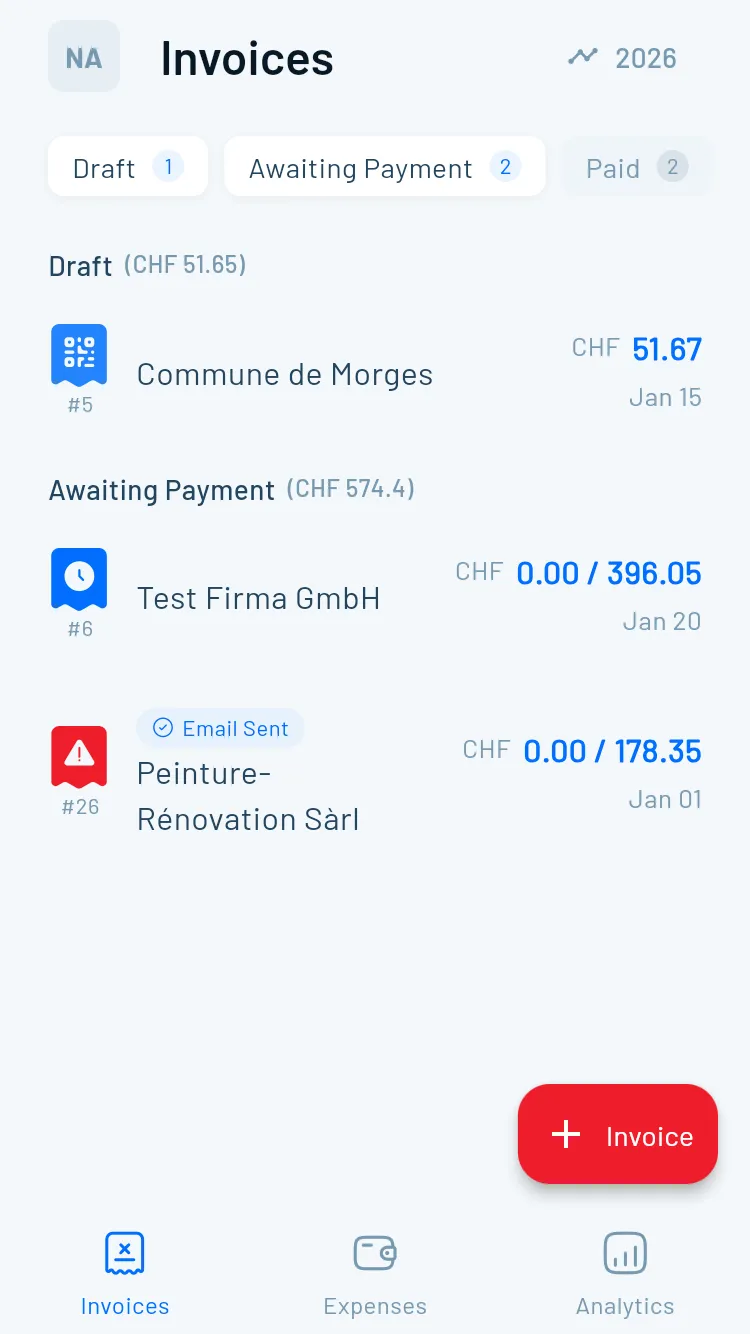
Magic Heidi creates QR-bills and quotes, records expenses and tracks payments. Explore the invoicing software. Magic Heidi Free includes 3 invoices and 3 expenses. Pro costs CHF 24.99 a month billed annually (CHF 299.00 a year), or CHF 39.00 billed monthly. See pricing.
If you're comparing options, here's a quick contrast:
Compare the features your business needs and consult bexio pricing for current prices.
Compare the features your business needs and consult bexio pricing for current prices. Magic Heidi Free includes 3 invoices and 3 expenses. Pro costs CHF 24.99 a month billed annually (CHF 299.00 a year), or CHF 39.00 billed monthly. See pricing.
FAQ: Florist Invoicing in Switzerland
Do I need to charge MWST as a self-employed florist in Switzerland?
You must charge 8.1% MWST if your annual taxable revenue exceeds CHF 100'000.00. Below that threshold, MWST registration is optional. Many florists register voluntarily to reclaim Vorsteur (input tax) on wholesale flowers, equipment, and delivery costs.
What MWST rate applies to flowers and florist services?
Both cut flowers and florist services (arrangements, wedding design, installation) are taxed at the standard rate of 8.1% since January 1, 2024. The 2.6% reduced rate applies only to food, books, and newspapers. It doesn't apply to anything a florist sells.
QR-bills replaced red and orange payment slips in October 2022. A regular IBAN works with a Creditor Reference or no reference; a QR-IBAN must be paired with a QR reference. This change does not make a QR code mandatory on every invoice.
The QR-Rechnung replaced the old ESR on October 1, 2022. While private cash sales don't need one, any invoice paid by bank transfer should include the QR payment part. It makes payment easier for clients and enables automatic payment matching via the 27-digit QR-Reference.
How do I invoice a wedding deposit (Akonto)?
Send an Akontorechnung for 30 to 50% of the total quote when the couple books. Include the full scope of work, deposit amount, cancellation terms, and a QR-Rechnung. After the wedding, send a Schlussrechnung (final invoice) that itemizes everything delivered, credits the Akonto already paid, and applies 8.1% MWST to the full amount.
Can I deliver flowers without a delivery fee on the invoice?
You can, but listing delivery as a separate line item is better practice. Delivery is part of your taxable service at 8.1% MWST. Showing it separately helps clients understand the cost breakdown and lets you track delivery revenue in your accounting.
What's the best invoicing software for Swiss florists?
Compare the features your business needs and consult bexio pricing for current prices. Magic Heidi Free includes 3 invoices and 3 expenses. Pro costs CHF 24.99 a month billed annually (CHF 299.00 a year), or CHF 39.00 billed monthly. See pricing.
Conclusion: Get Your Florist Rechnung Right
Article 26 of the VAT Act (MWSTG) sets out the required VAT invoice details. The Swiss invoice template helps organise them.
The biggest mistake most self-employed florists make isn't the invoicing itself. It's doing it manually. Word templates, Excel sheets, and handwritten receipts lead to MWST errors, lost invoices, and stressful tax seasons, especially around Valentine's Day and Mother's Day when volume triples.
Magic Heidi creates QR-bills and quotes, records expenses and tracks payments. Explore the invoicing software.
Ready to stop wasting time on admin and get back to designing with flowers? Try Magic Heidi free, your first QR invoice in 30 seconds, no credit card required.