Installment Payments Switzerland: How Installment Agreements Work for Freelancers
Installment payments in Switzerland are regulated by the OR but raise MWST questions: When is the tax due? What belongs in an installment agreement? And what to do in case of payment default? This guide covers the legal basics, tax treatment, and a template for your next installment agreement.

Founder of Magic Heidi
An installment payment in Switzerland is a contractual agreement in which a customer settles an invoice not all at once, but in several partial amounts over an agreed period. It is regulated in the Code of Obligations (OR), in particular in Articles 314 and 102 OR. For freelancers and self-employed individuals, installment payments are a useful tool to facilitate larger orders for clients — but they come with tax obligations and risks that you need to understand.
Imagine you have completed an order for CHF 24,000. The customer is solvent but asks to pay in six monthly installments of CHF 4,000. That sounds like a good deal — more order volume, a satisfied customer, predictable income. But what does this mean for your MWST reporting? What happens if the customer defaults on the third installment? And what should be included in an installment agreement to make it hold up in court?
In this guide, I explain how installment payments work in Switzerland: the legal basics, correct MWST treatment, what belongs in an installment agreement, and how to protect yourself when a customer misses a payment. With concrete CHF examples, a template, and no legal jargon.
Key Takeaways
- An installment payment is a contractual agreement under OR Art. 314 — there is no legal obligation to offer installment payments, but once you agree to them, the agreement is legally binding.
- The MWST becomes due upon invoicing — not upon receipt of payment. If you issue a total invoice with MWST and split it into installments, you owe the entire MWST immediately, even if the money has not arrived yet.
- An installment agreement must include at least: total amount, number and amount of installments, due dates, interest rate in case of default, and the legal consequence of non-payment.
- In case of payment default, OR Art. 102 applies: From the day after the installment's due date, the statutory default interest (5%) accrues, and you can declare the entire remaining balance immediately due.
- The alternative to installment payments is the partial performance invoice: You issue separate invoices after each milestone — cleaner for MWST and easier in case of disputes.
What Is an Installment Payment and When Does It Make Sense?
An installment payment is the splitting of an invoice amount into several partial payments over an agreed period. The term is not explicitly mentioned in the Swiss Code of Obligations — the legal basis is of a general nature: OR Art. 314 governs the rescission and modification of contracts by agreement, and OR Art. 102 deals with the debtor's default. An installment payment is therefore a voluntary contractual arrangement between you and your customer.
For freelancers and self-employed individuals, installment payments make sense in the following situations:
- Large orders (from approx. CHF 10,000): The customer cannot or does not want to pay the total amount all at once, but the order is too important to decline.
- Long-running projects: For projects spanning several months, a monthly installment payment can smooth the cash flow situation for both sides.
- Private customers: For B2C customers (e.g., coaching, treatments, craft services), installment payments are often a competitive advantage — the customer can finance a service they could not afford all at once.
- Regular customers: For long-standing customers whose payment habits you know, installment payments are a service with little risk.
When an installment payment does not make sense:
- With new customers without a credit check
- With customers known to have poor payment habits
- For amounts under CHF 2,000 — the administrative effort is disproportionate to the benefit
- When your own cash flow cannot support it — you don't pay your bills in installments either
Mini-Story: Claudia, Web Designer from Zurich
Claudia runs her own web design agency and usually works with SMEs in the CHF 8,000–25,000 range per project. A new startup wanted an online shop for CHF 18,000 but asked for installment payments over six months. Claudia agreed, arranged six monthly installments of CHF 3,000, and issued a total invoice with a QR-Rechnung.
Three months later, the startup stopped paying the fourth installment. Claudia faced a problem: she had already remitted the entire MWST of 8.1% on the CHF 18,000 to the ESTV — that's CHF 1,458 — but had only received CHF 9,000. She had pre-financed the MWST for the outstanding CHF 9,000.
Had Claudia instead issued six separate partial performance invoices, the MWST would only have been due on the portion already delivered and invoiced each time. The lesson: With installment payments, invoicing is the critical factor — it determines when the MWST becomes due.
Installment Payment vs. Partial Performance Invoice: The Crucial Difference
Many freelancers confuse installment payments with partial performance invoices. The difference is tax-relevant and can cost you a lot of money.
| Installment Payment | Partial Performance Invoice | |
|---|---|---|
| Invoice | One total invoice with an agreed installment plan | Multiple separate invoices per milestone |
| MWST due | Entire MWST upon invoicing (immediately) | MWST on each partial performance invoice |
| Service delivery | Service may already be fully rendered | Service is delivered step by step and invoiced |
| Risk on default | MWST pre-financed, remaining claim open | Only the next installment is missing, MWST correlates with revenue |
| Bookkeeping effort | One invoice, multiple payments | Multiple invoices, multiple payments |
Recommendation: If you have the choice, prefer partial performance invoices. They align MWST due dates with payment receipts and reduce your pre-financing risk. Installment payments with a total invoice are more of a tool for the consumer goods sector (e.g., beauty salons, fitness centers, private treatments), where the service is delivered upfront and payment is stretched out afterward.
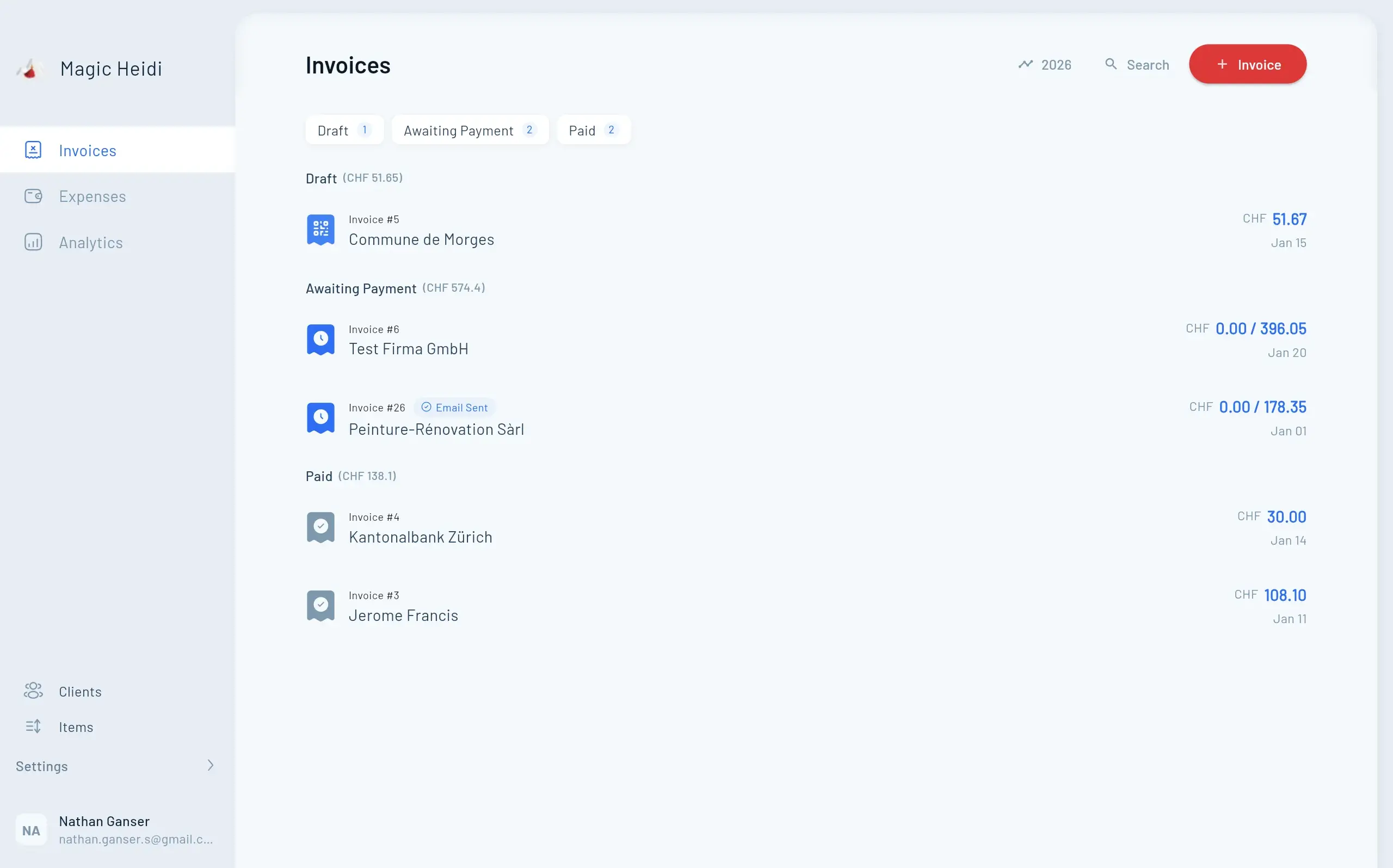
For more on correct invoicing with QR-Rechnung, see our guide on creating a QR-Rechnung. With the invoicing software from Magic Heidi, you can handle both partial performance invoices and installment agreements with QR-Rechnung — directly from your phone.
MWST on Installment Payments: When the Tax Becomes Due
The most common source of errors with installment payments is the MWST treatment. The basic rule is: The MWST becomes due upon invoicing, not upon receipt of payment. This means:
- If you issue a total invoice for CHF 18,000 (incl. MWST) and agree on installment payments, you owe the entire MWST on the CHF 18,000 to the ESTV — in the reporting period in which you issued the invoice. Whether the customer has already paid is irrelevant for the MWST obligation.
- If you issue six separate invoices of CHF 3,000 each (incl. MWST), the MWST is only due on the invoiced amount each time — spread over several reporting periods.
This rule is set out in Art. 32 MWSTG: The tax arises upon invoicing or upon receipt of the service. The ESTV explains this in detail in its guidelines on MWST for partial and installment payments.
Three Scenarios Compared
Scenario 1: Total Invoice with Installment Payment You issue an invoice in March for CHF 18,000 (incl. 8.1% MWST = CHF 1,350 net MWST). The customer pays in six installments from March to August. You must declare and remit the entire CHF 1,350 MWST in the Q1 reporting (January–March) — even though you only received CHF 3,000 from the customer in March. You pre-finance CHF 1,125 in MWST.
Scenario 2: Partial Performance Invoices You issue an invoice for CHF 3,000 (incl. MWST) each month. In March, you declare only the MWST of the March invoice (CHF 225), in April the MWST of the April invoice, and so on. MWST due dates and payment receipts run in sync. No pre-financing.
Scenario 3: Installment Payment with Advance Invoice You issue an advance invoice for 50% (CHF 9,000) and a final invoice for the remaining 50%. The customer asks to pay the final invoice in installments. The MWST on the advance invoice is due in Q1, and the MWST on the final invoice in the quarter of the final invoice. This is a compromise that halves the pre-financing risk.
What to Do When a Customer Defaults
If a customer defaults on an installment payment and the claim becomes uncollectible, you can claim a bad debt loss. This means: You correct the MWST already remitted in the next reporting period and get the money back from the ESTV. Prerequisite: You have demonstrably sent payment reminders and either initiated debt collection or determined the customer's bankruptcy.
For full details on debt collection and handling payment defaults, see our guide on Debt Collection Switzerland. And if you don't yet send systematic payment reminders, read our guide on writing a payment reminder — that's the first step before you collect on an installment.
The Installment Agreement: What Must Be Included
An installment agreement is only as good as what's in it. Verbal arrangements are valid under the OR, but practically worthless in disputes. Write down every installment payment — no matter how small.
Here are the elements that must be included in every installment agreement:
- Total amount and MWST: The full invoice amount incl. MWST, shown as net and gross amounts.
- Number and amount of installments: How many installments, in what amount. Example: "6 monthly installments of CHF 3,000.00 each."
- Due dates: When is each installment due? Example: "The first installment is due on the 15th of the month following invoicing, with subsequent installments due on the 15th of each following month."
- Payment method: QR-Rechnung with QR-IBAN, direct debit, or bank transfer. We recommend the QR-Rechnung — it is the Swiss standard defined by Swiss Payment Standards.
- Interest rate on default: From the day after the installment's due date, the statutory default interest of 5% applies (OR Art. 104). You can agree on a higher rate, but must state it in the agreement.
- Legal consequence of payment default: What happens if the customer doesn't pay an installment? The most important clause: Forfeiture clause — if an installment is missed, the entire remaining balance becomes immediately due. This clause must be expressly agreed (OR Art. 314).
- Right of withdrawal: Under what conditions can you withdraw from the contract? Typically: after two missed installments.
- Retention of title: For goods deliveries, you can agree that ownership transfers only upon full payment (OR Art. 716). For services, this is less relevant.
Template: Installment Agreement
Here is a template you can adapt and use:
Installment Agreement
Between Your Name / Company (hereinafter "Contractor") and Customer Name / Company (hereinafter "Client")
regarding Invoice No. Number dated Date for a total amount of CHF Amount (incl. 8.1% MWST)
1. Installment Plan
The total amount will be paid in Number installments as follows:
| Installment | Amount | Due on |
|---|---|---|
| 1st Installment | CHF Amount | Date |
| 2nd Installment | CHF Amount | Date |
| 3rd Installment | CHF Amount | Date |
| ... | ... | ... |
2. Payment Method
Payment is made via QR-Rechnung to the QR-IBAN IBAN in favor of Name.
3. Default Interest
In the event of late payment of an installment, default interest of 5% per year (OR Art. 104) shall be owed from the day following the due date. The statutory default interest is calculated on the overdue installment until it is fully settled.
4. Forfeiture Clause
If an installment is not paid within 10 days of the due date, the entire remaining balance becomes immediately due (OR Art. 314). In this case, the Contractor may suspend further services until full payment is received.
5. MWST
The MWST is included in the installment amounts. The tax treatment follows invoicing in accordance with Art. 32 MWSTG.
6. Severability Clause
Should any provision of this agreement be invalid, the validity of the remaining provisions shall remain unaffected. The invalid provision shall be replaced by a valid one that comes closest to the economic purpose.
Place, Date: _________________
Contractor: _________________
Client: _________________
This template does not replace legal advice. For complex contracts or large amounts, consult a lawyer.
Payment Default on Installment Payments: What to Do When an Installment Is Missed
If a customer fails to pay an installment, you need to act quickly. The forfeiture clause in your agreement gives you the right to declare the entire remaining balance due — but only if you enforce it.
Step-by-Step Procedure
1. Payment Reminder (Day 1–3 after due date)
Send a short, friendly reminder. Often it was simply forgotten — a brief email or message is enough. No threats, no drama. Example: "Dear Name, the installment dated Date for CHF Amount has not yet reached us. Could you please check? The QR-Rechnung is attached."
2. First Payment Reminder (Day 7–10 after due date)
If there is no response to the reminder, send a formal first payment reminder. Set a grace period of 7 days and mention the forfeiture clause. Example: "We remind you of the unpaid installment dated Date. We grant you a grace period until Date to make the payment. After this deadline expires, the entire remaining balance of CHF Amount will become due in accordance with Section 4 of the installment agreement."
3. Forfeiture of Installments and Final Reminder (Day 14–17 after due date)
If the grace period has expired, declare the forfeiture of the installment plan in writing. The entire remaining balance becomes due. Send a final reminder with a payment deadline of 10 days and a warning of debt collection.
4. Initiate Debt Collection
If the final reminder also goes unheeded, it's time for the debt collection office. Debt collection in Switzerland is a simple, formalized procedure that can be initiated from approx. CHF 30 advance payment at the debt collection office. The complete process is described in our guide on Debt Collection Switzerland.
Mini-Story: Stefan, Furniture Maker from Basel
Stefan builds custom solid wood tables and completed an order for CHF 12,000. The customer asked for installment payments over four months at CHF 3,000 each. Stefan arranged an installment agreement with a forfeiture clause and issued a total invoice with QR-Rechnung.
The first two installments arrived on time. The third installment failed to appear. Stefan sent a reminder, then a formal payment reminder with a grace period. After the grace period expired, he declared the forfeiture of the installment plan — the remaining CHF 6,000 became immediately due. The customer did not respond.
Stefan initiated debt collection. The Basel debt collection office served the payment order. The debtor did not file a legal objection (the claim was obviously justified), and six weeks later Stefan had his money — including debt collection costs that the debtor had to cover.
Stefan's conclusion: "The forfeiture clause was the decisive point. Without it, I could only have collected on the outstanding installment of CHF 3,000 — not the entire CHF 6,000. That made the difference between a worthwhile procedure and one that barely pays off."
Statutory Default Interest
From the day after an installment's due date, the statutory default interest of 5% per year accrues (OR Art. 104). This means: On an overdue installment of CHF 3,000, interest of CHF 150 per year accrues — or about CHF 13 per month. That sounds like little, but with larger outstanding balances it adds up.
You can also agree on a higher interest rate in the installment agreement — for example 8% or 10%. This is permissible as long as the interest is not classified as usurious (OR Art. 273 for consumer credit, but freelancer contracts do not fall under this). A higher rate is a deterrent against late payments.
The legal basics on default can be found in OR Art. 102 and 103, available on admin.ch.
Installment Purchase vs. Installment Agreement: The Legal Difference
The terms "installment payment" and "installment purchase agreement" are often used interchangeably, but they are not the same in legal terms. The difference is relevant for freelancers because the installment purchase agreement is subject to stricter protective regulations.
Installment Agreement
An installment agreement is a simple contractual arrangement in which you agree with your customer that an invoice will be paid in installments. It falls under the general contract law of the OR. There are no special formal requirements, no statutory grace period, and no right of withdrawal. It is flexible and can be designed individually.
Installment Purchase Agreement
An installment purchase agreement is a special type of contract that falls under the Federal Act on Installment Purchase and Foreclosure Sale (AbzG). It is characterized by:
- Retention of title: The goods remain the property of the seller until full payment (OR Art. 716).
- Grace period: In case of payment arrears, the seller cannot withdraw immediately — they must grant the buyer a reasonable grace period.
- Buyer protection: The buyer can pay off early and receives a pro-rata refund of interest (AbzG Art. 9).
For most freelancers and self-employed individuals, the installment agreement is the right instrument. The installment purchase agreement is mainly found in the consumer goods sector (car financing, furniture purchases, electronics). When you provide a service and split an invoice into installments, that is an installment agreement, not an installment purchase agreement.
The OR text (available on admin.ch) contains the full provisions on contract modification and default.
Booking Installment Payments Correctly: Practical Tips
If you offer installment payments, you need to record them correctly in your accounting. Here are the most important tips:
1. Record Receivables Separately
Book the outstanding installment receivable separately from your regular receivables. This way you can see at a glance how much money is outstanding in installments and which installments are overdue. In the Swiss chart of accounts structure (Kontenrahmen KMU), the corresponding accounts are found in the area of receivables from deliveries and services.
2. Remit MWST Correctly
If you issue a total invoice with MWST, you must remit the entire MWST to the ESTV in the reporting period of invoicing — regardless of when the installments arrive. Factor this into your cash flow planning.
3. Allocate Payment Receipts
Each installment must be allocated to the original invoice. If a customer transfers multiple installments at once, book them as individual payments against the corresponding invoice — not as a lump sum. This keeps your receivables history cleanly traceable.
4. Record Interest
Default interest that you receive from a customer is taxable revenue. Book it as interest income, not as a reduction of the receivable. If you yourself owe interest on late MWST payments to the ESTV (which happens when you report late), this is deductible as a business expense.
5. Book Bad Debt Loss Correctly
If an installment is definitively lost (debt collection yields no result, customer bankruptcy), book the loss as a bad debt loss. The MWST you already remitted on that installment can be corrected in the next MWST reporting period — you get it back from the ESTV.
With the accounting software from Magic Heidi, you can cleanly record installment payments, partial performance invoices, and outstanding receivables — including automatic MWST calculation and QR-Rechnung. From CHF 25 per month, significantly cheaper than bexio and tailored specifically to Swiss freelancers.
Conclusion: Using Installment Payments Correctly
Installment payments can be a valuable tool for winning larger orders and retaining customers. But they come with risks: MWST pre-financing, default risk, and additional administrative effort. The most important rules:
- Prefer partial performance invoices when possible. They synchronize MWST and payment receipts.
- Write down every installment agreement — with forfeiture clause, interest rate, and clear due dates.
- React quickly in case of default — reminder, payment reminder, forfeiture declaration, debt collection. Don't hesitate.
- Keep an eye on the MWST — with total invoices, the entire MWST becomes due immediately, even if the money hasn't arrived yet.
- Use the right software to manage installments, receivables, and reminders cleanly.
With Magic Heidi, you have an invoicing and accounting software that covers all these functions — from QR-Rechnung to dunning to MWST reporting. Try it free, no credit card required, ready in 30 seconds.
Further Links and Sources
- OR on admin.ch — Code of Obligations, in particular Art. 102 (default), Art. 104 (default interest), Art. 314 (contract modification)
- ESTV — Value Added Tax: Information on MWST for partial and installment payments
- Swiss Payment Standards — QR-Rechnung standards and specifications
- Debt Collection Switzerland — Our guide to the Swiss debt collection process
- Writing a Payment Reminder — Templates and tips for dunning
This article provides general information and does not replace legal advice. For specific individual cases, consult a specialist or a lawyer.