 Magic Heidi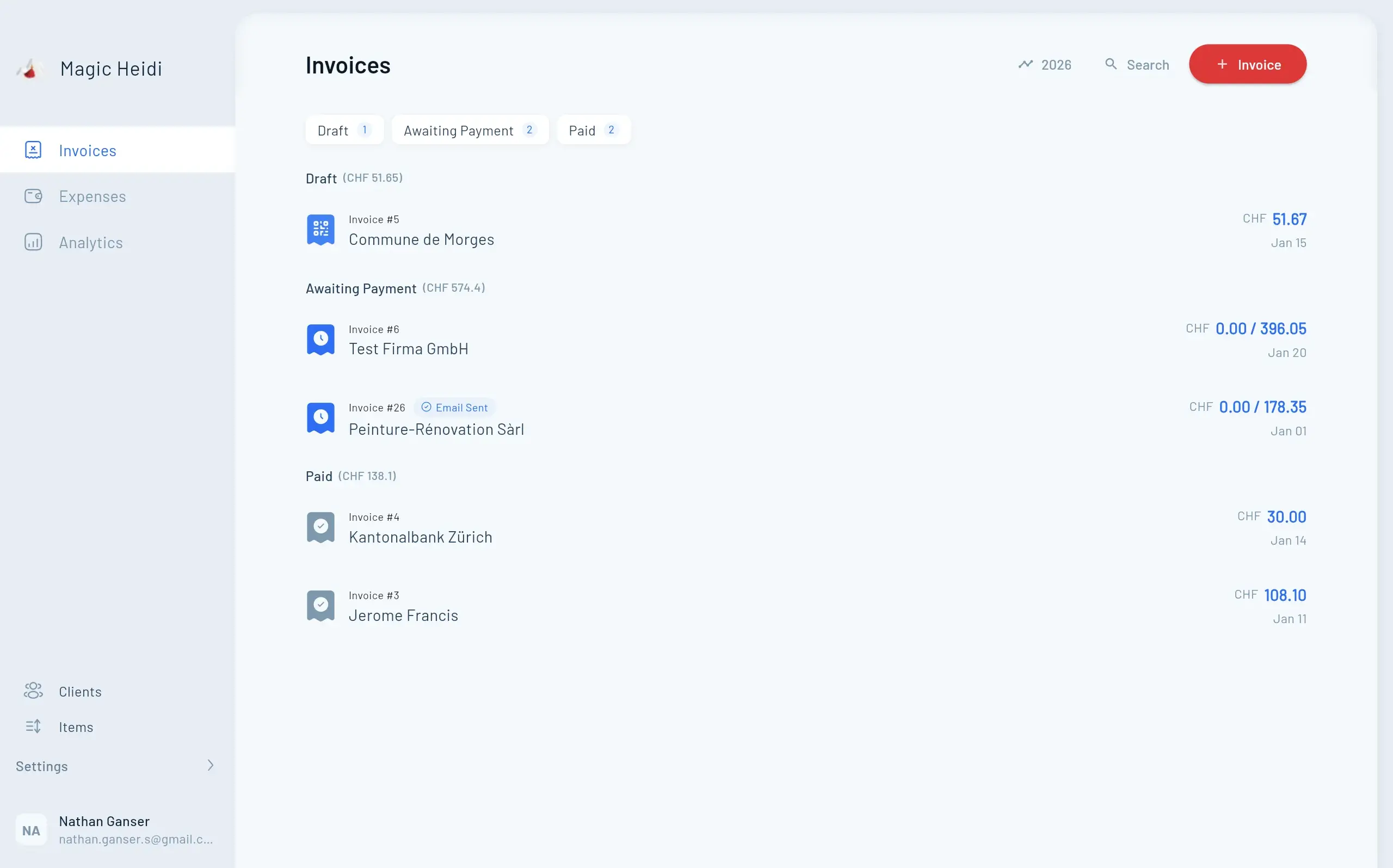
E-Invoicing in Switzerland: The Right Format for Your Electronic Invoice
E-invoicing Switzerland 2026: is a PDF by email enough? QR-Rechnung, eBill, ZUGFeRD and the MWST rules compared — with a clear pick per client type.

Founder of Magic Heidi
E-invoicing in Switzerland is not a single format — it is an umbrella term. Any electronic invoice you send by email, portal or interface is a valid invoice for VAT purposes, provided the content is right and origin, integrity and legibility stay traceable. Unlike Germany, Switzerland has no obligation to send structured e-invoices.
That sounds relaxing, but in practice it creates confusion. Does your next invoice have to be an XML file now? Does every PDF need a ZUGFeRD stamp? And what about the QR payment part you have been using for years?
Confirm the customer’s technical requirements before sending the invoice.
No e-invoicing mandate in Switzerland
A PDF sent by email is a valid electronic invoice as long as it carries every mandatory detail under Art. 26 MWSTG. Sending it costs you CHF 0.00.
The QR-Rechnung is the Swiss standard
Since 1 October 2022 the QR payment part is the only valid payment slip in Swiss payment traffic. Red and orange payment slips are no longer processed.
eBill for many private clients
With eBill the invoice lands straight in your client's e-banking. Worth it for many small invoices to private individuals, less so for five large corporate clients.
Germany is different
Confirm the customer’s technical requirements before sending the invoice.
10 years of retention
You have to keep electronic invoices legible, unaltered and retrievable for 10 years — exactly like paper receipts.
Key takeaways For consistent invoice details and records, use the Swiss invoice template or bookkeeping software. Hypothetical example: amounts illustrate the calculation only. They do not describe a real customer or a guaranteed outcome.
What is an e-invoice? The three forms at a glance
An electronic invoice is any invoice document that does not arrive on paper. That sounds trivial, but it is the core of the confusion. Within that definition there are three very different forms — and only one of them is what Germany and the EU mean by "e-invoice".
1. Structured e-invoice. The invoice data exists as a machine-readable file, usually XML. Your client's computer reads amount, date and line items directly, without anyone typing them in. Well-known formats: XRechnung (pure XML) and ZUGFeRD (PDF with embedded data). Both are based on the EU standard EN 16931. In Switzerland this form is voluntary.
2. Semi-structured or hybrid invoice. A PDF that carries additional data. The classic Swiss example: the QR payment part in your PDF. The Swiss QR Code transfers the payment data into e-banking automatically, while the invoice line items themselves stay unstructured. For Switzerland this is the de facto standard.
3. Unstructured invoice. A normal PDF by email. No embedded data, no interface. Still fully valid for MWST purposes, as long as every mandatory detail is right. For the vast majority of Swiss small businesses, exactly that is enough. How to build such an invoice correctly is covered in the guide to writing an invoice in Switzerland.
Why the distinction matters: anyone who reads online that "e-invoicing is becoming mandatory" thinks of Switzerland — but the sentence almost always refers to Germany. The standards that apply there are not the standards your Swiss bookkeeping needs.
E-invoice or QR-Rechnung: what actually counts in Switzerland
This is the question I hear most often. The confusion is understandable, because both terms have been floating through guides for years.
The answer: the QR-Rechnung is a payment standard, not an invoice format. It governs how your clients pay — scan the code, release it in e-banking, and the reference links payment and invoice. The e-invoice describes which file format the invoice is sent in. The PDF with a QR payment part combines both: a semi-structured e-invoice with the Swiss payment standard.
A constructed but typical example: a business coach in Bern with around 22 clients, mostly local companies. She read about the German e-invoicing mandate and was convinced she now needed an expensive specialist solution. Her accountant's offer: an invoicing portal with a CHF 660.00 annual fee plus a charge per invoice sent.
Ten minutes of research made it clear this would have been money thrown out of the window. Her invoices as PDFs with a QR payment part already are electronic invoices in the sense of Swiss VAT law. Her clients pay by e-banking, the reference matches the payment to the invoice, done.
Confirm the customer’s technical requirements before sending the invoice.
Sending digital invoices: the MWST rules that apply
Good news first: Swiss VAT law is media-neutral. Whether you send your invoice by post, by email or through an interface makes no difference for MWST. What counts is the content — and that is set out in Art. 26 MWSTG.
The mandatory details are always the same:
- Your full name or company name plus address
- UID or MWST number of the invoice issuer
- Name and address of your client
- Invoice date and sequential invoice number
- Type, scope and date of the service provided
- Consideration, MWST rate (8.1% standard rate, 3.8% for accommodation, 2.6% reduced) and tax amount, or a note on the tax exemption
This applies to the electronic invoice exactly as it does to paper. A compact overview and a ready-made Swiss invoice template are on the template page.
For electronic invoices and receipts there is one point many people skip: origin, integrity and legibility have to stay traceable for the entire retention period. That follows from the rules on proper bookkeeping (Geschäftsbücherverordnung) and from ESTV practice. In concrete terms: your client has to be able to trust that the invoice really comes from you and was not altered in transit.
How you ensure that is up to you. A qualified electronic signature is not required. In practice a documented, traceable process is enough: invoices always go through the same software and the same sender address, every invoice is uniquely numbered, the PDF is archived unaltered, and the payment can be matched to the invoice via the reference. The current explanations are on estv.admin.ch. Last checked: September 2026.
In short: in Switzerland every digital invoice is a valid invoice if the content is right and your process is credible. Conversely, the fanciest format will not help you if a mandatory detail is missing.
Invoicing Germany: ZUGFeRD and XRechnung
Germany’s domestic B2B rules do not automatically apply to a Swiss supplier. Confirm the required format with your customer.
eBill: the invoice straight into your client's e-banking
There is a fourth route that often gets forgotten: eBill. Behind it sits an offering from SIX that runs through most Swiss banks, PostFinance included. Your client approves you once in their e-banking — and from then on every new invoice appears right there. Payment takes two clicks, with no QR code to scan and no switching channels.
The difference from the QR code: with the QR code the client actively scans every invoice. With eBill the invoice is already in the e-banking the moment you send it. In practice that shortens the time until the money arrives and cuts the number of reminders.
Who is it worth it for? Above all for businesses with many small invoices to private individuals — practices, associations, subscription models, online shops. As the invoice issuer you pay a transaction fee in the centime range per invoice depending on the provider, and some banks charge a one-off setup fee. For pure B2B service providers with five large corporate clients, the effort rarely pays off.
By the way, how your clients actually pay a QR-code invoice is explained in the article on paying QR-code invoices.
Formats compared: cost and effort
So you do not have to guess, here is the direct comparison of the four common routes. The cost figures are rough orders of magnitude for a micro business.
| Format | How it works | Best for | Cost per invoice |
|---|---|---|---|
| PDF by email | Invoice as an attachment, payment by bank transfer | Business clients in Switzerland | CHF 0.00 |
| PDF with QR-Rechnung | Attachment plus scannable payment part | Swiss clients of every kind | CHF 0.00 by email, around CHF 1.50 printed with postage |
| ZUGFeRD / XRechnung | PDF with embedded XML data, or pure XML | Business clients in Germany and the EU | Depends on the tool or portal you use |
| eBill | Invoice appears directly in the client's e-banking | Private clients, practices, associations | A few centimes per invoice, depending on provider |
What the table leaves out is the software effort. Because the real question is not "which format" but "which tool".
Compare the features your business needs and consult bexio pricing for current prices. Magic Heidi Free includes 3 invoices and 3 expenses. Pro costs CHF 24.99 a month billed annually (CHF 299.00 a year), or CHF 39.00 billed monthly. See pricing.
And one more piece of advice against overkill thinking: you do not need every format on day one. Start with the PDF plus QR-Rechnung for Swiss clients. Deal with ZUGFeRD as soon as the first German client asks. eBill is worth it once you have many private clients. That way every investment stays where it pays off.
Archiving: a 10-year retention duty
One point that easily gets lost in all the format stress: the retention duty. Business books, accounting vouchers and therefore your invoices have to be kept for 10 years — legible, unaltered and retrievable throughout that whole period. That applies identically to paper and to electronic invoices. The current wording of the law is on fedlex.admin.ch.
In practice that means three things. First: store the invoice the way you sent it — a PDF belongs in the archive as a PDF, not just as a printout. Second: make sure you can still find every invoice eight years from now. A folder called "Invoices 2026" on your hard drive is a start; software with an automatic archive is the better goal. Third: back up regularly. A hard drive that dies after four years is not retention.
The consequences of a sloppy archive are tangible. In an MWST audit every voucher has to be traceable. If documents are missing, the ESTV can estimate the tax at its dutiful discretion — and such an estimate rarely falls in your favour. Compared with the cost of an orderly archive, that is an expensive way to save.
Conclusion: less format anxiety, more paid invoices
QR-bills replaced red and orange payment slips in October 2022. A regular IBAN works with a Creditor Reference or no reference; a QR-IBAN must be paired with a QR reference. This change does not make a QR code mandatory on every invoice.
Your to-do list is therefore short. Check that your invoices contain every mandatory detail under Art. 26 MWSTG. Work out whether you have business clients in Germany — if so, sort out early how you will deliver structured invoices to them. And check whether eBill fits your client base.
Magic Heidi creates QR-bills and quotes, records expenses and tracks payments. Explore the invoicing software.
Frequently asked questions about e-invoicing in Switzerland
Is a PDF by email a valid e-invoice in Switzerland?
Yes. Swiss VAT law is media-neutral: what matters are the mandatory details under Art. 26 MWSTG plus the traceability of origin, integrity and legibility over the retention period. A normal PDF is enough for that, and a qualified electronic signature is not required.
Is there an e-invoicing mandate in Switzerland like in Germany?
QR-bills replaced red and orange payment slips in October 2022. A regular IBAN works with a Creditor Reference or no reference; a QR-IBAN must be paired with a QR reference. This change does not make a QR code mandatory on every invoice.
Do I need ZUGFeRD for clients in Germany?
Confirm the customer’s technical requirements before sending the invoice.
What is the difference between an e-invoice and a QR-Rechnung?
The QR-Rechnung governs the payment: the Swiss QR Code transfers IBAN, amount and reference into e-banking automatically. The e-invoice describes the file format of the invoice. Your PDF with a QR payment part is both at once: a semi-structured e-invoice with the Swiss payment standard.
What does an electronic invoice cost in Switzerland?
Compare the features your business needs and consult bexio pricing for current prices. Magic Heidi Free includes 3 invoices and 3 expenses. Pro costs CHF 24.99 a month billed annually (CHF 299.00 a year), or CHF 39.00 billed monthly. See pricing.
How long do I have to keep electronic invoices?
10 years, just like paper invoices. They have to stay legible, unaltered and retrievable for the whole period. Keep the PDF in its original format and back it up regularly — in an MWST audit only what you can actually produce counts.