Calculating the Contribution Margin: What Your Work Is Really Worth
Calculate the contribution margin: formula, DB1 DB2 DB3 & CHF examples for self-employed in Switzerland. Which service really pays? Read on here!

Founder of Magic Heidi
The formula is simpler than you think: Contribution margin = net revenue − variable costs. That's it. And yet it answers a question that revenue can never answer: which of your services actually makes money — and which is just tagging along?
Most self-employed people in Switzerland know their revenue. They know they billed CHF 90,000.00 last year. But ask them what contribution margin their best-selling service brings in, and it goes quiet. That's exactly where the problem starts. Because revenue tells you nothing about what's left per job after materials, travel and purchases. The contribution margin does.
In this guide, I'll show you how contribution margin accounting works — step by step, with Swiss figures, three real-world cases and all the formulas you need. No business school lecture, just what you really need as a photographer, graphic designer, beautician or consultant.
The Essentials at a Glance
- Contribution margin = net revenue (excluding MWST, the Swiss VAT, at 8.1%) − variable costs. Example: CHF 1,000.00 in net revenue minus CHF 250.00 in variable costs = CHF 750.00 contribution margin.
- MWST (the standard rate is 8.1%) never counts toward the contribution margin. Always calculate net first — otherwise you overestimate yourself by 8.1%.
- The contribution margin is not profit. It first has to cover your fixed costs (e.g. rent, AHV/IV/EO — the Swiss state pension and associated insurances — at 10.1%) before it turns into profit.
- Break-even = fixed costs ÷ contribution margin rate. With CHF 4,275.00 in fixed costs and CHF 71.25 in contribution margin per hour, you're in the black after 60 hours.
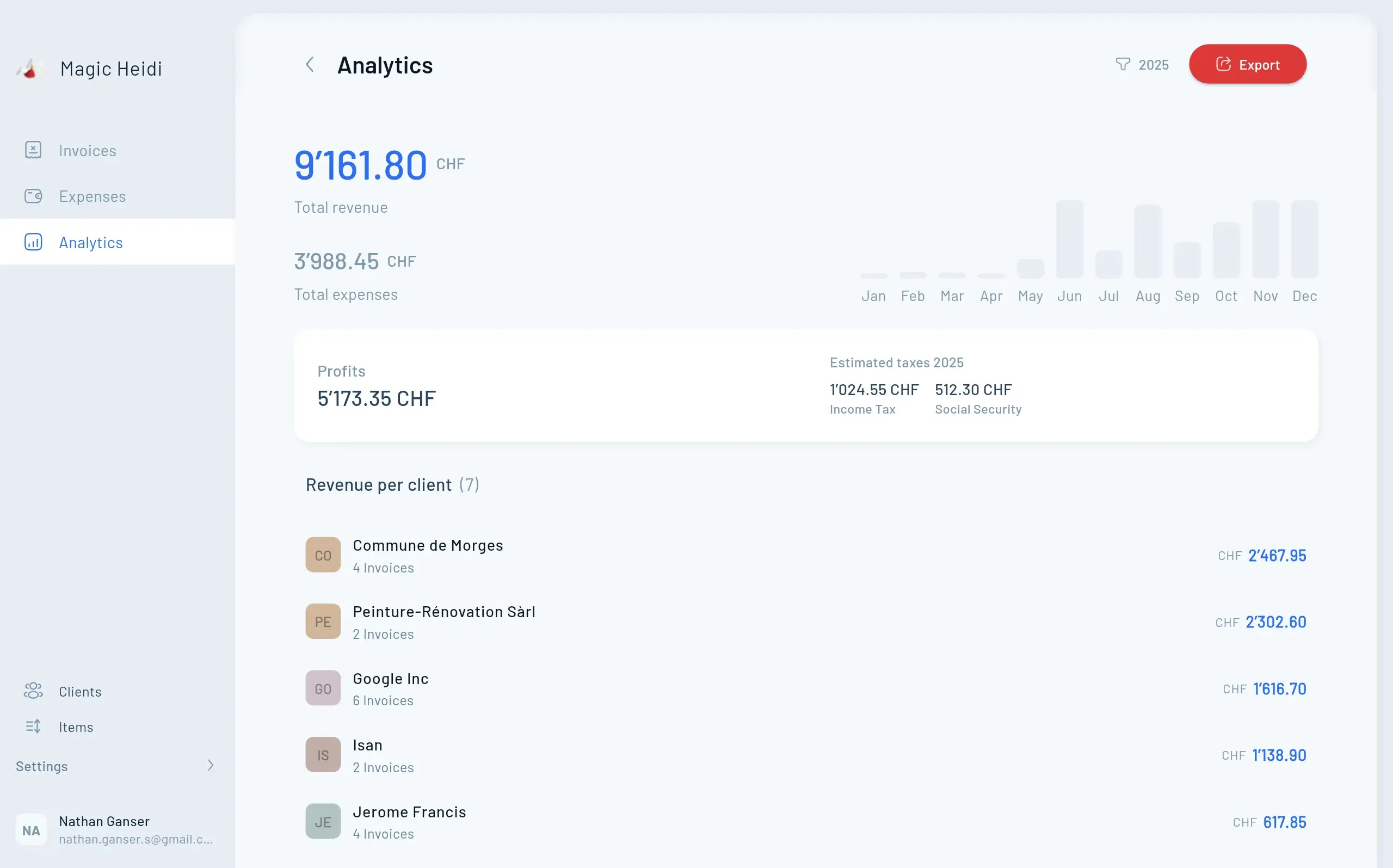
- Magic Heidi categorises income and expenses per service automatically — from CHF 25.00 per month, significantly cheaper than bexio.
What Is the Contribution Margin?
The contribution margin (literally: the amount that "contributes to covering" your costs) is the amount a service contributes toward covering your fixed costs. You take the revenue from a job, subtract all the variable costs that arise directly from that job — and what's left is the contribution margin. It "covers" your fixed costs. Once everything is covered and something still remains, that's your profit.
Sounds academic? It isn't. It's the most practical number you can know as a self-employed person. Here's how it differs from the three figures it's constantly confused with:
Contribution margin vs. revenue: Revenue is everything on the invoice (net). The contribution margin is what remains of it after the job-dependent costs. CHF 5,000.00 in revenue sounds good — with CHF 4,200.00 in variable costs, a contribution margin of CHF 800.00 remains, and suddenly it sounds a lot less good.
Contribution margin vs. profit: Profit only arises once the contribution margin has covered all fixed costs — rent, insurance, AHV/IV/EO contributions, software subscriptions. The contribution margin is a preliminary stage of profit, but one you can calculate per service. You only know profit for the business as a whole. That's the crucial difference.
Contribution margin vs. contribution margin ratio: The contribution margin ratio is the contribution margin as a percentage of revenue. A contribution margin of CHF 750.00 on CHF 1,000.00 in revenue = a 75% margin. The margin is good for comparing services, the absolute contribution margin for planning. You need both.
Why MWST Has to Come Out First
The revenue in the formula is always net revenue. MWST is not revenue you earn — you collect it and pass it on to the ESTV (Swiss Federal Tax Administration). It's a pure pass-through item. Anyone who bills CHF 10,810.00 gross and calculates with that figure has 8.1% of slack in the system that doesn't exist. Correct: CHF 10,000.00 in net revenue. You can read more in the guide Invoicing MWST as a Freelancer.
And one more thing: clean contribution margins need clean numbers. Anyone who collects receipts in a drawer and spends January guessing backwards which costs belonged to which job inevitably calculates with rough estimates. The bookkeeping obligation under Art. 957a OR (Swiss Code of Obligations) requires self-employed people to keep orderly records of income and expenses anyway — use them for your contribution margin accounting instead of keeping them just for your tax return.
Calculating the Contribution Margin: The Formula
Contribution margin calculation comes in two variants, and you need both.
Unit contribution margin (per unit, per job, per hour):
DB = net revenue per unit − variable costs per unit
Total contribution margin (for an entire service, a month or a year):
Total DB = DB per unit × quantity
Example: you sell a package with a unit contribution margin of CHF 750.00, 40 times a year. Total contribution margin: CHF 30,000.00. This figure now has to cover your fixed costs. If something remains, you make a profit. If something is missing, you make a loss — no matter how full your calendar is.
Here's a simple example calculation for a consultant:
| Item | Amount |
|---|---|
| Net revenue per job (without 8.1% MWST) | CHF 2,400.00 |
| − Variable costs (travel, materials, subcontracted work, licence purchases) | CHF 650.00 |
| = Unit contribution margin | CHF 1,750.00 |
| Contribution margin ratio | 72.9% |
| × 18 jobs per year | CHF 31,500.00 total |
You see: CHF 2,400.00 in revenue and CHF 1,750.00 in contribution margin are two very different statements. The contribution margin formula gives you the second — and the second is the one you make decisions with.
DB1, DB2, DB3: Multi-Step Contribution Margin Accounting
In classic multi-step contribution margin accounting, fixed costs are broken down into blocks:
- DB1 = revenue − variable costs. The standard contribution margin we've been calculating so far. It covers all fixed costs.
- DB2 = DB1 − product-specific fixed costs. Costs that arise only for a specific service — e.g. the annual licence for your image editing software, which is only used for your retouching service.
- DB3 = DB2 − division-specific fixed costs. Costs of an entire division — e.g. the rent for a studio used only for photography services.
For most solo self-employed people, DB1 covers 90% of decisions. But DB2 and DB3 become important as soon as you ask: "Does this add-on service even carry its own fixed costs?" A service with a positive DB1 but a negative DB2 costs you money — it covers its variable costs, but not the software you subscribed to because of it.
Real-World Example: Which of Your Services Really Carries the Business?
Now it gets concrete. Marek is a photographer in Zurich who runs a sole proprietorship and offers three packages. He generates around CHF 115,000.00 in annual revenue and still never feels secure. So for the first time, he calculates per package.
| Package | Net Revenue | Variable Costs | Contribution Margin | DB Margin |
|---|---|---|---|---|
| Wedding (full day) | CHF 3,500.00 | CHF 900.00 | CHF 2,600.00 | 74.3% |
| Portrait session (1h) | CHF 950.00 | CHF 150.00 | CHF 800.00 | 84.2% |
| Product shoot (half day) | CHF 1,200.00 | CHF 750.00 | CHF 450.00 | 37.5% |
The variable costs for the wedding: a second photographer, travel, memory cards, an online gallery. For the product shoot, they're high purchases: studio rent per half day, special equipment, purchased retouching. For the portrait session, almost nothing — just travel and the gallery.
The result surprises Marek. The wedding brings the largest absolute contribution margin — sure, he knew that. But the portrait session has the best margin at 84.2%. And the product shoot? A 37.5% margin and CHF 450.00 in contribution margin per half day. Marek had thought of the shoot as "good side business" because it brings in CHF 1,200.00. After deducting direct costs, CHF 450.00 remains — less than a single portrait session at a fraction of the effort.
Marek responds: he reprices the product shoot at CHF 1,500.00 (DB: CHF 750.00, 50% margin) and books the cheapest studio time instead of the premium slots. With around 12 product shoots a year, his annual contribution margin rises by CHF 3,600.00 — with identical working hours, without winning a single new customer.
That's the essence of contribution margin accounting: it doesn't show where the revenue is generated, but where the money is generated. And when you write a quote, you can use the DB figure directly as an argument — for yourself, when deciding whether to grant a discount. A CHF 200.00 discount on a wedding costs Marek CHF 200.00 in DB. On the product shoot, the same discount eats up almost half the contribution margin.
The Contribution Margin and Your Hourly Rate
Sandra is a beautician in Bern. She charges CHF 95.00 per hour and works around 120 client hours a month. On paper, that earns her CHF 11,400.00 a month. She calculates her contribution margin per hour — and finds two uncomfortable truths.
Step 1 — Variable costs: Products and consumables add up to around CHF 2,850.00 a month. That's the largest variable item in cosmetics — creams, ampoules, disposable gloves, sterile materials.
| Item | Amount |
|---|---|
| Net revenue (120 h × CHF 95.00) | CHF 11,400.00 |
| − Variable costs (products, consumables) | CHF 2,850.00 |
| = Total contribution margin | CHF 8,550.00 |
| DB per client hour | CHF 71.25 |
Step 2 — The unpaid time: But Sandra doesn't work 120 hours. She works around 160 — about 40 of them for admin, courses, social media, training, purchasing. These hours generate no revenue, but they do generate costs. If you convert the contribution margin to the hours actually worked, that gives CHF 8,550.00 ÷ 160 = CHF 53.44 per real working hour. Of the CHF 95.00 on the price list, CHF 53.44 in contribution margin actually remains. That's not bad news — it's the honest number Sandra can plan with. If you want to calculate your own hour on a solid basis, the hourly rate calculator will help.
Step 3 — The fixed costs the DB has to cover: Sandra's studio rent in Bern, insurance, software and the AHV/IV/EO contributions of 10.1% she pays as a self-employed person are fixed costs. They arise whether she works 80 or 140 client hours. Let's call them CHF 4,275.00 per month altogether.
Step 4 — Break-even: Now the break-even formula comes into play:
Break-even = fixed costs ÷ contribution margin rate
CHF 4,275.00 ÷ CHF 71.25 = 60 client hours. From hour 61 onwards, Sandra actually makes money each month. Before that, she is — economically speaking — working toward covering her fixed costs. With 120 client hours she's comfortably in the black. But would a 70-hour month be a problem? No — it only gets tight below 60 hours. She didn't know this number before.
The beautiful thing about the contribution margin: it makes scenarios calculable. Increase the price by CHF 10.00? DB per hour rises to CHF 81.25, break-even drops to around 53 hours. An assistant subscription that takes 8 hours of admin off your hands? 8 unpaid hours become 8 client hours at CHF 71.25 = CHF 570.00 in additional DB per month. Without contribution margin accounting, considerations like these are pure gut feeling.
Minimum Price: When a Job Is Really Worth It
Luca is a graphic designer in Basel and receives an enquiry: a complete redesign of an entire web presence, flat fee CHF 4,000.00, an estimated 120 hours of work. He calculates: variable costs (stock photos, licences, fonts) around CHF 400.00. Contribution margin: CHF 3,600.00. Positive. At first glance, a good job.
But Luca is almost fully booked. And here lies the trap that regularly catches self-employed people in exactly this situation: when your calendar is full, what counts is not the absolute contribution margin, but the contribution margin per hour.
CHF 3,600.00 in DB over 120 hours = CHF 30.00 DB per hour. Luca's regular clients bring him CHF 60.00 in DB per hour. If he filled the 120 hours with regular client work, he'd generate a contribution margin of CHF 7,200.00 — twice as much as with the web project. So the job doesn't cost him 400 francs in materials, but CHF 3,600.00 in foregone contribution margin.
So Luca makes a new offer: the same service, but calculated as a CHF 7,200.00 flat fee, with a reduced scope at CHF 4,800.00 as an alternative. The client chooses the reduced scope — a DB of CHF 4,400.00 over 75 hours = around CHF 58.70 per hour. Almost Luca's normal rate, and the client gets a framework that fits him.
From this, you can derive three decision rules that work in any pricing situation:
- Contribution margin positive? Then the job at least covers its own variable costs and at worst doesn't make a loss. A basic requirement, but no reason to celebrate.
- Barely positive and time available? In slow periods — semester holidays, seasonal lows — jobs with a thin DB are better than empty hours, because the fixed costs keep running anyway.
- Calendar full? Then decide by contribution margin per hour, not by absolute DB. With a full calendar, CHF 3,600.00 over 120 hours is a worse deal than CHF 1,800.00 over 20 hours.
The minimum price itself, by the way, is the point where the DB hits zero: net revenue = variable costs. Anything below that costs you money — the job becomes a subsidy for your customer. For long-term planning, it's worth taking a look at calculating net profit: it shows what's left at the end after all costs, once the contribution margin has covered the fixed costs.
Typical Mistakes When Calculating the Contribution Margin
Mistake 1: Including MWST. The classic. Booking CHF 10,810.00 gross as revenue instead of CHF 10,000.00 net — and just like that, the contribution margin is 8.1% too high in every line. The settlement with the ESTV will eventually bring the difference to light, but you'll have long since made your pricing decisions on the wrong numbers.
Mistake 2: Treating fixed costs as variable. The studio rent or software subscription doesn't arise "because of this job" — it keeps running even if the customer walks away. Anyone who spreads fixed costs across individual jobs calculates nice-looking contribution margins and then wonders why nothing is left at the end of the month. Rule of thumb: only costs that wouldn't exist without the job are variable.
Mistake 3: Valuing your own working time at CHF 0.00. With pure services, variable costs are minimal, so the DB is almost the entire revenue — and everything looks wonderfully profitable. But your time is your scarcest resource. At least for comparisons (see Luca), you should always calculate the DB per hour, otherwise you're comparing apples with timetables.
Mistake 4: Treating all costs the same. A single DB for the entire business is like an average temperature for all of Switzerland — technically correct, practically useless. The contribution margin only works if you calculate it per service. Only then do you see the thin package. That's exactly why it also works as an early warning system in your number controlling — if you want to dig deeper, read more about the management analysis.
Mistake 5: Confusing the contribution margin with the margin. "I have a 70% margin" and "I have CHF 700.00 in DB" are different statements. A high margin on a small volume can cover less than a medium margin on a large volume. Use the margin for comparisons, the absolute DB for covering your fixed costs — and know both.
FAQ: Calculating the Contribution Margin
What is the formula for the contribution margin?
Contribution margin = net revenue − variable costs. Net revenue is the invoice amount without MWST (8.1% standard rate). Variable costs are all expenses that arise from the specific job: materials, purchases, travel, subcontracted work. Example: CHF 1,000.00 net revenue − CHF 250.00 variable costs = CHF 750.00 contribution margin.
What do DB1, DB2 and DB3 mean?
DB1 is the classic contribution margin: revenue minus variable costs. DB2 additionally deducts the service-specific fixed costs (e.g. software used only for that service). DB3 additionally deducts division-specific fixed costs (e.g. the studio rent for the photography division). For most solo self-employed people, DB1 is enough for day-to-day decisions.
Is the contribution margin the same as profit?
No. The contribution margin first has to cover your fixed costs — rent, insurance, AHV/IV/EO contributions (10.1% for self-employed people in 2026), software subscriptions. Only when the total contribution margin exceeds all fixed costs does profit arise. The contribution margin is therefore a preliminary stage of profit that can be calculated per service.
What is a good contribution margin ratio?
For pure services (consulting, IT, design), 60–80% is realistic because hardly any variable costs arise. For services with a high share of materials (cosmetics, photography with purchases, trades), 30–50% is common. Below 20% it becomes critical — the service then barely contributes anything toward your fixed costs.
What is Deckungsbeitrag called in English?
The German term Deckungsbeitrag is called contribution margin in English. The formula is identical: revenue minus variable costs. In Anglo-Saxon reports you'll also find the abbreviation CM or the term gross margin, though gross margin is not exactly the same thing — there, usually only the costs of the manufactured products are deducted.
Does MWST belong in the contribution margin?
No, never. MWST (in Switzerland 8.1% standard rate, 2.6% reduced rate) is a pass-through item: you collect it and pass it on to the ESTV. The revenue in the contribution margin formula is always net revenue without MWST. Anyone who calculates gross systematically overstates every contribution margin by 8.1%.