Swiss UID Number: What It Is, When You Get One, and When to Use It
If you work independently in Switzerland, the UID shows up quickly in conversations about registration, VAT, invoices, and official forms. The confusing part is that not every freelancer gets it the same way, and the UID is not always the number you should print on an invoice.

Quick answer
The Swiss UID number is the enterprise identification number used by public authorities to identify businesses in Switzerland. It starts with CHE and is followed by nine digits.
For freelancers and sole proprietors, the practical questions are usually these:
- Do I get one automatically? Usually once your business is recorded by a Swiss authority connected to the UID register.
- Is it the same as the VAT number? Not exactly. Your VAT number is your UID plus the suffix MWST, TVA, or IVA.
- Do I need it on every invoice? Only if you are VAT registered. If you are not subject to VAT, you generally should not add a VAT suffix.
This guide explains the difference in plain language.
What a Swiss UID number actually is
Most articles stop at the definition. For freelancers, the useful part is how the number behaves in real life.
One identifier
The UID is the single business identifier used across Swiss public administration.
Format
It is shown as CHE-123.456.789. The digits are assigned, not chosen by you.
Public lookup
Businesses can be checked in the official UID register online.
Free
Entry in the official UID register is free for businesses.
Why the UID exists
Swiss authorities introduced the UID to reduce the number of different identifiers used across administration. According to the Swiss SME portal, every company active in Switzerland has been assigned a UID since January 2011, and since January 1, 2014 the UID has also been the identifier used for the Trade Register and for VAT.
That sounds abstract, but the benefit is simple: instead of juggling separate reference numbers for different offices, a business can be identified with one core number.
UID vs VAT number: the distinction that trips people up
This is where many freelancers make mistakes.
The UID is your enterprise identifier.
Your Swiss VAT number is the UID with a suffix:
- CHE-123.456.789 MWST
- CHE-123.456.789 TVA
- CHE-123.456.789 IVA
The Swiss Federal Tax Administration is explicit here: the English suffix VAT is not allowed as the official Swiss VAT suffix on invoices. In practice, the UID and VAT number look almost identical, which is why people often use the terms loosely. But when you prepare invoices or tax forms, the distinction matters.
Also important: Swiss UID is not the same as an EU VAT ID
Swiss official guidance also notes that the Swiss UID and the EU VAT identification number are different systems. If you work with EU clients, do not assume that a Swiss UID automatically works like an EU VAT ID.
When freelancers and sole proprietors get a UID
There is no single one-line rule for every case, so it is better to think in terms of administrative touchpoints.
You start a genuine independent activity
A sole proprietorship exists once an independent and lasting economic activity begins. That does not automatically mean every register updates instantly.
- You operate in your own name and at your own risk
- You usually need recognition as self-employed by the compensation fund
- Supporting documents may be requested depending on the case
A connected authority records your business
The SME portal explains that enterprises receive a UID when they are reported to an authority connected to the UID register.
- This can happen through social insurance registration
- It can happen through the Trade Register
- It can also happen through VAT registration
Trade Register entry is not always required
For sole proprietorships, Trade Register entry becomes mandatory when the business is run in commercial form and annual revenue exceeds CHF 100,000.
- Below that level, registration can still be optional
- Even without a Trade Register entry, sole proprietorships can appear in the UID register
- That is one reason freelancers should not equate UID with Trade Register status
A detail many freelancers miss
The Swiss SME portal states that sole proprietorships without a Trade Register entry are still published in the UID register. In those cases, the business name is generally shown as the self-employed person's first name and surname. A fantasy or brand name may appear only as an additional name.
That matters if you:
- invoice under a brand-style business name,
- want customers to find you in the register,
- or expect the UID register name to mirror your website or logo.
If you are a solo freelancer, the official register may look more personal and less branded than you expected.
How to check a UID number
You can verify a Swiss UID in the official UID register. This is useful when:
- checking your own published details,
- confirming a supplier or client,
- verifying whether a business is VAT registered,
- or making sure the legal name matches the entity you are invoicing.
For freelancers, this is also a simple way to catch small but annoying mistakes before they show up on invoices or contracts.
UID, VAT number, and Trade Register: what each one means
These three get mixed together constantly, but they solve different problems.
| Identifier | What it does | When freelancers care |
|---|---|---|
| UID | Main Swiss business identifier | Used for official identification and register checks |
| VAT number | UID plus MWST / TVA / IVA | Used on invoices if you are VAT registered |
| Trade Register entry | Commercial registration status | Mandatory for some sole proprietorships, optional for others |
What should go on your invoice?
The right answer depends on whether you are VAT registered, not just on whether you have a UID.
If you are not VAT registered
You may still have a UID, but that does not automatically mean you should present yourself as VAT registered.
In practice, a freelancer below the Swiss VAT threshold should focus on clean invoice basics:
- legal name or business name used correctly,
- address,
- invoice date,
- invoice number,
- clear description of services,
- amount due,
- payment terms.
If you are unsure whether a VAT suffix belongs on your invoice, check your VAT status first rather than copying what a larger company does.
If you are VAT registered
Then the invoice should use the VAT number format based on your UID, with MWST, TVA, or IVA as suffix.
This is the version that matters for Swiss VAT compliance.
Practical rule
Think of it like this:
- UID = who your business is
- VAT number = how your business appears for Swiss VAT purposes
They are related, but they are not interchangeable in every context.
Before you send your next invoice, check these 5 points
A short review now saves a lot of friction later.
Look yourself up
Confirm your official entry in the UID register and check how the business name appears.
Confirm VAT status
Use the VAT version of the number only if you are actually VAT registered.
Use the right suffix
Swiss practice uses MWST, TVA, or IVA. Do not default to VAT as the Swiss suffix.
Match contracts and invoices
Your legal name, invoice details, and register data should not contradict each other.
Keep the admin simple
Store your UID, invoice settings, and VAT settings in one place so mistakes do not repeat.
Use your UID without the admin guesswork
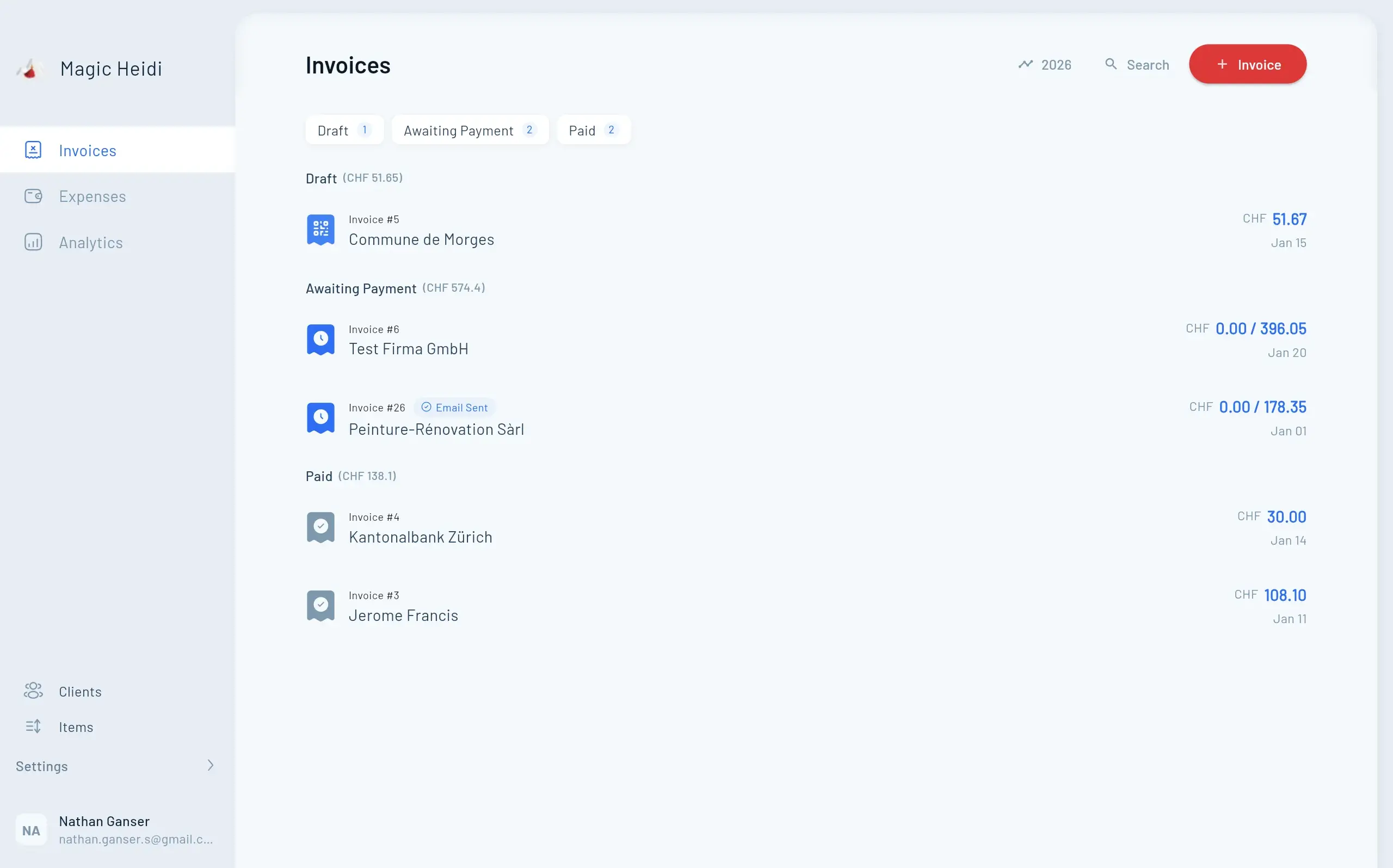
Magic Heidi helps Swiss freelancers keep invoicing, bookkeeping, and VAT admin in one place instead of spreading critical details across PDFs, notes, and memory.
- 🧾Swiss-compliant invoices
Create clean invoices with the right company details
- ⚡Less manual correction
Save your business settings once and reuse them
- 📊VAT-ready workflows
Keep your invoicing and tax setup aligned
- 📁Better records
Stay organised when authorities or clients ask for details
- Invoice #3
Magic Heidi
CHF 500
Jan 29
- Invoice #2
Webbiger LTD
CHF 2000
Jan 24
- Invoice #1
John Doe
CHF 600
Jan 20
Swiss UID number: freelancer questions
Do all freelancers in Switzerland have a UID?
Not necessarily from day one in the same way, but businesses receive a UID once they are recorded by a connected authority. In practice, freelancers often encounter this through social insurance, Trade Register, or VAT processes.
Can I have a UID without being in the Trade Register?
Yes. The Swiss SME portal states that sole proprietorships without a Trade Register entry can still be published in the UID register.
Is my UID the same as my VAT number?
Close, but not identical. Your VAT number is your UID with the suffix MWST, TVA, or IVA.
Can I write VAT after the number on a Swiss invoice?
Swiss tax guidance says the official Swiss VAT suffix is MWST, TVA, or IVA. The English abbreviation VAT is not the official Swiss suffix.
Where can I check a Swiss UID number?
In the official UID register published by the Federal Statistical Office.
Need cleaner invoicing and less admin friction?
Magic Heidi helps Swiss freelancers handle invoices, expenses, and VAT-related admin without turning every invoice into a compliance puzzle.