Swiss Expense Report Template 2026: a Practical Version You Can Copy
Need a clean expense report for Switzerland? This guide shows what to include, how to keep receipts audit-ready, and when a spreadsheet stops being enough.
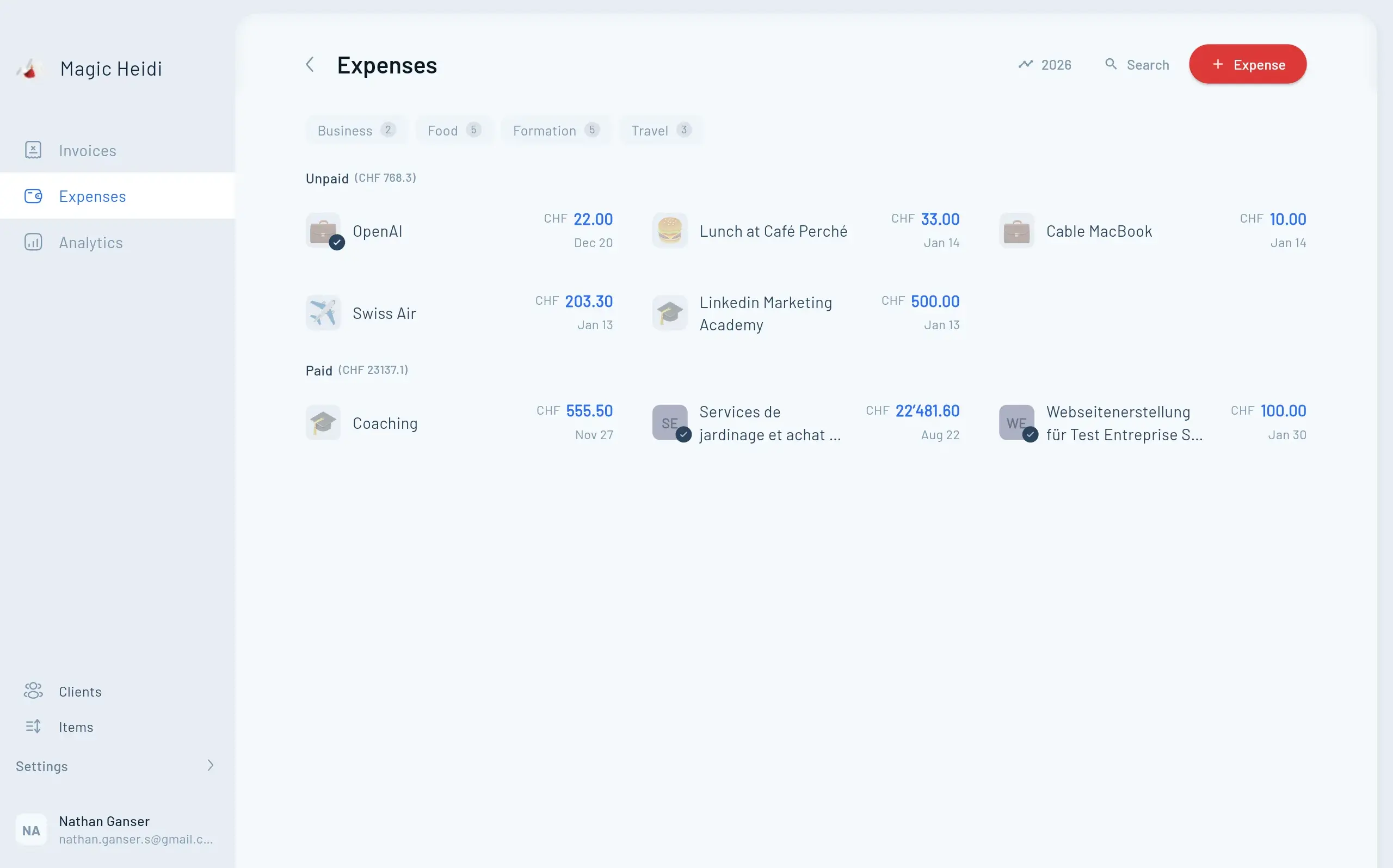
If you are looking for a Swiss expense report template, most pages online give you a file and very little context. The result is usually the same: missing receipts, unclear VAT handling, and an approval process that breaks the moment more than one person is involved.
This guide takes the more useful route. You get:
- a copyable Swiss expense report template
- the fields that matter in practice
- the difference between employee reimbursement and sole-proprietor bookkeeping
- the evidence you should keep for accounting and VAT purposes
For employees in Switzerland, expense reimbursement is anchored in the Swiss Code of Obligations, which says employers must reimburse necessary expenses caused by the work. For freelancers and sole proprietors, the same template is still useful, but as an internal accounting record rather than a reimbursement claim.
The key idea is simple: a good expense report does not just list costs. It shows who spent the money, why it was business-related, when it happened, how much VAT was involved, and which receipt proves it.
What a Swiss expense report must cover
Whether you use Excel, Google Sheets, or software, these are the core fields worth keeping.
Claimant and period
Name, role or business, and the month or trip covered by the report.
Expense details
Date, supplier, category, business purpose, currency, and total amount.
VAT visibility
Amount excl. VAT, VAT rate, VAT amount, and gross total when relevant.
Proof and approval
Receipt reference, attachment, approver, and payment or reimbursement status.
Copyable Swiss expense report template
Use this structure in Excel, Numbers, or Google Sheets:
| Date | Category | Supplier | Business purpose | Project / client | Amount excl. VAT | VAT rate | VAT amount | Amount incl. VAT | Currency | Payment method | Receipt attached | Notes |
|---|---|---|---|---|---|---|---|---|---|---|---|---|
| 2026-04-03 | Train | SBB | Client meeting in Zurich | Client A | 42.55 | 8.1% | 3.45 | 46.00 | CHF | Personal card | Yes | Return trip |
| 2026-04-03 | Meal | Restaurant Example | Lunch during client meeting | Client A | 55.50 | 8.1% | 4.50 | 60.00 | CHF | Personal card | Yes | Two participants |
| 2026-04-04 | Parking | City Parking | On-site workshop | Client B | 11.10 | 8.1% | 0.90 | 12.00 | CHF | Cash | Yes | 3 hours |
| 2026-04-05 | Office supplies | Office World | Printer paper and folders | Internal | 27.75 | 8.1% | 2.25 | 30.00 | CHF | Business card | Yes | April stock |
Recommended header fields above the table:
- claimant name
- company name
- reporting period
- currency
- bank details or payout method
- approver name
- submission date
At the bottom, add:
- subtotal excl. VAT
- total VAT
- total incl. VAT
- amount to reimburse
- signatures or approval timestamps
Employee expense report vs. freelancer expense log
This distinction matters.
If you have employees
The document is a reimbursement request. The employee paid first and is asking the employer to repay necessary business expenses. Internal policy and approval rules matter a lot.
If you are a freelancer or sole proprietor
You usually do not “reimburse yourself” in the same way. Instead, the report acts as a structured support document for bookkeeping. It helps you group receipts, document business purpose, and prepare VAT or tax work more cleanly.
That is one reason many Swiss freelancers start with a spreadsheet but later move to software: the template is fine at first, but the receipt trail becomes the real workload.
The real bottleneck is usually not the template
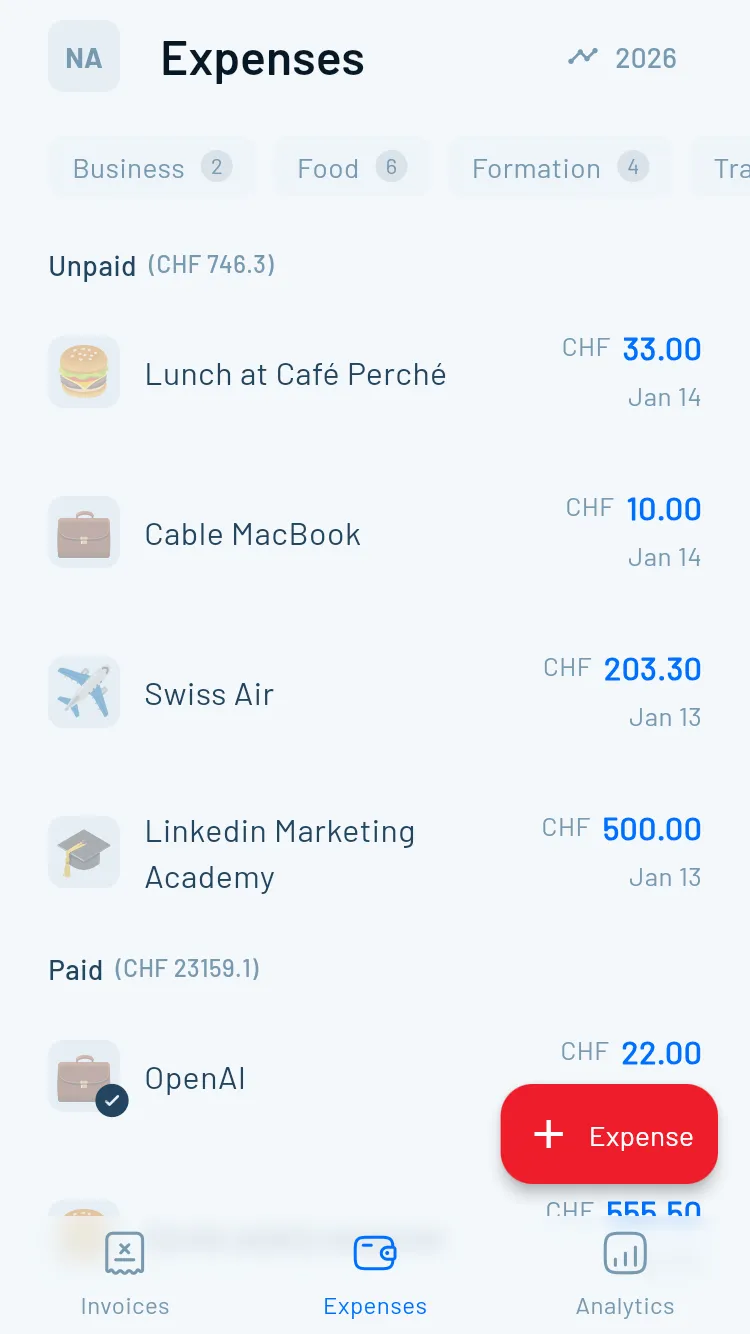
It is collecting receipts, linking them to the right category, and keeping the record clean enough for bookkeeping, VAT work, and later questions.
Which expenses usually belong on a Swiss expense report?
The usual categories are:
- public transport and business travel
- accommodation during business trips
- meals connected to business travel or client meetings
- parking, tolls, and local transport
- office supplies and small business purchases
- software or tools paid personally for business use
- mileage, if your employer or internal policy allows private-vehicle reimbursement
The safe rule is not “Can I imagine this being useful for work?” but rather “Was this expense necessary for the business activity, and can I prove it?”
What supporting documents should you keep?
For practical Swiss bookkeeping, keep the original or digital receipt whenever possible. That includes:
- till receipts
- supplier invoices
- hotel invoices
- transport tickets
- digital confirmations for online purchases
- mileage records where applicable
If VAT matters, the receipt quality matters too. A card statement alone shows that money left the account, but it usually does not describe the purchase clearly enough to replace the underlying receipt.
What about VAT?
This is where many templates are too weak.
If your business uses the effective VAT method, it helps to record the net amount, VAT rate, VAT amount, and gross amount separately. That makes bookkeeping and VAT reconciliation much easier later.
If your business uses the net tax rate method, the logic is different and input tax recovery usually does not work the same way. In that case, the report is still useful, but you should not design the template as if every receipt automatically leads to input tax recovery.
Either way, keep the receipt. The Swiss Federal Tax Administration expects accounting records and supporting documents to be understandable and reviewable.
A simple approval flow that works
For small teams, this is usually enough:
- The claimant enters each expense within a few days.
- Receipts are attached immediately, not at month-end.
- A manager checks business purpose and policy fit.
- Accounting or the founder checks VAT and category consistency.
- Reimbursement is paid and marked as completed.
This is simple, but it solves three common problems: missing receipts, duplicated claims, and month-end chaos.
When a spreadsheet is enough, and when it is not
Use a spreadsheet if:
- one person submits expenses
- monthly volume is low
- approvals are simple
- VAT handling is straightforward
Move to software if:
- multiple people submit expenses
- receipts arrive through phones and email
- you want faster month-end closing
- you need cleaner audit trails
- you want expenses to connect directly to bookkeeping
For Swiss freelancers, this often happens sooner than expected. The problem is rarely the template itself. It is the time lost on chasing receipts and retyping data.
Swiss expense report questions
Is there one mandatory Swiss expense report form?
No single universal form is required for everyone. What matters is that the report is clear, complete, and backed by supporting documents. Companies often add their own policy and approval fields.
Can freelancers use the same template?
Yes. For freelancers, it usually works as an internal expense log for bookkeeping rather than a formal reimbursement request to an employer.
Should I include VAT columns?
Usually yes, especially if you account for VAT using the effective method. Separate net amount, VAT, and gross amount make later reconciliation much easier.
How quickly should expenses be recorded?
As close to the purchase date as possible. Waiting until the end of the month is the easiest way to lose receipts and context.
Is a bank or card statement enough?
Usually no. It proves payment, but it often does not replace the underlying receipt or invoice that explains what was bought and why.
How long should records be kept?
In Switzerland, accounting records and supporting documents generally need to be retained for 10 years.
A template helps. Automation helps more.
If you are still forwarding receipts, filling tables by hand, and cleaning up VAT questions later, Magic Heidi gives you a much cleaner Swiss workflow: receipt capture, categorisation, and bookkeeping-ready records in one place.
Sources used for this guide
- Swiss Code of Obligations, Art. 327a on reimbursement of necessary work-related expenses
- Swiss Federal Tax Administration guidance on VAT rates and VAT control documentation
- Swiss Tax Conference sample expense regulation template (2026)
- Current Swiss web pages competing for this search intent, which consistently emphasize receipts, clear categories, approval flow, and VAT-ready detail
This article is general information, not tax or legal advice. Rules can differ depending on your company policy, canton, and VAT method.