Tierarzt Rechnung Schweiz
Veterinarians in Switzerland must issue invoices that comply with Swiss law (7 mandatory elements under Art. 26 MWSTV, QR-Rechnung) and apply 8.1% MWST on all treatments — veterinary medicine is not exempt like human medicine. Here's how to get it right.

Why Proper Invoicing Matters
for Swiss Veterinarians
Since October 2022, the QR-Rechnung is mandatory — old ESR payment slips are gone. Veterinarians face 8.1% MWST on all treatments (no medical exemption like human healthcare), the GOT fee schedule, multiple billing paths (private pet owners, livestock farmers, animal insurance, mobile vet), and seven mandatory invoice elements under Art. 26 MWSTV. Get any wrong and you risk rejected insurance claims, ESTV audit headaches, or clients who refuse to pay.
QR-Rechnung Mandate
Old ESR slips gone since Oct 2022 — QR code with QR-IBAN now required8.1% MWST on All Treatments
Veterinary medicine is NOT MWST-exempt — every treatment carries standard MWSTMultiple Billing Paths
Private pet owners, livestock farmers, Tierhalterversicherung, and mobile vet — each with different rulesArt. 26 MWSTV Elements
Seven mandatory fields including MWST number and service descriptionKey Takeaways
- Veterinary services in Switzerland are MWST-pflichtig at 8.1% — unlike human medicine, animal treatment is not exempt under Art. 21 MWSTG. Every Rechnung must show MWST if you're above the CHF 100,000 threshold.
- QR-Rechnung is mandatory since October 2022. The old red/orange ESR slips are gone — every invoice needs a Swiss QR code for payment.
- Seven mandatory invoice elements under Art. 26 MWSTV apply if you're MWST-registered: name/address, recipient, date, quantity/description, net amount, MWST rate and amount, and your MWST number.
- The GOT (Gebührenordnung für Tierärzte) sets the fee framework for Swiss veterinary services. The GST (Gesellschaft Schweizer Tierärzte) maintains the tariff catalog.
- Multiple billing paths exist: private pet owners, livestock farmers (with VAT recovery options), Tierhalterversicherung claims, and mobile/house-call veterinary services. Each has different invoice recipients and tariff rules.
If you're a self-employed veterinarian in Switzerland — or planning to become one — invoicing is where compliance, tax law, and daily practice collide. One wrong line on your Rechnung can mean a rejected claim from the Tierhalterversicherung, an MWST correction from the ESTV, or a client who refuses to pay. This guide walks through everything you need to know about Tierarzt Rechnung erstellen in Switzerland: the legal requirements, the MWST rules that confuse most practitioners, the billing scenarios, the GOT tariff structure, and a ready-to-use invoice template.
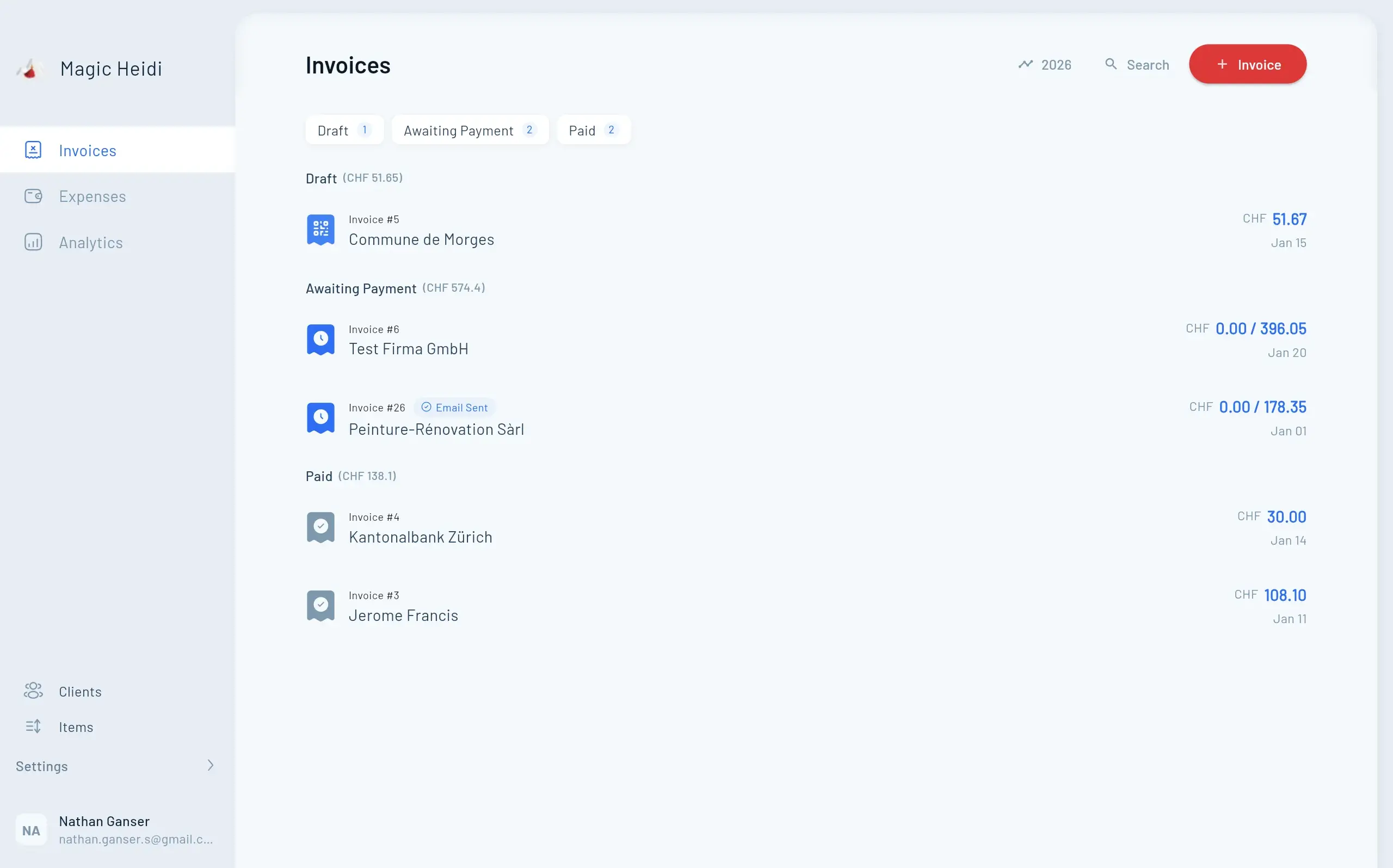
We'll also show how Magic Heidi's invoicing workflow handles the Swiss-specific quirks — QR-Rechnung generation, MWST calculation at 8.1%, and patient/owner tracking — without the bloat of enterprise practice management software like Vetera or Diana.
Swiss Invoice Requirements: 7 Mandatory Elements (Art. 26 MWSTV)
Every Tierarzt Rechnung Schweiz must meet formal requirements. If you're MWST-registered, Art. 26 of the Mehrwertsteuerverordnung (MWSTV) defines seven mandatory elements your invoice must contain:
- Your name and address — full practice name, street, postal code, city.
- The recipient's name and address — the pet owner, farmer, or insurance company.
- Invoice date — the day you issue the Rechnung.
- Quantity and description of services — e.g., "Impfung Hund, Kaninchen, Konsultation" or "Chirurgische Behandlung Katze, Kastration" with the GOT position number.
- Taxable amount — the net amount before MWST.
- MWST rate and MWST amount — 8.1% and the resulting tax, shown separately.
- Your MWST number (MWST-Nr.) — the UID-based number the ESTV assigns when you register.
Below the CHF 100,000 threshold? You're not MWST-liable. State clearly: "Mehrwertsteuer nicht ausgewiesen, da nicht steuerpflichtig." This tells the client — and the ESTV — that you're under the threshold and haven't opted in.
The QR-Rechnung: Non-Negotiable Since 2022
Since October 1, 2022, the QR-Rechnung is the only accepted payment slip format in Switzerland. The old ESR (orange/red) and BESR (red) slips are retired. Every invoice you issue — to a private pet owner, a farmer, or an insurance company — should include a QR-Rechnung payment part with the Swiss QR code.
The QR code encodes your IBAN (QR-IBAN), the amount, your name, and the reference number. Clients scan it with their banking app. Insurance companies can process it automatically. No QR code = manual payment friction, and increasingly, delayed or refused payments.
Dr. Sandra, a mobile veterinarian in the canton of Aargau, learned this the hard way. She sent handwritten invoices without the QR payment part in early 2023. Three clients paid late, and one farmer's Tierhalterversicherung rejected the claim because the format didn't meet the new standard. She switched to Magic Heidi's invoicing workflow, which generates the QR-Rechnung payment part automatically on every invoice — no manual formatting, no rejected claims.
MWST Rules for Veterinarians: No Medical Exemption
This is the core difference between veterinary and human medical invoicing in Switzerland — and it trips up practitioners who assume the rules are the same.
The Rule
Under Art. 21 Abs. 2 Ziff. 19 MWSTG, human medical treatment provided by licensed physicians and allied health professionals (including medically prescribed physiotherapy) is MWST-exempt. However, veterinary medicine — treatment of animals — is NOT covered by this exemption. Veterinary services are commercial services and are MWST-pflichtig at 8.1% (the standard rate since January 1, 2024).
There is no reduced rate for veterinary care. There is no exemption for emergency treatments, surgeries, or preventative care. Every service you provide as a veterinarian — consultations, vaccinations, surgeries, dental work, house calls — carries 8.1% MWST if you're MWST-registered.
Why This Matters
A veterinarian who previously worked in human healthcare, or who consults online advice from non-Swiss sources (German vet associations often discuss different MWST rules), may incorrectly assume their invoices are MWST-exempt. They're not. If you register for MWST and then fail to charge it, you'll owe the full 8.1% to the ESTV out of your own pocket — you can't retroactively bill the client for your mistake.
The CHF 100,000 Threshold
You only register for MWST if your annual taxable revenue exceeds CHF 100,000. Below that, you're a "nicht steuerpflichtig" small business. Many solo and mobile veterinarians stay below this threshold, especially in their first years. But here's the consideration: if you're below the threshold, you can't reclaim input tax (Vorsteuer) on your business expenses — equipment, medication, clinic rent, vehicle costs for house calls. For a veterinarian with significant capital investment (surgical equipment, X-ray machines, a mobile clinic vehicle), voluntary MWST registration may make financial sense even below the threshold. Talk to a tax advisor about whether voluntary registration is worth it for your practice.
Once registered, you file MWST returns with the ESTV — typically quarterly or annually, depending on your revenue.
Input Tax Recovery on Livestock Veterinary Services
For livestock veterinarians, there's an additional layer: farmers who are MWST-registered can reclaim the MWST you charge as input tax (Vorsteuerabzug). So a dairy farmer who pays your CHF 200 invoice plus CHF 16.20 MWST for a cow treatment can deduct that MWST from their own MWST liability. This means your MWST charge isn't an extra cost for MWST-registered farmers — it's a pass-through. But you still need to show it correctly on the invoice, or the farmer can't reclaim it.
Billing Scenarios: Private, Livestock, Insurance, Mobile Vet
Swiss veterinary billing splits into four scenarios, each with different payers, tariffs, and invoice formats.
1. Private Pet Owners (Kleintierpraxis)
The most common billing path. A pet owner brings their animal to your practice or requests a house call. You treat the animal, issue an invoice directly to the owner, and the owner pays. The invoice includes the QR-Rechnung payment part, 8.1% MWST (if registered), and all seven Art. 26 MWSTV elements.
Private pet owners pay out of pocket. Some have Tierhalterversicherung (pet insurance) that reimburses them — but you still bill the owner, not the insurance company. The owner submits your invoice to their insurer for reimbursement.
2. Livestock Farmers (Gross tierpraxis / Nutztierpraxis)
Farmers with cattle, sheep, goats, pigs, or poultry need regular veterinary care — herd health checks, vaccinations, emergency treatments, fertility management. Livestock invoicing differs from pet invoicing in several ways:
- Bulk billing: You may treat an entire herd in one visit, issuing a single invoice with multiple line items (e.g., "Tetanus-Impfung, 12 Rinder" or "Bestandesuntersuchung, 50 Schweine").
- MWST recovery: MWST-registered farmers reclaim your MWST as input tax, so the MWST isn't an extra cost for them.
- Tariff structure: The GOT has specific positions for livestock treatments, often billed per animal or per herd visit.
- Travel costs: House/farm calls include travel fees (Fahrtkosten), which are also MWST-pflichtig.
Dr. Markus, a large animal veterinarian in the Emmental, visits 15 farms per week. He bills per animal treated, with a farm call fee of CHF 80 plus mileage. His invoices list each animal by ear tag number (Ohrmarkennummer) when required by the farmer's records. He uses Magic Heidi's invoicing workflow to generate farm-specific invoices on his phone, right after leaving the stable.
3. Tierhalterversicherung (Animal Insurance Claims)
Some pet owners have Tierhalterversicherung — animal health insurance that covers veterinary costs. Unlike human Krankenkasse, pet insurance typically works on a reimbursement model: the owner pays your invoice, then submits it to the insurer.
However, some insurers (e.g., Tiervivo, Animalo, Sanitas Tier) offer direct billing with participating veterinarians. In this case, you bill the insurance company directly, and the owner only pays their deductible (Selbstbehalt). Check your contract with each insurer — the billing path differs by provider.
For direct insurance billing, your invoice must include the insurance policy number (Versicherungspolicennummer), the animal's name and microchip number, and the treatment details. The GOT tariff positions apply for standardized treatments.
4. Mobile and House-Call Veterinary Services
Mobile veterinarians — who travel to clients' homes, farms, or stables — face additional invoicing considerations:
- Travel fees (Fahrtkosten): Most mobile vets charge a base call fee plus per-kilometer costs. These are MWST-pflichtig like all other services.
- Time-based billing: Some mobile vets charge for consultation time plus treatments, especially for extended visits.
- On-the-spot invoicing: Mobile vets benefit from issuing invoices immediately after treatment — before leaving the client's property. This reduces unpaid invoices and improves cash flow. A mobile-first invoicing tool like Magic Heidi lets you create and send the QR-Rechnung from your phone in under a minute.
- Multiple animals per visit: A house call may involve treating multiple pets (e.g., vaccinating all cats in a household). Each treatment is a separate line item.
Sarah runs a mobile cat clinic in Geneva. She visits 8-10 homes per day, treating one to three cats per visit. Before switching to mobile invoicing, she wrote invoices by hand in the evening — and regularly forgot details or lost receipts. Now she creates the QR-Rechnung on her phone before leaving each home. Clients pay faster, and her bookkeeping is always current.
Swiss Compliance
Built for Veterinarians
Magic Heidi handles every Swiss-specific requirement for veterinary invoices automatically — QR-Rechnung generation, 8.1% MWST on all treatments, GOT tariff positions, and multi-path billing templates.
Compliant QR code with QR-IBAN on every Swiss invoice
Standard MWST on all veterinary treatments — no medical exemption confusion
Store animal name, species, microchip number, and owner contact per invoice
Create and send invoices from your phone between house calls — no laptop needed
Pricing and GOT Tariff Structures for Swiss Veterinarians
The GOT (Gebührenordnung für Tierärzte) is the Swiss veterinary fee schedule. It's maintained by the GST (Gesellschaft Schweizer Tierärzte) — the Swiss Veterinary Association — and provides standardized tariff positions for veterinary services.
How the GOT Works
The GOT defines tariff positions (Tarifpositionen) for specific treatments — consultations, vaccinations, surgeries, dental work, diagnostic imaging, laboratory tests, and more. Each position has a fee range (Taxpunktwert) that varies by canton and practice type. The GOT ensures transparency and consistency in veterinary pricing across Switzerland.
For example:
- Consultation (Konsultation): Base fee for a standard examination
- Vaccination (Impfung): Position for the vaccine itself plus the administration fee
- Surgery (Chirurgie): Graded by complexity — from minor procedures (e.g., abscess treatment) to major surgeries (e.g., laparotomy)
- Dental treatment (Zahnbehandlung): Scaling, extraction, and related positions
- Diagnostic imaging (Bildgebung): X-ray, ultrasound positions
- House call (Hausbesuch): Travel and on-site treatment positions
You bill the GOT position that matches the service you provided. The GST website publishes the current GOT and provides guidance for Swiss veterinarians.
Private Practice Rates
Beyond the GOT framework, you have pricing flexibility for services not covered by insurance contracts. Common price ranges for Swiss veterinary services:
- Consultation (15 min): CHF 65–95
- Vaccination (per vaccine + administration): CHF 50–80
- Cat castration: CHF 200–350
- Dog castration: CHF 250–500 (size-dependent)
- Dog spay (Kastration Hündin): CHF 350–700 (size-dependent)
- Dental cleaning (Zahnsteinentfernung): CHF 120–250
- X-ray (per plate): CHF 80–150
- House call fee (Fahrtkosten): CHF 60–120 plus CHF 1.50–2.50/km
Higher rates apply in Zurich, Geneva, and Lausanne. Rural practices trend lower. Livestock herd health contracts may use monthly retainer arrangements rather than per-visit billing.
For a full pricing comparison of how Magic Heidi stacks up against dedicated veterinary practice management software (Vetera CHF 200+/month, Diana CHF 150+/month), see our breakdown — most solo veterinarians don't need a full PMS to send a compliant Rechnung.
Invoice Template for Swiss Veterinarians
Here's a ready-to-use template for a Swiss veterinary Rechnung. Adapt the fields to your practice.
INVOICE — RECHNUNG
[Practice Name / Dr. Name]
[Street Address]
[Postal Code, City]
Phone: [phone] | Email: [email]
MWST-Nr.: [CHE-XXX.XXX.XXX MWST] (if registered)
Bill to:
[Owner Name]
[Address]
Animal: [Name, Species, Breed, Microchip No.]
Invoice No.: 2026-0142
Date: 03.07.2026
Services rendered:
- Konsultation, Hund, 20 min (GOT [Position])
Date: 28.06.2026 CHF 85.00
- Impfung, DHPP (GOT [Position])
Date: 28.06.2026 CHF 65.00
- Entwurmung, Tabletten (GOT [Position])
Date: 28.06.2026 CHF 25.00
Subtotal: CHF 175.00
MWST (8.1%): CHF 14.18
Total due: CHF 189.18
Payment terms: 30 days
[QR-Rechnung payment part with Swiss QR code]
For a livestock farm visit, the template looks different:
INVOICE — RECHNUNG
[Practice Name / Dr. Name]
[Address]
Bill to:
[Farm Name / Farmer Name]
[Address]
Farm UID: [CHE-XXX.XXX.XXX] (if MWST-registered farmer)
Invoice No.: 2026-0143
Date: 03.07.2026
Farm visit: 28.06.2026, [Farm Address]
Services rendered:
- Bestandesuntersuchung, 45 Rinder (GOT [Position])
CHF 280.00
- Tetanus-Impfung, 12 Rinder (GOT [Position])
CHF 240.00
- Fahrtkosten (Farm call + 25 km)
CHF 110.00
Subtotal: CHF 630.00
MWST (8.1%): CHF 51.03
Total due: CHF 681.03
Payment terms: 30 days
[QR-Rechnung payment part with Swiss QR code]
Notice the difference: livestock invoices include the farm visit details, per-animal or per-herd billing, and the farmer's UID (so they can reclaim MWST). Magic Heidi's MWST management handles the 8.1% calculation automatically on every invoice — pet or livestock.
How Magic Heidi Simplifies Veterinary Invoicing
Most Swiss invoicing tools are built for general freelancers — they don't understand the animal-specific details that define veterinary billing. Dedicated veterinary practice management software (Vetera, Diana, Unomed) is powerful but expensive and complex — overkill for solo practitioners and mobile vets.
Built for Swiss Veterinarians
- QR-Rechnung generation on every invoice — no manual formatting, no rejected payments.
- 8.1% MWST automatically calculated on all veterinary treatments — no confusion about exemptions.
- Patient and owner tracking — store animal name, species, breed, microchip number, and owner contact on each invoice.
- Multi-path billing templates — private pet owner, livestock farm, insurance direct billing, and mobile house call — switch without retyping.
- Mobile-first — issue invoices from your phone between house calls. No laptop required. Create the QR-Rechnung before you leave the client's property.
Sarah in Geneva used to spend Sunday evenings catching up on a week of handwritten invoices. Now she sends them from her phone, right after each house call, while she's walking back to her car. Payments arrive faster, and she never forgets a treatment.
Pricing Without the Overkill
Vetera charges CHF 200+/month for full practice management. Diana costs CHF 150+/month. These are excellent systems for multi-vet clinics with reception staff, but overkill for a solo practitioner who needs to send 20-30 invoices per month. Magic Heidi starts at CHF 25/month — everything you need for compliant Swiss veterinary invoicing, nothing you don't. See the full pricing comparison.
AI Expense Scanning
Track practice expenses — medication, equipment, clinic rent, vehicle costs for house calls, continuing education — with AI expense scanning. Snap a photo of a receipt, and Magic Heidi extracts the amount, MWST, and category. Useful when you're juggling 15 treatments a day and don't have time for manual bookkeeping.
From Registration to First Invoice
When you set up your veterinary practice — whether as an Einzelfirma or a GmbH — you need to register with the Ausgleichskasse for AHV/AVS contributions, and potentially with the ESTV for MWST if you expect to exceed CHF 100,000 in annual revenue. Your UID number (Unternehmens-Identifikationsnummer) goes on every invoice. Magic Heidi helps you get from registration to your first QR-Rechnung in under five minutes — no setup wizard, no configuration menus, no 30-minute onboarding call.
FAQ: Veterinarian Invoices in Switzerland
Is veterinary treatment MWST-exempt in Switzerland?
No. Veterinary services are MWST-pflichtig at 8.1% — the standard Swiss MWST rate. Unlike human medicine (which is exempt under Art. 21 MWSTG), animal treatment is a commercial service. If you're MWST-registered, every invoice must show 8.1% MWST.
What's the MWST threshold for veterinarians?
CHF 100,000 annual taxable revenue. Below that, you're not MWST-liable and state 'Mehrwertsteuer nicht ausgewiesen, da nicht steuerpflichtig.' Above CHF 100,000, you must register with the ESTV and file MWST returns. Voluntary registration below the threshold may make sense if you have significant input tax (Vorsteuer) on equipment and supplies.
What is the GOT (Gebührenordnung für Tierärzte)?
The GOT is the Swiss veterinary fee schedule maintained by the GST (Gesellschaft Schweizer Tierärzte). It defines standardized tariff positions (Tarifpositionen) for veterinary treatments — consultations, vaccinations, surgeries, imaging, dental work, and house calls. The GOT ensures pricing transparency across Swiss veterinary practices.
Do I bill the pet owner or the Tierhalterversicherung?
Typically, you bill the pet owner directly, and the owner submits your invoice to their Tierhalterversicherung for reimbursement. Some insurers offer direct billing with participating veterinarians — in that case, you bill the insurer and the owner pays only their Selbstbehalt (deductible). Check your contract with each insurer.
Can farmers reclaim the MWST on my livestock veterinary invoices?
Yes. MWST-registered farmers can reclaim the 8.1% MWST you charge as input tax (Vorsteuerabzug). This means your MWST charge isn't an extra cost for them — it's a pass-through. But you must show the MWST correctly on the invoice, including your MWST number, for the farmer to reclaim it.
Do I need to register with the Ausgleichskasse?
Yes. Every self-employed veterinarian in Switzerland must register with the Ausgleichskasse for AHV/AVS contributions, even below the MWST threshold. You pay AHV contributions as a percentage of your income. You may also need Handelsregister registration depending on your legal form (Einzelfirma vs. GmbH).
Can I use Magic Heidi instead of dedicated veterinary software like Vetera?
It depends on your practice. If you're a solo veterinarian or mobile vet who needs compliant invoicing, MWST calculation, and expense tracking — Magic Heidi is all you need at CHF 25-39/month. If you run a multi-vet clinic with reception staff, appointment scheduling, lab integration, and patient records, a full PMS like Vetera or Diana is more appropriate. Many solo vets use Magic Heidi alongside a simpler patient records system.
Conclusion
Writing a compliant Tierarzt Rechnung Schweiz comes down to three things: the seven Art. 26 MWSTV elements, the QR-Rechnung payment part, and 8.1% MWST on all veterinary treatments. Get those right, and your invoices pass insurance scrutiny, ESTV audits, and client payment apps without friction.
The key difference from human healthcare invoicing: veterinary services are never MWST-exempt. Every treatment — from a CHF 30 vaccination to a CHF 700 surgery — carries 8.1% MWST if you're registered. Track your threshold. Show the MWST correctly. Use a tool that understands the difference.
Magic Heidi handles all of this at CHF 25–39/month, mobile-first, without the enterprise bloat of Vetera or Diana. Try it free — your first Rechnung goes out in under five minutes.
Start invoicing with Magic Heidi →
References: GST (Gesellschaft Schweizer Tierärzte) for GOT tariff and professional guidance · KMU Admin for MWST regulations · ESTV for tax authority information.
Create Your First Veterinary Invoice in 30 Seconds
No credit card required. Start invoicing your clients professionally today — QR codes, 8.1% MWST, and expense tracking all included.