 Magic Heidi
 Writing a Collective Invoice in Switzerland
A collective invoice (Sammelrechnung) combines multiple deliveries and services for the same client into a single new invoice — saving you postage, admin work, and payment chasing. Here is how to create one correctly in Switzerland: with a service date on every line item, 8.1% VAT (MWST), and a QR-bill.
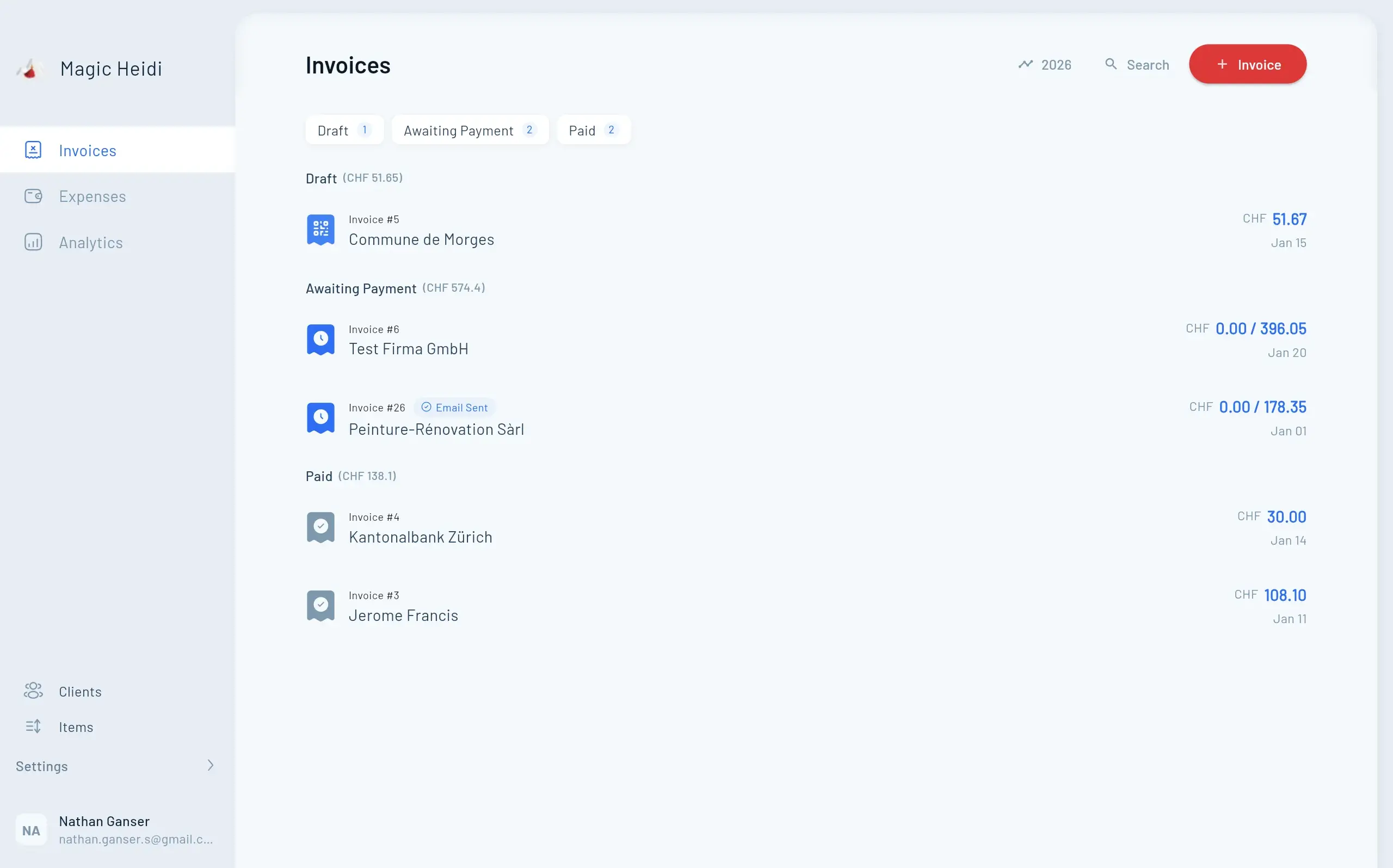
Why a correct collective invoice means less hassle
If you deliver many small services to the same client — tutoring, graphic design, cleaning, trades work — you drown in individual invoices without a collective invoice. But Switzerland has firm rules: every line item needs its own service date, every invoice number must be sequential, and above CHF 100,000 annual revenue you must charge 8.1% VAT (MWST). Mistakes here lead to questions from the ESTV (Swiss Federal Tax Administration) and late payments.
Too many individual invoices
5 invoices of CHF 30 each cost you more effort than they bring in — a collective invoice saves time and postageService date on every line item
With multiple service dates, each line item carries its own date — otherwise your VAT reporting gets shakyCharging 8.1% VAT correctly
{ "Above CHF 100,000 revenue": { "standard rate": { " Below": "add the note \"VAT not charged, not liable to VAT\"" } } }Sequential invoice number
Every collective invoice needs its own number in your invoice sequence — no gaps, no duplicatesThe essentials at a glance
- A collective invoice (Sammelrechnung) combines multiple services for the same client that have not yet been invoiced into a single new invoice. Invoices you have already issued cannot simply be "glued together" — that requires a credit note and a fresh invoice.
- Every line item needs its own service date if the services were delivered on different days. That is what Art. 26 MWSTV (Swiss VAT Ordinance) requires — and your client needs it for their bookkeeping.
- Above CHF 100,000 annual revenue you charge 8.1% VAT (2.6% on reduced-rate supplies such as books). Below that threshold, you write on the invoice: "VAT not charged, not liable to VAT."
- A collective invoice still needs a sequential invoice number, all mandatory details, and a QR-bill payment part with a QR-IBAN and reference number. Otherwise payment slows down.
- A 30-day payment term is the Swiss standard. Due dates and default interest follow the Swiss Code of Obligations — clear terms on the invoice save you collection effort.
You have a regular client you do work for every week — and at the end of the month, five mini-invoices of CHF 30 or CHF 80 pile up on your desk? That costs you postage, time, and payment chasing. The solution: write a collective invoice and bill all of the client's outstanding services on a single invoice.
In this guide you will learn what a collective invoice must legally contain in Switzerland: which mandatory details Art. 26 MWSTV requires, how to handle 8.1% VAT and multiple service dates, how a collective invoice differs from a partial invoice (Teilrechnung), an advance payment (Akonto), and a final invoice (Schlussrechnung) — and how to send a finished collective invoice with QR-bill in 30 seconds using Magic Heidi's invoicing workflow.
What is a collective invoice?
A collective invoice is an invoice that combines multiple services for the same client that have not yet been billed into a single, new invoice. Instead of writing a separate document for each individual service, you bill everything at once at the end of a week, a month, or a project.
Example: you give tutoring lessons. Four times a month, at CHF 80 per hour. Instead of four invoices of CHF 80 each, at the end of the month you write one collective invoice for CHF 320 (plus VAT if you are VAT-registered) — with four line items and four service dates.
The delimitation matters, because this is where many people make the crucial mistake:
- Collective invoice = multiple services that have never been invoiced before go into a new invoice. That is allowed and standard practice.
- NOT allowed: retroactively merging already-issued individual invoices into a collective invoice. An invoice that has been issued is a finished document with its own invoice number and its own due date. You cannot "absorb" it into a new document. If a client wants to make a single payment covering several old invoices, you instead issue a credit note for the old invoices and then re-bill the services with a clean, new collective invoice.
The difference from an individual invoice, then, lies not in the content but in timing and structure: an individual invoice documents a service immediately, while a collective invoice gathers multiple services and bills them together. Both must meet the same mandatory details — the collective invoice additionally carries the service date of each line item.
One more delimitation: a collective invoice is not a summary of documents for multiple clients. Everything must belong to the same recipient of the services, otherwise the allocation for VAT and bookkeeping becomes opaque.
When a collective invoice pays off
Let's do the cold math. You tutor at CHF 80 per hour, four times a month, for the same student:
| Option | Number of invoices | Amount per invoice | Effort |
|---|---|---|---|
| Individual invoice after each lesson | 4 | CHF 80.00 | Create 4x, send 4x, check 4 payments |
| Collective invoice at month-end | 1 | CHF 320.00 | Create 1x, send 1x, check 1 payment |
Four documents of CHF 80 each are an effort-to-revenue ratio that just does not add up. Every invoice costs you creation, sending, payment checking, and — in the worst case — collections. With a collective invoice, that effort drops to a quarter. Add to that: the effort per payment stays the same whether CHF 80 or CHF 320 is transferred. The client pays once instead of four times — which also improves their payment discipline.
Léa, a tutor in Lausanne, solved it this way. She teaches five students, two lessons per week each. She used to write a small invoice after every lesson — CHF 80 here, CHF 80 there. Payments trickled in throughout the month, and parents who had overlooked an invoice had to be chased individually. Today, on the last Friday of the month, she issues one collective invoice of CHF 640.00 per family (eight lessons, with service dates on every line item). The parents know the rhythm, payments arrive predictably at month-end — and Léa no longer spends her Sunday evenings on invoices, but on her studies.
So a collective invoice pays off whenever:
- you deliver regularly recurring small services for the same client (tutoring, graphic design, programming, cleaning, garden maintenance, consulting),
- you run projects with many small individual jobs and the client expects one consolidated bill,
- you want to cut postage and administration costs, and
- your clients prefer one clear overall statement instead of booking a new document every week.
It does not pay off for one-off large contracts (an individual invoice is clearer there), for clients with strict internal approval processes per individual service, or when the contract sets a different billing rhythm. A good invoice template helps you create both variants with a consistent look.
Collective invoices and VAT: 8.1%, 2.6%, and the CHF 100,000 threshold
VAT (MWST, the Swiss VAT at an 8.1% standard rate) is the point where collective invoices most often go wrong. The basic rules:
- Standard rate: 8.1% — applies to almost all services and supplies (since 1 January 2024).
- Reduced rate: 2.6% — only for the supplies listed in the law, such as books, newspapers, foodstuffs, and non-prescription medicines.
- If you are not liable to VAT, you do not charge any VAT at all.
Every line item with its own service date
Art. 26 MWSTV requires the invoice to show the date or period of the service delivery, whenever it does not match the invoice date. On a collective invoice it almost never matches — after all, you are combining services from different days or weeks on one document.
The clean solution: every line item gets its own service date. Example:
- 05.09.2026 — Math tutoring, 90 min — CHF 120.00
- 12.09.2026 — Math tutoring, 90 min — CHF 120.00
- 19.09.2026 — Math tutoring, 90 min — CHF 120.00
For services delivered over a period (e.g., a retainer arrangement in September), a period indication such as "Service period: 01.09.–30.09.2026" is sufficient. What matters for VAT: the applicable rate follows the time of the service delivery, not the invoice date. The standard rate rose from 7.7% to 8.1% on 1 January 2024 — so if you had only collected services delivered in late 2023 in January 2024, you would bill those line items at 7.7% and the January line items at 8.1%. The rate has been stable since — but if the ESTV adjusts the rate in future, the service date on your collective invoice is what counts, not the day you send it. The current rate overview from the ESTV is available at estv.admin.ch.
Below CHF 100,000: the not-liable-to-VAT note
If you are not VAT-registered (annual revenue below CHF 100,000 and no voluntary registration), you may not charge VAT. Instead, write on every collective invoice:
"VAT not charged, not liable to VAT."
This applies to collective invoices just as it does to individual invoices. The note protects you: a client who wrongly expects VAT immediately sees that your net amount is the final amount.
Impact on your VAT return
For the VAT return to the ESTV, a collective invoice counts like any other invoice: the service becomes taxable when you deliver it — not when you issue the invoice (under agreed-consideration accounting). If you bill monthly and collect at month-end, you have a natural rhythm: all services of a month flow through the month-end collective invoice into the same reporting period. That is one of the biggest advantages of the collective invoice: your VAT return and your invoice journal stay in sync, because you are not mixing services from two different quarters on one document. (Under cash-basis accounting it is the receipt of payment that counts — even then, the collective invoice remains a clean, self-contained document.)
In short:
| Situation | How VAT appears on the collective invoice |
|---|---|
| Liable to VAT (above CHF 100,000 revenue) | 8.1% (or 2.6%) per line item or applied to the subtotal, VAT amount shown separately, VAT number in the header |
| Not liable to VAT (below CHF 100,000) | Note: "VAT not charged, not liable to VAT." |
| Mixed rates on one collective invoice | Each line item at its own rate — totals shown separately for 8.1% and 2.6% |
Mandatory details under Art. 26 MWSTV — the 7 elements
If you are VAT-registered, your collective invoice must also meet the seven mandatory elements of Art. 26 of the Swiss VAT Ordinance. Outside of VAT liability, the rule is: none of it hurts — and almost all of it belongs on a professional invoice anyway, because the Swiss Code of Obligations and your client's bookkeeping expect it.
- Your name and address, as you appear in business dealings — plus the note that you are registered in the register of taxable persons, and your VAT number (UID).
- Name and address of the recipient of the services — the client you are issuing the collective invoice to.
- Date or period of the service delivery, if not identical to the invoice date — for the collective invoice the key point: the service date on every line item.
- The nature, subject, and scope of the service — every line item on the collective invoice needs a clear description (What? How much? At what price?).
- The consideration — net subtotal, each line item with unit price and amount.
- The VAT rate and the VAT amount — 8.1% or 2.6%, shown separately.
- A sequential invoice number — every collective invoice gets the next free number in your sequence (e.g., 2026-0147). No number twice, no gaps.
Alongside the VAT Ordinance, the Swiss Code of Obligations (OR) governs the civil-law side of an invoice: what you claim is a receivable under the underlying contract, and due date, default, and limitation follow the general rules of the OR. In practice, this means for your collective invoice:
- Absent an agreement to the contrary, a receivable falls due when you make it payable — which is why a clear payment term belongs on the invoice.
- If the client defaults, the statutory default interest of 5% runs (Art. 104 OR) — you can invoke this in your terms.
- Receivables generally become time-barred after 10 years (Art. 127 OR), for periodic services and work at 5 years (Art. 128 OR). A collective invoice does not prescribe differently than other receivables — what counts is the underlying service.
The sequential invoice number deserves an extra note for collective invoices: collective invoices are not an exception. They count in your number sequence exactly like individual invoices. If you collect automatically at the push of a button at month-end, make sure your tool creates the collective invoice as a normal invoice with the next free number — not as a separate series. In Magic Heidi this happens automatically, because every collective invoice goes through the normal invoice workflow (Invoicing).
In addition to the mandatory details, every collective invoice carries a QR-bill payment part — more on that next.
Collective invoice vs partial invoice, advance payment, and final invoice
These four terms are often mixed up — yet they govern four different billing situations:
| Term | What happens | Typical use case |
|---|---|---|
| Collective invoice | Multiple still-open individual services for the same client are combined into a new invoice | Recurring small services: tutoring, graphic design, support, cleaning |
| Partial invoice (Teilrechnung) | Partial acceptances of one single service (e.g., a large project) are invoiced | Trades: partial roofing work per construction stage |
| Advance payment (Akonto) | The client pays in advance; the service has not (fully) been delivered yet | Project start: material costs, down payment of 30–50% |
| Final invoice (Schlussrechnung) | Last invoice of a project, offsets advance payments and partial invoices already paid, and shows the remaining balance | Project completion after advance payments |
The difference in one sentence: the collective invoice bundles multiple independent services. The final invoice closes out a single project and offsets prepayments. The partial invoice is an interim invoice for one project, and the advance payment is a prepayment.
Marco, a painter in Winterthur, uses both patterns in combination. For a stairwell renovation he charges an advance payment of CHF 1,000 and issues a partial invoice after each of two construction stages — that is project logic. In parallel, he looks after four regular clients with recurring small repairs: a door paint job here, a window frame there. He used to write an individual invoice of CHF 200 or CHF 400 for every small job. Since he collects the small jobs into one collective invoice per client per quarter, he writes a single document of CHF 3,450.00 for the same client at quarter-end — four sub-jobs, four service dates, one number, one payment. He saves three invoices per client per quarter, and his clients get a clean overview of all repairs.
If you want to agree on installment payments instead of collecting, our article on agreeing on installment payments in Switzerland will help.
QR-bill and payment practice
In Switzerland, the collective invoice is also sent as a QR-bill — the QR-bill has been the standard payment instrument in Swiss invoicing since October 2022, and the old ISR (ESR) payment slips have disappeared.
For this you need:
- A QR-IBAN from your bank — an IBAN reserved for QR-bills (recognizable by the QR-IID, the bank identification block in the QR format). Only with a QR-IBAN can you use the reference-number procedure (QR reference).
- A QR reference number — shown at the bottom right of the QR-bill. It links the payment unambiguously to your collective invoice, so incoming payments are matched automatically.
- The payment part with the Swiss QR code — the client scans it with their banking app or pays at the bank branch.
In practice this means: the QR code encodes your QR-IBAN, the total amount of the collective invoice, and the reference number. The client scans, confirms, done — no transfer form, no typos in the amount or the number.
Payment term: 30 days is the Swiss standard. Without an agreement to the contrary, an invoice falls due with a reasonable payment term; 30 days from the invoice date is common practice. For recurring collective invoices, a fixed rhythm pays off: e.g., "on the last Friday of each month, payable within 10 days" or "monthly invoice, payable within 30 days." Clients get used to the rhythm — and you get used to predictable incoming payments. You can find details on deadlines and collections in our guide to payment terms in Switzerland.
Priska, a graphic designer with clients in Zurich and Basel, switched her payment practice to monthly collective invoices. She serves three clients on retainer — always small design jobs, a logo tweak here, a social media template there. She used to bill every little item separately: amounts from CHF 90 to CHF 250, sometimes twenty documents a month. Bookkeeping on both sides was correspondingly messy. Today she collects all of a client's jobs each month and sends one collective invoice of around CHF 1,800.00 at month-end — with every line item, its service date, and its hourly rate. The QR payment part carries the reference number, and the payment term is set to 10 days. Her incoming payments have been predictable ever since, and the question "Did you get my invoice from the 3rd?" no longer comes up.
A practical note on sending: you also send the collective invoice as a PDF — by email, or by post with a physical QR-bill payment part. The QR code works in both cases. Our tutorial on creating a QR-bill shows you how to build the payment part correctly.
Creating a collective invoice: step by step
Here is how it works in practice — from collecting to sending:
- Record services as soon as they occur. Enter every individual service right after delivery — with date, description, and amount. Anyone who collects "from memory" at month-end risks forgotten line items or lost amounts. In Magic Heidi you can record services directly as open items on the client.
- Set the collection date. Monthly is the most common rhythm; quarterly or project-based works too. Fix the date and communicate it to the client: "You will receive a collective invoice at the end of each month."
- Check client and invoice details. Name and address of the recipient, your VAT number (if registered), payment terms — everything that belongs in the invoice header.
- List line items with service dates. Every line item: service date, description, quantity, unit price, amount. Never omit them with multiple dates — the service date is a mandatory detail and important for your client's bookkeeping.
- Show subtotal, VAT, and total. Net amount, then 8.1% VAT separately (or the not-liable-to-VAT note), then the total amount. Show mixed rates separately.
- Assign the sequential number and attach the QR payment part. The next free invoice number from your sequence, QR-IBAN and QR reference number in the payment part, payment term in the footer — then send.
And here is the ready-to-copy template:
Collective invoice

Léa Dupont — Tutoring
Rue de la Bourdonnette 12
1007 Lausanne
VAT no.: CHE-XXX.XXX.XXX (if registered)

Invoice to:
Meier family
Seestrasse 8
6004 Lucerne

Invoice no.: 2026-0147
Invoice date: 30.09.2026
Service period: 01.09.–30.09.2026

Line items:
05.09.2026  Math tutoring, 90 min          CHF 120.00
12.09.2026  Math tutoring, 90 min          CHF 120.00
19.09.2026  Math tutoring, 90 min          CHF 120.00
26.09.2026  Math tutoring, 90 min          CHF 120.00

Subtotal net:                          CHF 480.00
VAT (8.1%):                            CHF 38.88
Total:                                 CHF 518.88
— alternatively, if not liable to VAT: —
Subtotal:                              CHF 480.00
VAT not charged, not liable to VAT.
Total:                                 CHF 480.00

Payable within 30 days by QR-bill.
[QR-bill payment part with QR-IBAN and reference number]
For invoices subject to VAT, the rule is: the VAT rate and amount must never be missing. For those not liable to VAT, the note applies. Everything else — service dates per line item, sequential number, payment term — applies to both.
With Magic Heidi, manual assembly is a thing of the past: you record services continuously as open items, select the client at month-end, click "Create collective invoice" — and line items, service dates, VAT calculation, sequential number, and QR payment part are automatically correct. More on the workflow on the invoicing software page.
FAQ: Collective invoices in Switzerland
Does every service date have to be listed individually on a collective invoice?
Yes — if the services were delivered on different days, every line item carries the date of the service delivery. Art. 26 MWSTV requires the date or period of the service whenever it does not match the invoice date. For services delivered over a continuous period, a period indication is sufficient (e.g., "01.09.–30.09.2026").
May I combine invoices I have already issued into a collective invoice?
No. An issued invoice is a finished document with its own number and due date — you cannot merge it into a new document. If you need everything on one document, you issue a credit note for the old invoices and then re-bill the services with a clean, new collective invoice. The outstanding receivable does not shift in the process — only the document is restructured.
How does a collective invoice affect my VAT return?
The service becomes taxable when it is delivered — not when the collective invoice is sent. With monthly collection, all services of a month flow into the same reporting period, which simplifies your VAT return to the ESTV. The VAT rate follows the service date, and every line item is billed at the rate of its service. Since 1 January 2024, these are 8.1% (standard rate) and 2.6% (reduced-rate supplies).
What is the difference between a collective invoice and a final invoice?
The collective invoice combines multiple independent services for the same client into a new invoice — for example, all tutoring lessons of a month. The final invoice closes out a single project, offsetting advance payments and partial invoices already paid before showing the remaining balance. A collective invoice does not offset prepayments; it only collects open individual services.
Which industries benefit from a collective invoice?
Wherever recurring small services occur for the same client: tutoring and teaching, graphic design and web design, IT support, cleaning services, garden maintenance, small trades jobs, legal and tax consulting on retainer. The common denominator: many small amounts, one client, one fixed billing rhythm. For one-off jobs or large projects with advance payments, an individual or final invoice is clearer.
Does a collective invoice become time-barred differently than an individual invoice?
No. What counts is the underlying receivable, not the form of the invoice. Swiss receivables generally become time-barred after 10 years (Art. 127 OR); for periodic services, work, and other special receivables, the shorter period of 5 years applies (Art. 128 OR). The claim arises when the service is delivered — the collective invoice does not change that. In case of default, the statutory default interest of 5% per year also runs (Art. 104 OR).
Conclusion
Writing a collective invoice in Switzerland is not rocket science — but it follows the same rules as any other invoice: seven mandatory details under Art. 26 MWSTV, the service date on every line item, a sequential invoice number, 8.1% VAT (if liable), and a QR-bill payment part with QR-IBAN and reference number.
The real advantage lies in the rhythm: record services continuously, bill once at month-end, receive one payment. Fewer documents, less collection work, more predictable incoming payments — and for that you do not need an Excel contraption, just a workflow that does the collecting for you.
Magic Heidi does exactly that: record services as open items, bundle them into a collective invoice with one click — with correct service dates, automatic VAT calculation, sequential number, and QR-bill. From CHF 24.99/month, mobile-first, no credit card required to try it. Your first collective invoice goes out in under five minutes.
Start invoicing with Magic Heidi →
Sources: KMU Admin for invoicing and self-employment · Paymentstandards.ch for the QR-bill standard · ESTV for VAT rules and mandatory details (see text).
Create your collective invoice in 30 seconds
No credit card required. Record services as you go, bundle them into a collective invoice at month-end — including QR-bill and VAT.