 Magic Heidi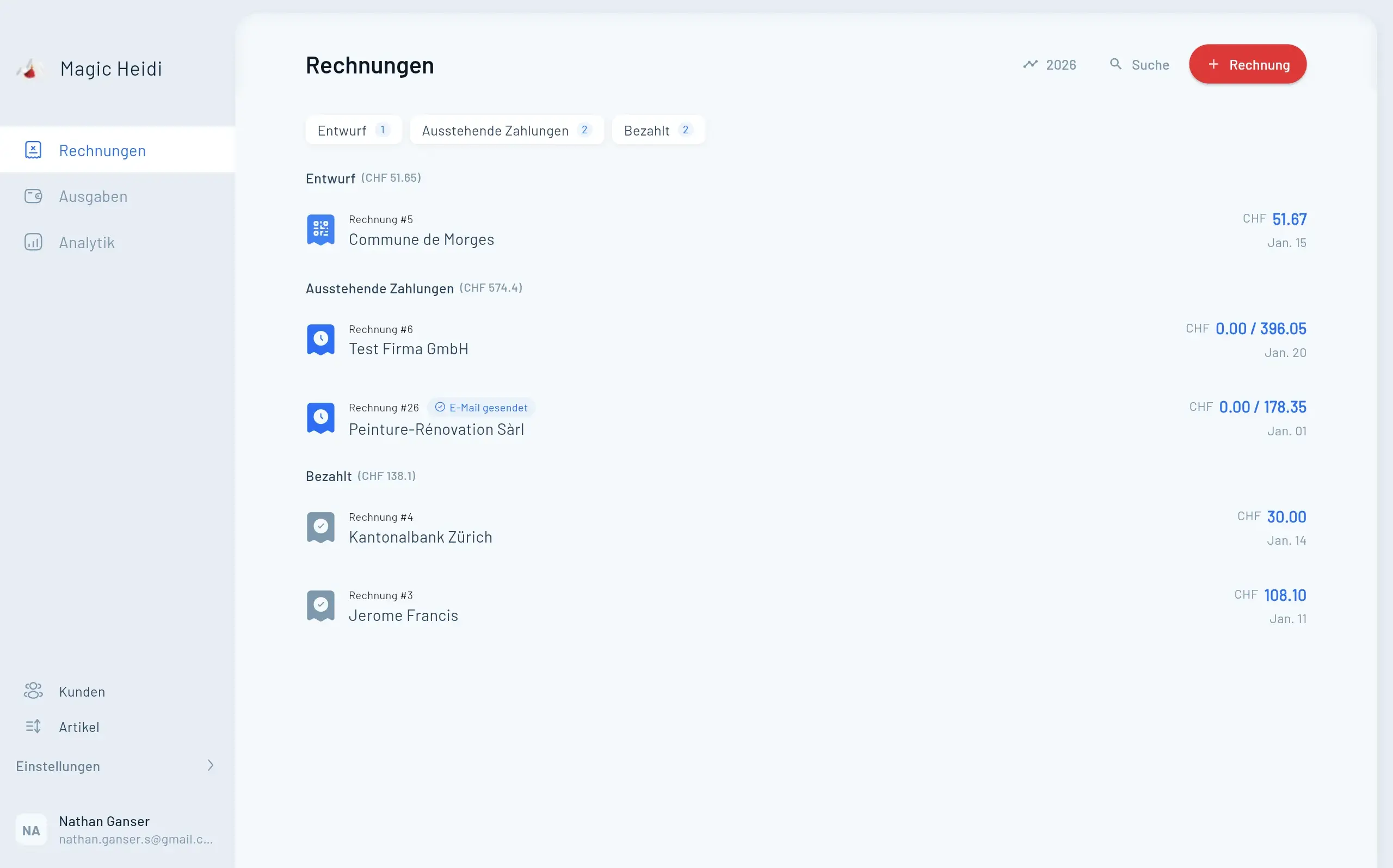
Pension Fund for Sole Proprietorships | Magic Heidi
Pension fund for a sole proprietorship: yes, via voluntary BVG or a 1e plan. Secure retirement savings and tax benefits in 2026 – with Magic Heidi.

Founder of Magic Heidi
As the owner of a sole proprietorship (Einzelfirma), you are self-employed – which means there is no employer to enroll you in a pension fund (Pensionskasse). The short answer to the question "pension fund for a sole proprietorship?": Yes, but not through the classic employee route. You have three options: voluntary BVG membership with a pension fund, a 1e retirement plan once your income is higher, or – for many the most pragmatic solution – pillar 3a with high contribution limits. Which option fits your sole proprietorship depends mainly on your income. This guide walks you through the routes available in 2026, with CHF examples and the key pitfalls to watch for.
The key points at a glance
- As the owner of a sole proprietorship, you have no employer – mandatory BVG membership does not apply to you
- Voluntary BVG membership: possible through an insurance solution, from a minimum annual income (check the threshold with the pension fund)
- 1e plans: only worthwhile for income above the maximum BVG threshold (check the cap with the Federal Social Insurance Office)
- Pillar 3a without a pension fund: you can contribute up to around CHF 37,000 per year (for self-employed people without a pension fund; check the current limit with the FTA/ESTV)
- Contributions to BVG and pillar 3a are fully tax-deductible
Can a sole proprietorship even have a pension fund?
It's a fair question, because the second pillar (BVG) was designed as retirement provision for employees. Mandatory BVG membership only kicks in for employees above a defined annual salary threshold, which the Federal Social Insurance Office adjusts regularly. As the owner of a sole proprietorship, that employer layer simply doesn't exist for you. Nobody pays half of your contributions.
Does that mean: no pension fund, full stop? No. The BVG law provides for voluntary membership for the self-employed. If you earn enough, you can register with a pension fund or through an insurance provider and pay into a compliant pension fund. A sole proprietorship doesn't mean "no retirement provision" – it just means you are responsible for everything yourself. AHV (the Swiss state pension) is mandatory for you (see ahv.ch), while the pension fund remains your decision.
If you want an overview of the whole retirement landscape – AHV, BVG, pillar 3a – check our guide to retirement planning for the self-employed. And if you haven't yet founded your sole proprietorship, our article on founding a sole proprietorship in Switzerland is a good place to start.
Voluntary BVG membership: how it works
Self-employed people can join a pension fund voluntarily. This requires a minimum annual earned income, with the exact threshold set by regulation. Have the pension fund or admin.ch confirm the current limit rather than planning with outdated figures.
The steps typically look like this:
- You apply for membership with a pension fund or an insurance provider that offers voluntary BVG solutions for the self-employed
- The institution reviews your earned income – your income statement or tax return is what counts
- Once accepted, you pay contributions on the insured salary, which you can partly determine yourself within the allowed range
- The contributions are – as for employees – fully deductible from your taxable income
The big advantage over pillar 3a: the contribution limits are much higher, and the contributions directly reduce your taxable income. The catch: there is no employer share. Every franc comes from you. A true pension fund solution also involves administrative work and fees. For small sole proprietorships, this usually only pays off once your marginal tax rate rises noticeably – roughly speaking, once you are paying five figures in taxes.
1e retirement plans for higher incomes
Since 2017 there have been so-called 1e plans – retirement solutions for income above the maximum BVG threshold. They were designed for executives, but they suit high-earning self-employed people just as well. The logic: on the part of your income that no longer fits into the mandatory pension fund anyway, you can run a more flexible, more growth-oriented solution.
The differences from classic BVG:
- Higher contribution base: only the salary above the coordinated salary threshold is insured in the 1e segment
- Investment freedom: you choose the investment strategy yourself – from conservative to aggressive
- Your risk: losses are borne by the insured person, not the institution. In return, strong performance means more at the end
- Lump-sum withdrawal at retirement is more flexibly regulated in the 1e segment than in mandatory BVG
Who is this for? For self-employed people with a net income well above the maximum BVG threshold – as a rule of thumb, from around CHF 130,000 to 150,000 per year. Below that, the effort is usually not justified, and pillar 3a plus voluntary BVG cover the need better.
Pillar 3a as the simple alternative
For most sole proprietorships, pillar 3a is the most pragmatic first step. No application with a pension fund, no minimum contributions, no fees for complicated structures: open a savings account or securities account with a bank or insurance provider, deposit, deduct from your taxes – done.
The crucial difference from employees: as a self-employed person without a pension fund, the higher limit applies to you. Roughly speaking, you can contribute around CHF 7,400 if you are also employed – but as a sole proprietorship without a pension fund, up to around CHF 37,000 per year. The Swiss Federal Tax Administration (ESTV) publishes the exact, current amounts; check them before contributing at estv.admin.ch.
This setup is a genuine tax advantage for sole proprietorships: if you have a good year, you top up your 3a and noticeably reduce your taxable income. The next, weaker year, you simply skip it. By the way, you can make up contributions at any time up to your tax return – what counts is the calendar year.
What happens to your pension fund balance when you go self-employed?
A case most guides miss: you were previously employed and have already built up pension fund savings. When you found your sole proprietorship, this balance is not paid out – it moves into a vested benefits account or stays with your previous institution as policy-free retirement provision. The capital remains anchored in the second pillar for tax purposes: you can later use it to finance residential property via the pension withdrawal form, or withdraw it at retirement age.
Three points that matter here:
- No forced withdrawal: the balance stays intact and tax-sheltered even without a new pension fund affiliation
- Interest and safety: vested benefits accounts earn interest and carry virtually no risk – though the return is modest
- Re-entry possible: if you later join a pension fund voluntarily again, you can transfer the balance there and continue building your retirement income
Important: submit the certificate of coverage form from your previous pension institution within the required deadline, otherwise the institution moves your balance to a contingent institution on its own – and the account fees there are charged to you. If you would rather invest the balance yourself, you may be able to transfer part of it into a restricted pillar 3a solution, provided the conditions are met; clarify the details with both institutions before making the switch.
For newly founded sole proprietorships this is the most convenient starting point: your existing pension capital keeps working while you build up new savings flexibly through pillar 3a. Cashing out the balance at the wrong moment – for example in the middle of a high-income tax year – can easily cost you several thousand francs in taxes, because lump-sum withdrawals are taxed progressively.
Tax deductions: what you need to know
Retirement provision is one of the biggest legal tax levers for the self-employed. This applies to all three options:
- AHV contributions: as a self-employed person you pay the full contributions – they are deductible as business expenses
- Voluntary BVG membership: contributions fully deductible in the year of payment
- Pillar 3a: also fully deductible, up to the respective limit
If you want to systematically use all the deduction options – from home office to professional expenses to retirement contributions – take a look at our guide to tax deductions for the self-employed. Combined with clean bookkeeping, this saves you real money every year: record expenses, scan receipts, have the numbers at hand for your tax return. With the features of Magic Heidi, you can do this without paying a fiduciary premium for the basics.
What fits your sole proprietorship best
Three practical examples show how different the answer can be.
Sandra, graphic designer, 46, sole proprietorship in Lucerne
Sandra has annual revenue of CHF 48,000, leaving around CHF 40,000 after expenses. A voluntary BVG membership with administrative fees and fixed minimum contributions would be overkill for her. She opts for pillar 3a: CHF 10,000 to 15,000 each year, depending on how the year goes. With a marginal tax rate of around 25%, this saves her roughly CHF 2,500 to 3,750 in taxes per year – while building up capital that she can draw down gradually from age 59.
Markus, management consultant, 41, sole proprietorship in Zurich
Markus expects a net income of CHF 180,000. For him, the two-track approach pays off: a 1e solution for the part of his income above the BVG threshold, plus pillar 3a at the maximum. His fiduciary first advised him to join a voluntary BVG plan, but then ran the numbers with him: for his profile, the lower costs and investment freedom of the 1e plan are the better choice. Important for Markus: he bears the investment risk himself, which is why he has invested 60% in a balanced strategy.
Claudia, physiotherapist, 52, sole proprietorship in Bern
Claudia earns CHF 85,000 and wants to retire in 13 years at 65 – the regular AHV retirement age for women and men. She chooses voluntary BVG membership through her professional pension fund plus pillar 3a. Her reason: at 52, her contributions convert into an annuity at a significantly better rate, and she wants to build a guaranteed pension alongside AHV by retirement. The higher contributions of around CHF 18,000 per year also noticeably reduce her taxable income.
The rule of thumb that follows: below roughly CHF 60,000 net income, pillar 3a is usually enough. Between CHF 60,000 and CHF 130,000, voluntary BVG membership is worth considering. Above that, combining it with a 1e plan pays off.
Frequently asked questions (FAQ)
Can I join a pension fund as a sole proprietorship?
Yes, but not as an employee. You can register voluntarily with a pension fund or insurance provider if your self-employed earned income reaches the required threshold. Ask the institution for the current limit or check it on admin.ch.
Does the state pay part of my pension fund contributions?
No. As a self-employed person there is no employer share. You bear all the contributions yourself – but they are fully tax-deductible.
How much can I contribute to pillar 3a?
As a self-employed person without a pension fund, the high limit of around CHF 37,000 per year applies. If you are connected to a pension fund, the lower employee limit of around CHF 7,400 applies. The ESTV publishes the exact amounts each year.
From what income does a 1e plan make sense?
Only for income well above the maximum BVG threshold – as a rule of thumb, from around CHF 130,000 to 150,000 net income per year. Below that, voluntary BVG or pillar 3a are usually a better fit.
Are pension fund contributions tax-deductible?
Yes. Contributions to a voluntary BVG solution and deposits into pillar 3a are fully deductible from taxable income – in the year of payment.
Does AHV count as a pension fund?
No. AHV is the first pillar and mandatory for the self-employed. The pension fund (BVG) is the second pillar and remains voluntary for you. Contributions to both are tax-deductible.