 Magic Heidi
 Swiss VAT Methods Explained: Choose the Right One for Your Business
Choosing the wrong VAT method costs Swiss businesses thousands of francs every year. Not in taxes—in wasted administrative hours. This guide breaks down every VAT accounting method available in Switzerland for 2025.

January 2025 Brought Major Changes.
Are You Up to Date?
The January 2025 LTVA revision introduced new annual declaration options, updated thresholds, and changed rules for net tax rates. If you're still working with 2023 information, you're making decisions with outdated data.
Annual Declarations
New option for businesses under CHF 5MEasier Switching
Change methods at any calendar yearMandatory E-Filing
Paper forms no longer acceptedSwiss VAT Rates 2025-2026
Before diving into methods, here are the current rates that remained unchanged from 2024.
Standard Rate
8.1% — Most goods and services
Reduced Rate
2.6% — Food, books, newspapers, medicines
Special Rate
3.8% — Hospitality services
Registration Threshold
CHF 100,000 annual turnover
The Two Main VAT Calculation Methods
Every VAT-registered business in Switzerland uses one of two systems to calculate what they owe. Think of these as the foundation—everything else builds on top.
Effective Method: Input Tax Deduction
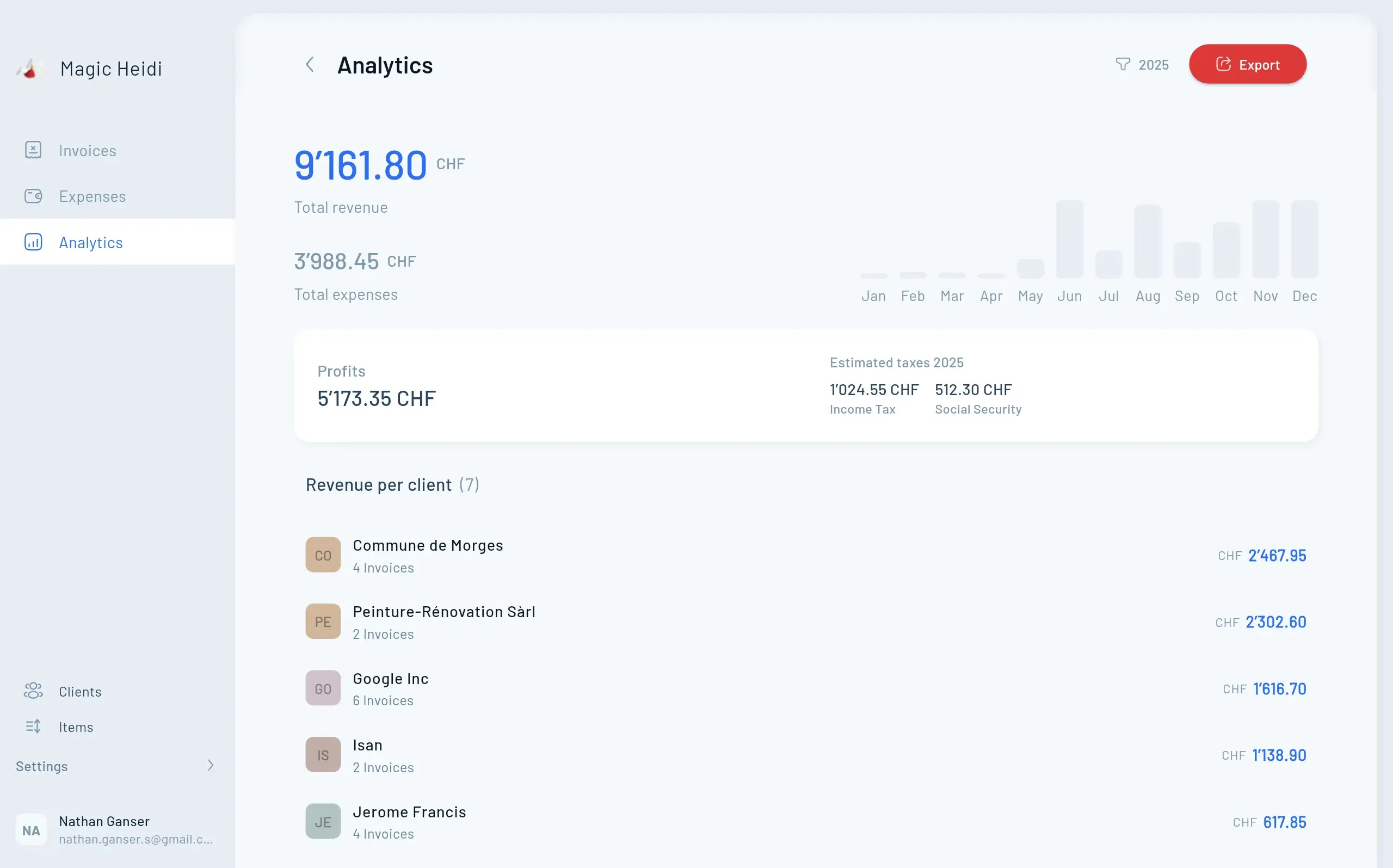
This is the standard approach. You track VAT on everything: collect VAT on every sale (output tax), track VAT on every business purchase (input tax), and pay the difference.
Effective Method Example
You invoice CHF 108,100 including 8.1% VAT. Your output tax is CHF 8,100.
You spent CHF 32,430 on business supplies including VAT. Your input tax is CHF 2,430.
VAT due: CHF 8,100 - CHF 2,430 = CHF 5,670
Best for:
- Businesses with significant deductible expenses
- Companies with complex supply chains
- Exporters who benefit from input tax recovery
- Any business above the TDFN thresholds
Net Tax Rate Method: TDFN Simplified
This simplified approach uses a flat percentage based on your industry. No tracking input tax on purchases—apply your industry-specific rate to total turnover and pay that amount.

TDFN Example
An architect with TDFN rate of 6.2% earns CHF 400,000 (including VAT) per semester.
VAT due: CHF 400,000 × 6.2% = CHF 24,800
That's it. No need to track VAT on office supplies, software, or equipment.
Eligibility Requirements (2025)
- Annual taxable turnover: Maximum CHF 5.024 million
- Annual VAT liability: Maximum CHF 108,000
- Swiss-based business (foreign companies lost TDFN access in 2025)
Sample TDFN Rates by Industry
| Industry | Rate |
|---|---|
| Food delivery services | 0.1% |
| Travel agencies | 2.1% |
| Sports equipment rental | 3.0% |
| Marketing services | 5.9% |
| Architects | 6.2% |
| Translation agencies | 6.8% |
What Changed in 2025:
Key LTVA Updates
The January 2025 revision brought significant changes that affect how you manage VAT.
New Annual Declaration Option
Businesses under CHF 5.005 million turnover can now request annual declarations. One submission per year instead of four or two.
- Less paperwork
- Fewer deadlines
- Reduced administrative burden
- Request through AFC e-portal
Multiple TDFN Rates Allowed
Businesses must now apply the appropriate TDFN rate to any activity representing more than 10% of total taxable turnover.
- No cap on number of rates
- Apply rate per activity type
- More accurate calculations
- Reflects true business mix
Easier Method Switching
Previously required a 3-year waiting period. Now you can switch methods at the start of any new calendar year.
- Switch at any January 1
- No waiting period
- Submit before year end
- AFC confirms eligibility
Mandatory Electronic Filing
All VAT registration and declarations must go through the Federal Tax Administration's e-portal. Paper forms are no longer accepted.
- Register online only
- Submit declarations digitally
- Receive confirmations electronically
- Foreign companies excluded from TDFN
Agreed vs. Received Consideration
Within each calculation method, you choose when to report VAT. This affects your cash flow significantly.
Agreed Consideration
Invoice-Based: Report VAT when invoices are issued—regardless of payment status. You pay VAT before receiving payment.
Received Consideration
Payment-Based: Report VAT when money actually changes hands. Better cash flow, especially with slow-paying clients.
Agreed Consideration (Invoice-Based)
Scenario: You send a CHF 10,810 invoice on March 15. Your quarterly declaration covering January-March includes that CHF 810 output tax. Even if the client pays on May 20.
✅ Matches standard debtor-creditor accounting ✅ Required for most medium and large businesses
❌ You pay VAT before receiving payment ❌ Bad debts require adjustments after the fact
Received Consideration (Payment-Based)
Scenario: Same CHF 10,810 invoice sent March 15. Client pays May 20. That VAT appears in your Q2 declaration, not Q1.
✅ Pay VAT only on money you've received ✅ No adjustment needed for bad debts ✅ Better cash flow management
Best for: Small businesses without formal accounts receivable systems. Freelancers and sole proprietors.
Which Method Fits Your Business?
Use this comparison to guide your choice between the Effective Method and TDFN.
| Criteria | Effective Method | TDFN Method |
|---|---|---|
| Best for expenses | ✓ High expenses (30%+ of revenue) | ✓ Minimal expenses |
| Complexity | More tracking required | ✓ Simpler calculation |
| Exporters | ✓ Input tax recovery benefits | ✗ No recovery |
| Turnover limit | ✓ No limit | Max CHF 5.024 million |
| VAT liability limit | ✓ No limit | Max CHF 108,000 |
| Foreign companies | ✓ Allowed | ✗ Not allowed (2025) |
Same Business, Different Methods
Let's compare: Marketing consultant with CHF 200,000 annual revenue and CHF 30,000 business expenses (both including VAT).

Effective Method Calculation
- Revenue: CHF 200,000 ÷ 1.081 = CHF 185,013 net
- Output VAT: CHF 14,987
- Expenses: CHF 30,000 ÷ 1.081 = CHF 27,752 net
- Input VAT: CHF 2,248
- VAT due: CHF 14,987 - CHF 2,248 = CHF 12,739
TDFN Calculation (5.9% rate for marketing)
- Revenue × rate: CHF 200,000 × 5.9% = CHF 11,800
Result: TDFN saves CHF 939 annually in this scenario.
⚠️ But reverse the numbers—CHF 200,000 revenue, CHF 80,000 expenses—and the effective method wins by a significant margin. Always run the numbers for your specific situation.
Key Deadlines You Can't Miss
VAT declarations and payments are due within 60 days after each period ends. Miss the deadline? Interest charges begin immediately.
Q1 Deadline
Period ends March 31 → Due May 30
Q2 Deadline
Period ends June 30 → Due August 29
Semi-Annual H1
Period ends June 30 → Due August 29
Annual
Period ends Dec 31 → Due March 1
Common Mistakes to Avoid
These errors cost Swiss businesses time and money every year. Make sure you're not making them.
Not Running the Numbers
Choosing TDFN without calculating effective method costs firstWrong Consideration Method
Using agreed consideration with unreliable, late-paying clientsMissing the 60-Day Rule
Interest charges accumulate quickly—set calendar remindersHow to Switch Methods
Under the 2025 rules, switching is simpler:
- Timing: Submit your request before the new calendar year begins
- Where: Through the AFC e-portal
- Processing: AFC reviews and confirms eligibility
- Start date: Changes take effect January 1
For TDFN applications, you'll typically need 3 years of operating history under the effective method—unless your professional association already has approved sector rates.
Simplify VAT Management with the Right Tools
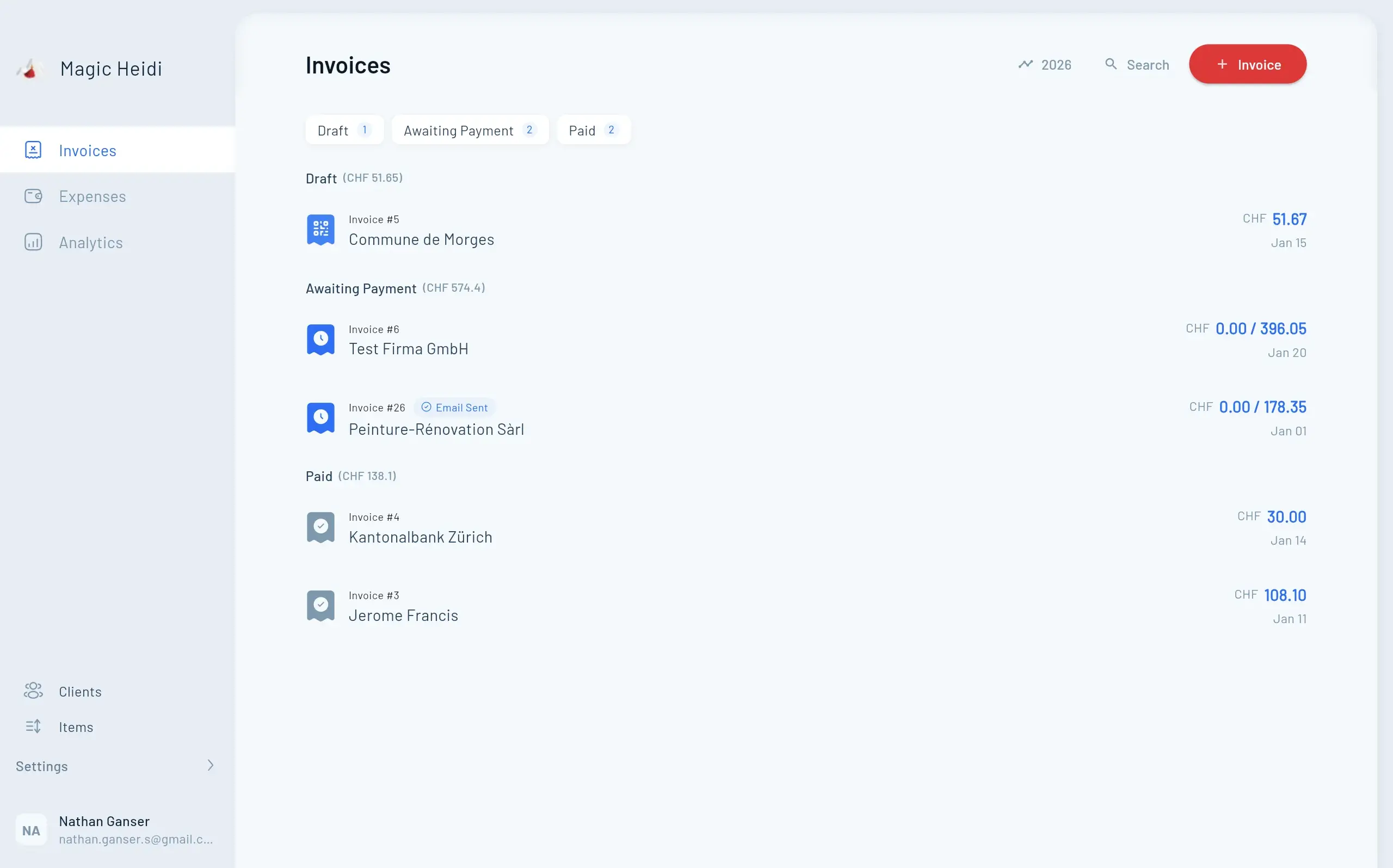
VAT compliance has real costs—even when the math works out to zero. Every invoice tracked, every declaration filed, every deadline monitored takes time. Magic Heidi automates VAT calculations, tracks deadlines, and generates compliant declarations.
Frequently Asked Questions
Can I voluntarily register for VAT below CHF 100,000 turnover?
Yes. Voluntary registration lets you recover input VAT on business purchases. Useful if you have significant startup costs or B2B clients who prefer VAT-registered suppliers.
What if I exceed the TDFN thresholds mid-year?
You must switch to the effective method at the start of the following calendar year. The AFC monitors this.
Do I show the TDFN rate on my invoices?
No. Always show the legal rate (8.1%, 2.6%, or 3.8%) on invoices. The TDFN rate is only for your internal calculation.
How long must I keep VAT records?
10 years from the end of the fiscal year they relate to.
Can I use different methods for different business activities?
No. You choose one calculation method (effective or TDFN) for the entire business. But with TDFN, different activities may use different sector rates.
Focus on Your Business, Not Your VAT Paperwork
Whether you use the effective method or TDFN, agreed or received consideration, Magic Heidi handles the complexity automatically.