 Magic Heidi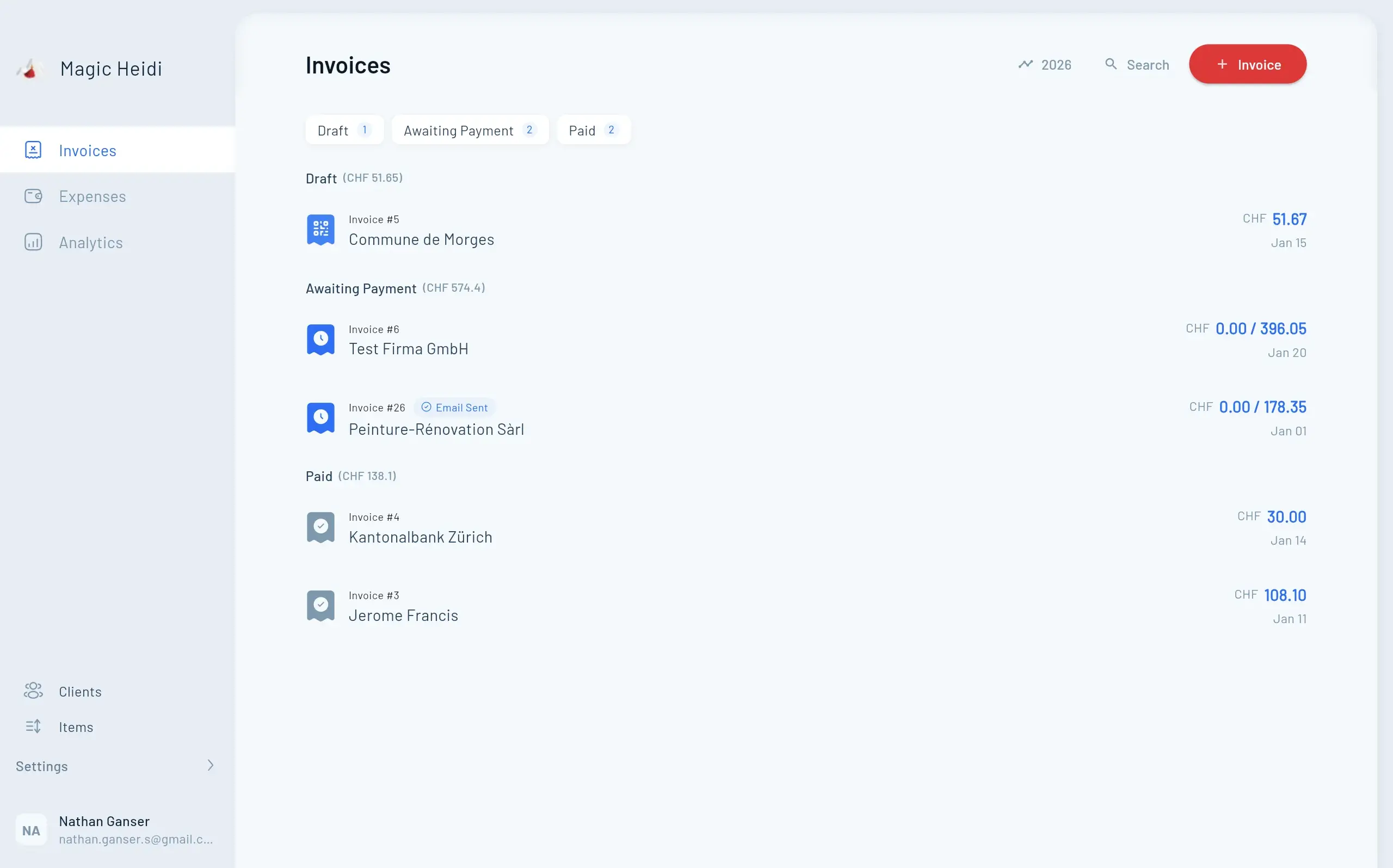
Gift Vouchers in Switzerland: Validity, VAT and Limitation Explained
Gift voucher validity in Switzerland: no legal expiry date, claims time-barred after 10 years, VAT due on redemption — explained briefly. Try Magic Heidi.

Founder of Magic Heidi
How long is a gift voucher valid? And can a hairdresser simply declare it "expired"? Voucher validity is a topic in Switzerland that regularly leaves customers and business owners puzzled — because everything is half as strictly regulated as you might think. The most important point first: there is no federal law that imposes an expiry date on your vouchers. A voucher is a simple receivable, and under Art. 127 of the Swiss Code of Obligations (OR) it only becomes time-barred after ten years. You may still set a shorter validity — but only if the customer learns about it at the time of purchase.
In this article you will learn what the law actually says, which validity periods are common in practice, when VAT (MWST, the Swiss VAT at an 8.1% standard rate) is due, and how to issue, redeem and manage vouchers cleanly in your business — with CHF examples for hairdressers, beauty studios, physiotherapists and personal trainers.
The essentials at a glance
- No Swiss law forces an expiry date onto gift vouchers. Without a set term, the voucher is valid until the claim becomes time-barred after 10 years (Art. 127 OR).
- In practice, 2 to 5 years of validity are the norm — the Swiss Retail Federation recommends 3 years. The customer must clearly be aware of the term at the time of purchase.
- Full-value voucher (CHF 100.00 sold for CHF 100.00): no VAT at the point of sale. The 8.1% only applies when the voucher is redeemed.
- Discounted voucher (CHF 100.00 sold for CHF 80.00): immediately taxable. VAT on CHF 80.00 at the time of sale; on redemption, the missing CHF 20.00 are taxed subsequently.
- Remaining balance stays a credit note or residual value on the voucher. You only have to pay it out in cash if you have promised to do so.
What the law really says: no expiry date, but limitation
A gift voucher is simply the accounting form of a plain fact: the customer pays today, you deliver later. Legally, this creates an unconditional receivable for the voucher holder against your business — they can demand the service at any time, and you have already pocketed the money.
Now comes the part that surprises many: in Switzerland there is no federal law that puts an expiry date on gift vouchers. Unlike in the EU, where many countries prescribe minimum validity periods, the legislator here stays silent. A voucher with no term printed on it remains valid until the claim becomes time-barred — and under Art. 127 OR that takes ten years.
The distinction between expiry and limitation matters:
- Expiry date: a contractually agreed term. You may set one — but it only holds if the customer is clearly informed at the time of purchase, for example through the print on the voucher or via your terms and conditions.
- Limitation: the statutory maximum period. After ten years, your business may refuse the service even without an expiry date. The holder can no longer enforce their claim.
If no validity is stated on the voucher or in your terms and conditions, the ten-year limitation period runs. That does not mean you must redeem vouchers for ten years without any recourse — but without a communicated term, you hold a weak hand if you want to refuse a redemption.
One special case on the side: if you give vouchers away for free, say as a promotional gift to regular customers, this is a gift (Schenkung). For the promise to be binding, the written form is required (Art. 469 OR). So write down what you gift to whom — before you announce it.
You can find the wording of the Code of Obligations at fedlex.admin.ch. Status: October 2026.
Voucher validity in practice: 2 to 5 years are the norm
Because the law stays silent, a convention has emerged: retailers and service providers set validity periods of 2 to 5 years. The Swiss Retail Federation recommends three years to its members — long enough that the recipient does not feel rushed, short enough that the administration stays manageable.
Large retailers often continue to accept expired vouchers as a gesture of goodwill. Some charge a small surcharge because the original purchase price would now be below the face value — most simply redeem them without a word. For small businesses, that is a strong argument for generosity: the marginal cost of a haircut is low, while the reputational damage of a turned-away customer is not.
For a term to hold, state it in three places:
- Printed on the voucher. The clearest signal: "Valid until 31.12.2028" or "Valid for 3 years from the date of purchase". The period variant is more honest, because a fixed date cannot be "overlooked" as easily.
- In your terms and conditions. In business with companies, the usual reference is sufficient. With private customers, the terms should genuinely be part of the purchase — a clause the customer has never seen holds poorly.
- At the point of sale. A verbal note alone rarely suffices as the sole legal proof. But it builds trust and prevents the discussion when the voucher lands at the till two years later.
You can find consumer information on gift vouchers and their validity at konsum.admin.ch. Whether your voucher clauses are cleanly worded is best checked by your accountant in case of doubt — that costs less than a dispute at the till.
VAT on vouchers: when a voucher becomes taxable
This is where it gets truly relevant for many businesses, because VAT practice distinguishes two voucher types — and their treatment is fundamentally different. The decisive reference is the practice of the ESTV (Swiss Federal Tax Administration); the details are available at estv.admin.ch.
Full-value voucher: no VAT at the point of sale
If you sell a voucher at face value — CHF 100.00 sold for CHF 100.00 — there is no supply and no service for tax purposes. The sale is a pure prepayment: the customer gives you money, and you still owe them everything. In your VAT return for that month, the following happens: nothing.
The tax only arises upon redemption. If the customer redeems the voucher for a service of CHF 100.00, you declare those CHF 100.00 with 8.1% — that is VAT of CHF 8.10 — in the reporting period of the redemption. For supplies subject to the reduced rate, the 2.6% rate applies instead.
Discounted voucher: VAT in two steps
If you sell a voucher with a CHF 100.00 face value for CHF 80.00 — say as an Easter promotion — a taxable service arises at the point of sale: you declare the paid price of CHF 80.00 with 8.1%, that is CHF 6.48, already in the month of sale.
Upon redemption, only the excess portion is taxed subsequently: the difference between face value and purchase price, i.e. CHF 20.00 — again 8.1%, that is CHF 1.62. In total you have declared CHF 8.10, exactly as with the full-value voucher. Only the timing is spread over two stages.
| Full-value (CHF 100.00 for CHF 100.00) | Discounted (CHF 100.00 for CHF 80.00) | |
|---|---|---|
| VAT at the point of sale | none | 8.1% on CHF 80.00 = CHF 6.48 |
| VAT on redemption | 8.1% on CHF 100.00 = CHF 8.10 | 8.1% on CHF 20.00 = CHF 1.62 |
| Total | CHF 8.10 | CHF 8.10 |
If you are not liable to VAT — annual revenue below CHF 100,000, no voluntary registration — none of this concerns you: you do not charge VAT and simply bill your prices. You can read the basics in the guide to VAT for freelancers.
Mini-story: Sonia, beauty studio in Zug
Sonia sells 120 vouchers with a CHF 100.00 face value for CHF 80.00 each at Easter. Business is booming — until her accountant asks in April why no tax on the voucher sales was booked in the VAT return. The promotion was, after all, discounted: CHF 9,600.00 in revenue (120 × CHF 80.00), plus CHF 777.60 VAT on top — due already in the second quarter. Sonia books it retroactively, and for the redemptions over the course of the year she declares the excess CHF 20.00 per receipt. The ESTV never objected to anything — but Sonia learned her lesson: promotional vouchers are not a prepayment, they are immediately taxable. How to disclose such special cases cleanly on studio invoices is covered in the guide to the invoice for your beauty studio.
Issuing a voucher correctly: mandatory details and the QR-bill
A voucher is a marketing tool and a legal document at once. The receipt should carry these details:
- Voucher number — sequential, so you can assign every voucher unambiguously in your records.
- Date of issue — for vouchers with a validity period, the validity starts here.
- Face value in CHF — for example CHF 100.00. Write amounts with a thousands separator and centimes: CHF 1,000.00, never "1000".
- Validity — if you set one: as a date ("valid until 31.12.2028") or as a period ("valid for 3 years from the date of issue"). A voucher without a validity statement is valid for ten years — protect yourself if that is not what you want.
- Redemption conditions — partial redemption allowed? Does the remaining balance stay on the voucher? No cash payout? The clearer, the less discussion.
- Your name and address — for a sole proprietorship exactly as it also appears on your invoices.
For the sale itself, you issue a simple sales receipt — for a full-value voucher not a VAT invoice, but a receipt with these lines:
- Voucher sale no. 2026-031, date: 12.11.2026
- Gift voucher no. G-1042, face value CHF 100.00
- "VAT will be declared upon redemption of the voucher"
- Payable by QR-bill (QR-Rechnung), reference number in the payment part
The QR-bill payment part is especially worthwhile when companies buy — say an employer ordering ten vouchers of CHF 100.00 each for the team. In that case you want a clean receipt with QR-IBAN and reference number, so the payment is assigned to your bookkeeping automatically.
If you also issue regular invoices with VAT, the mandatory details of Art. 26 MWSTV (Swiss VAT Ordinance) apply: name and address, invoice date, sequential number, nature and scope of the service, consideration, VAT rate and VAT amount. A clean invoice template takes care of the basic structure for you — voucher sales and redemptions are derived from it.
Record free promotional vouchers in writing so the promise is binding (Art. 469 OR). An entry in your voucher register is sufficient.
Redeeming: remaining balance, credit note and amounts that exceed the voucher
The customer places the voucher on the counter. Three scenarios can occur:
Scenario 1: The purchase exceeds the voucher value. The visit costs CHF 130.00, the voucher covers CHF 100.00. The customer pays the difference of CHF 30.00 — and VAT applies to the total amount. With a full-value voucher at 8.1%, you declare CHF 130.00, that is VAT of CHF 10.53. The voucher is fully used up and leaves your register.
Scenario 2: The purchase is smaller than the voucher value. The treatment costs CHF 60.00, the voucher is worth CHF 100.00. Two clean options:
- The remaining balance stays on the voucher. You note the new residual value of CHF 40.00 — handwritten with date and initials, or as a newly issued residual voucher. This is the most customer-friendly option and the usual one for gift vouchers.
- You issue a credit note (Gutschrift). The credit note for CHF 40.00 is a clean receipt with which the customer offsets the next service or an item. This fits well if you work with physical vouchers that you want to document individually.
Scenario 3: Part paid, part open. A combination of both — the same mechanism.
The redemption receipt should carry the note "Paid with voucher no. G-1042", plus date and residual value. That way every eye — yours, your accountant's, the ESTV's — can trace which voucher led to which revenue.
You do not have to offer a cash payout of the remaining balance — unless you have promised one. The clause "Remaining balance remains as a credit note, no cash payout" is common and permissible. Put this in writing before the customer walks in for the first time, not at the till.
Expired vouchers: goodwill instead of obligation
The classic scene: a customer stands at your door with a voucher that expired last week. Do you still have to redeem it? The short answer depends on how the term came about:
- Term validly agreed and communicated? Then you may refuse. The term was part of the deal, the customer bought into it at the time of purchase.
- Term never communicated? Then the clause does not hold — the voucher is valid until the claim becomes time-barred after ten years.
- Ten years passed? The claim is time-barred: you may refuse the service, and the holder can no longer do anything about it.
In practice, goodwill almost always pays off.
Mini-story: Bruno, hairdresser in Bern
Bruno runs his hairdressing business as a sole proprietorship and sells around 60 vouchers of CHF 100.00 each before Christmas — printed with a two-year validity. In January of the following year, a customer stands at his door with a voucher that expired three weeks earlier.
Bruno could refuse; the term is printed on the voucher. He redeems it anyway. The haircut costs him about an hour of working time — the money for it landed in his account long ago. The customer is so delighted that she immediately books a colour treatment for CHF 85.00 on top, paid in cash including VAT. She has come back every six weeks since. A refused voucher would never have brought her through the door again.
Lesson: The voucher is paid for before it is redeemed. Goodwill costs you only the marginal cost of your service — and buys you customer loyalty that you would otherwise have to advertise expensively. How to bill such receipts cleanly in a hairdresser's daily routine is shown in the guide to the hairdresser invoice.
Managing vouchers in your business
For service businesses — hairdressing, beauty, physiotherapy, personal training — vouchers are a cash flow instrument: money in December, services spread over the year. That smooths out the quiet months. But you now owe something, and that needs managing:
- Track your open voucher liabilities. Every voucher sold is a liability: money received, service still outstanding. Without a list, come autumn you no longer know how many francs' worth of services you still owe.
- Keep expiry dates in view. Note the expiry date in your register and actively remind customers before it passes. A short email saves goodwill instead of spending it.
- Revenue is revenue. Voucher sales count towards your annual revenue — relevant for AHV contributions, for taxes and for VAT liability from CHF 100,000. The money is not freely earned just because the service is still outstanding.
- Factor in no-show risk. For appointments paid with vouchers, the same applies as for prepayments: whoever does not show up has missed the service. Communicate your cancellation rule before the first appointment.
Mini-story: Fabian, personal trainer in Basel
Fabian sells twelve ten-session packages as vouchers in December, at CHF 120.00 each — a total of CHF 1,440.00. The January cash flow is delightful. The problem: by the end of March, only vouchers worth CHF 480.00 have been redeemed; the rest floats as an open liability over his calendar. One client moves to Zurich — with CHF 180.00 in remaining balance. Fabian's terms and conditions state that remaining balances stay as a credit note on the voucher and are not paid out in cash. The client accepts — which is exactly why this clause belongs in your terms before you sell, not in the dispute afterwards.
Fabian's system is a simple list: number, buyer, value, purchase date, expiry date, status. Excel is enough for that. Anyone already using invoicing software records voucher sales as open items and settles them with one click upon redemption — with the Magic Heidi invoicing module this runs in the same workflow as any other invoice.
Conclusion: vouchers are simple if you keep them simple
Gift voucher validity in Switzerland is not a legal minefield — it is a management question. Remember three things:
- Without a communicated term, the voucher is valid for ten years (Art. 127 OR). If you want it shorter, the validity goes on the voucher and into your terms and conditions.
- Full-value vouchers are VAT-neutral at the point of sale, discounted ones are immediately taxable. Selling CHF 100.00 for CHF 80.00 spreads the tax over two stages — plan for that in your accounting.
- The remaining balance stays as a credit note or residual value. Cash payout only if you promised it.
And if an expired voucher lands at your till: the customer has already paid for it. Goodwill costs you almost nothing — and brings customers back.
Magic Heidi takes the paperwork off your hands: record voucher sales as open items, settle redemptions with one click, QR-bill included — from CHF 25 per month, well below what bexio and the like cost. The pricing is transparent, and getting started works without a credit card. Start invoicing with Magic Heidi now →