 Magic Heidi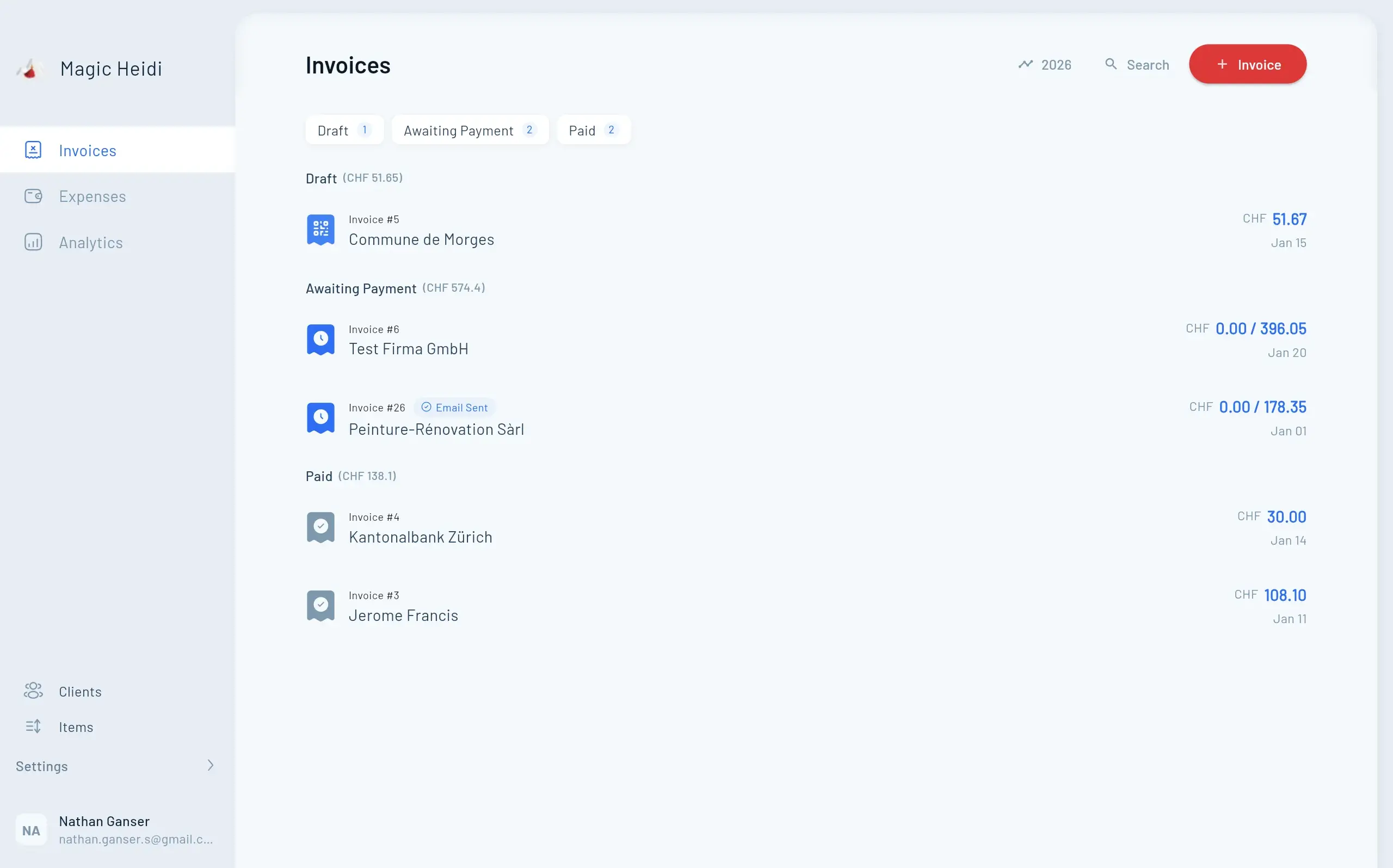
Erwerbsersatz (EO) in Switzerland 2026 | Magic Heidi
Erwerbsersatz (EO) 2026: 80% of your income, min. CHF 69/day plus CHF 75 business allowance. How the self-employed claim it.

Founder of Magic Heidi
As a self-employed person in Switzerland, you receive Erwerbsersatz (EO — loss-of-income compensation) for military service, civilian service or civil protection duty: 80% of your average income before the service, at least CHF 69.00 per day, plus your Sold (military pay) — and for the self-employed, a Betriebszulage (business allowance) of currently CHF 75.00 per day. The body responsible is the Erwerbsersatzordnung (EO, the income replacement scheme) — the same office that also pays the maternity allowance. The catch for freelancers: nobody fills in the forms for you. As an employee, your employer submits the application. As a self-employed person, the Meldekarte (reporting card) lands on your desk — and if you leave it lying there, the fund stays silent.
How to claim income replacement as a self-employed person, how your daily allowance is calculated, and what you need to record in your bookkeeping so that no franc is left behind — this guide explains it step by step. With concrete CHF examples, mini-stories from typical freelancer situations, and an FAQ answering the most common questions.
The key points at a glance
- Income replacement for service days: 80% of your income before the service, at least CHF 69.00 per day, CHF 124.00 with children
- Capped at CHF 220.00 per day — your Sold (military pay) comes on top
- The self-employed also receive a business allowance of currently CHF 75.00 per day for ongoing fixed costs
- It is all financed by contributions: as a self-employed person you pay AHV, IV and EO contributions totalling 10.6% of your income
- The application runs via the reporting card (Meldekarte) to your own compensation fund — no application, no money
What is the Erwerbsersatzordnung (EO)?
The Erwerbsersatzordnung (EO, income replacement scheme) is one of Switzerland's oldest social insurance schemes: the Erwerbsersatzgesetz (EOG, the Income Replacement Act) of 25 September 1952 has been in force for over 70 years. The idea behind it is simple. Anyone who performs service for Switzerland should not be financially worse off. The state obliges you to serve — in the military, in civilian service or in civil protection — and the EO replaces the earned income you miss out on during that time.
The EO does not only pay for military service. Income replacement is available for:
- Military service — from recruit school to the Wiederholungskurs (WK, refresher course)
- Civilian service — assignments and courses count the same as military service
- Civil protection service — service days and courses
- Red Cross service — for example for medical personnel
- Youth and Sport (J+S) courses — for persons in a leadership role, for example as a J+S instructor of children's courses
The EO is financed through the AHV/IV/EO contributions that everyone pays: employees, employers, the self-employed and people who are not gainfully employed. You pay into a common pot with your contributions — and when you yourself perform service, your income replacement comes out of that pot. How the Federal Social Insurance Office organises the EO is clearly explained on bsv.admin.ch.
For you as a self-employed person, the EO matters more than for employees — because it also pays benefits that have nothing to do with service: the maternity allowance also runs through the EO. Anyone who understands the EO understands a good chunk of the Swiss social insurance system. The legal basis, the EOG with the number SR 834.1, can be read on fedlex.admin.ch.
How much income replacement do you get as a self-employed person?
Income replacement amounts to 80% of your average earned income before the service. The minimum is CHF 69.00 per day — if you have children entitled to child allowances, it is at least CHF 124.00 per day. At the top end, the daily allowance is capped at CHF 220.00 per day. This is the official rule from fact sheet 6.01 "Erwerbsersatz" of the compensation funds (Ausgleichskassen), which you can find on ahv-iv.ch — the same reference your fund works with.
For the self-employed, the rule of thumb is the same formula that is used for the maternity allowance:
Daily allowance = AHV-relevant annual income × 0.8 ÷ 360
The basis is therefore your last AHV-relevant income — the income you declared to your Ausgleichskasse (compensation fund), not your revenue. What exactly counts as AHV-relevant income and what you may deduct depends on your legal form — more on this in the guide to the Einzelfirma (sole proprietorship) in Switzerland. The fund checks your figures; if in doubt it will ask for your latest AHV statement or tax return.
Here is what the calculation looks like for three typical income levels:
| AHV-relevant annual income | Daily allowance without children | Daily allowance with children |
|---|---|---|
| CHF 30,000 | CHF 69.00 (minimum; mathematically CHF 66.65) | CHF 124.00 (minimum) |
| CHF 60,000 | CHF 133.35 | CHF 133.35 |
| CHF 99,000 and more | CHF 220.00 (maximum) | CHF 220.00 (maximum) |
What about irregular income? Exactly the question that comes up most often for the self-employed. The fund works from your average income before the service — if your years fluctuate strongly, it examines several tax periods. If you only became self-employed shortly before recruit school and have not yet declared any AHV-relevant income, you get at least the minimum daily allowance of CHF 69.00; how the fund calculates this in detail depends on the canton and your situation — check this with your compensation fund before the service. Better than any rule of thumb: before you report for duty, work out once how much daily allowance you can expect, and plan your cash flow for the service weeks that follow.
And now the most important point that many people don't know: the Sold (military pay) comes on top. Income replacement and military pay (which you receive as a member of the armed forces or as a civilian service member) are not offset against each other — you get both. The amount of military pay depends on your rank and marital status. Income replacement follows your income; military pay follows your rank. Together, the two make up your total income during the service.
A mini-story to remember: Marco, a photographer from Lucerne. His AHV-relevant income in the year before his WK was CHF 96,000 — spread over roughly 250 working days, he bills about CHF 384.00 per working day. But the EO does not calculate with his day rate, it uses the formula: CHF 96,000 × 0.8 ÷ 360 = CHF 213.35 per day. For his 18 days of refresher course he receives around CHF 3,840.00 in income replacement — plus military pay and the business allowance, which we'll get to shortly. You don't get richer during service — but you don't have to pay for it either.
Business allowance and childcare allowance: what the self-employed get on top
Here comes the part that is specifically interesting for the self-employed — and that many don't know. In addition to income replacement, self-employed people can receive a Betriebszulage (business allowance). It compensates for the ongoing costs that keep running while you yourself are on service: rent for your office or workshop, subscriptions, insurance, machinery leases. It is currently CHF 75.00 per day. Important: the amount is adjusted regularly — check the current figure directly with your compensation fund before you plan with it.
A mini-story to remember: Reto, a carpenter from the Emmental. His workshop costs him around CHF 2,400.00 a month in fixed costs — rent, machine maintenance, liability insurance. For a two-week civil protection assignment that makes CHF 900.00 of business allowance (12 days × CHF 75.00). The workshop keeps running, the machines stay insured, the rent doesn't pay itself. The business allowance exists precisely for this gap. Reto's conclusion: "Without the allowance, I could hardly have justified the assignment."
On top of that there is the childcare allowance (Betreuungszulage). It goes to parents whose children under 12 cannot be looked after otherwise during the service — for example because the partner is working and the usual childcare falls away. The childcare allowance is applied for together with the income replacement and paid out by the same office. The details for military, Youth and Sport, and civilian service are explained by the Federal Compensation Office (EAK) in its fact sheets. Here too: your fund will tell you the current amount.
Remember the order: first the daily allowance (80% of your income, at least CHF 69.00, CHF 124.00 with children), then the business allowance (currently CHF 75.00 per day), then military pay. Three items you should check individually when you apply.
How to claim income replacement step by step
The application is the step where the self-employed make mistakes most often — mainly because nobody reminds you. Here is the process in four steps:
Step 1: Wait for the Meldekarte (reporting card) and check it. After you report for duty, the responsible service office sends you a reporting card — in the military usually via your support location, in civilian service via the responsible competence centre. This reporting card is the trigger for everything that follows. No reporting card, no payout: if no application is submitted, the fund simply stays silent. There is no automatic system that finds you on its own.
Step 2: Fill in the application form of your compensation fund. As a self-employed person, you submit the application to your own AHV compensation fund (Ausgleichskasse) — the fund where you pay your AHV contributions. Not your health insurer, not your employer's fund. Even if you are employed on the side: for your self-employed activity you always submit the application yourself, the employer only takes care of the employed part. Both incomes flow into the calculation. This is a peculiarity that surprises even experienced freelancers.
Step 3: Attach the documents. These include the reporting card, your AHV number and usually proof of your income — for example your latest AHV statement or your tax return. Tip: before filling in the application, check that your last AHV invoice has been paid. Outstanding contribution arrears delay the review unnecessarily.
Step 4: Meet the deadline. As a rule you must submit the application within 30 days — the exact deadline is printed on your reporting card, so check it there and not somewhere on the internet. Late applications can mean that individual daily allowances are forfeited. Submit the form as soon as you receive the reporting card — in the rhythm of a refresher course that means: report for duty, wait for the reporting card, submit immediately, get on with your life.
A mini-story to remember: Tim, a web designer from Basel. After a three-week refresher course, he left the reporting card lying in his inbox for two months — business was booming, customers weren't waiting. The payout came only after a considerable delay, and Tim had to chase the fund several times. His conclusion: "Two hours of effort I should have put in right after being discharged. Instead I spent months phoning the fund." Remember: the effort is small, the consequences of a delay are not.
Income replacement and your bookkeeping: what you need to record
Income replacement is money like any other — with two peculiarities you should know, otherwise the numbers will surprise you in January.
First: income replacement and military pay are taxable income. You declare both in your tax return like other earned income. So don't count on the full gross amount — set aside a reserve for taxes. Military pay is taxable as well — however modest it looks, it belongs in the tax form.
Second: AHV/IV/EO contributions are deducted at source. The compensation fund deducts the contributions directly from the daily allowance — so you receive a net payout. The income replacement you receive flows into your annual AHV statement and counts as a contribution period for your pension. That is not a disadvantage: your service years leave no contribution gap in your AHV — which is worth its weight in gold especially for the self-employed with fluctuating income.
What you need for your bookkeeping in concrete terms: a clean separation between income before the service, daily allowance payments from the EO, and any invoices you could (or could not) issue during the service. Keep your income and expenses in one place — that's exactly what a lean invoice and income tracker like Magic Heidi is for. That way you can see at a glance what was in the till during the WK — and what you need to report to the fund and the tax office.
An honest note: income replacement only pays for service days. If you fall ill outside of service and cannot work, the EO does not step in. For that you need daily sickness benefit insurance, which ideally you take out before you need it. Anyone who has ever had a longer period out knows why.
If you are not liable for service
Maybe you're reading this and thinking: "I'm not even liable for service — why does this matter?" In short: because you still pay.
Women without service obligation, people discharged from service and everyone who does not serve for other reasons still pay EO contributions — for the self-employed, together with AHV and IV, at 10.6% of AHV-relevant income. The EO is a solidarity-financed insurance, not an individual accounting by service days. In return, even people not liable for service benefit from it: the mother through the maternity allowance, the father through paternity leave, the part-time self-employed through every voluntarily performed service.
Wehrpflichtersatz (military service exemption tax): anyone who has been discharged or exempted from service instead pays the Wehrpflichtersatz — an annual levy, also collected via the compensation fund. It flows into the same pot and helps finance the EO.
Voluntary military service: since 2024, people without a legal service obligation can also serve voluntarily — and thereby acquire an entitlement to income replacement. So if you want to serve out of interest or for personal development, the EO is open to you like anyone else. The condition: you register for the service as described, and the reporting card also applies to voluntary service members.
By the way, people who are not gainfully employed also pay EO contributions — for example via their AHV contributions as students or during a sabbatical. How these contributions work is explained in our article on AHV contributions for non-employed persons.
Frequently asked questions about income replacement for the self-employed
Do I have to do anything as a self-employed person to get EO income replacement?
Yes. The compensation fund does not pay on its own. You submit the reporting card from your service unit together with the application form to your own AHV compensation fund — even if you are also employed. Without an application there is no payout.
How much income replacement do I get per day?
80% of your average income before the service, at least CHF 69.00 per day — with children at least CHF 124.00 — and at most CHF 220.00 per day. Rule of thumb for the self-employed: annual income × 0.8 ÷ 360 gives your daily allowance. Military pay and the business allowance of currently CHF 75.00 per day come on top.
By when do I have to submit the reporting card?
As a rule within 30 days — the specific deadline is printed on your reporting card, so check it there. Late applications can lead to daily allowances being forfeited. Ideally you submit the form as soon as you receive the reporting card.
Do I have to pay taxes and AHV on the income replacement?
Yes. Income replacement and military pay are taxable income and belong in your tax return. AHV/IV/EO contributions are deducted directly from the daily allowance and the benefit flows into your annual AHV statement — your service time therefore leaves no contribution gap.
What happens if I work during my service anyway?
The daily allowance can be reduced or cancelled for the days in question. Income replacement replaces income you cannot earn because of the service — if you work anyway, the reason for those days falls away. If in doubt, contact your compensation fund before accepting an assignment during your service.
Do I get income replacement as a civilian service member or in civil protection too?
Yes. Civilian service, civil protection, Red Cross service and led Youth and Sport courses are treated the same as military service: 80% of income, at least CHF 69.00 per day (CHF 124.00 with children), at most CHF 220.00. Here too, the application runs via the reporting card to your compensation fund.