Entertainment Expenses Deductible in Switzerland
Entertainment expenses deductible in Switzerland: learn when business meals can be claimed as a tax deduction and how to document your receipts properly.
Founder of Magic Heidi
You come back from lunch with a potential client, drop the restaurant receipt on your desk and ask yourself: Can I book this as a deductible entertainment expense, and do I get the VAT back as well? This is exactly where many freelancers and sole proprietorships stumble, because the receipt is there but the tax classification is missing. In practice, what matters is not the meal itself, but why it happened, who was there and how cleanly you document the occasion. If you have these three points under control, you save yourself trouble with your tax return and with input VAT later on.
In Switzerland the question is particularly delicate, because bookkeeping and VAT treatment overlap but are not the same thing. Business entertainment allows different deductions depending on the occasion, and the invoice can still be fully relevant for input VAT. That may look cumbersome at first glance, but it is very manageable in everyday life if you check the rules in the right order. That is exactly what this guide is about, step by step, with examples from a freelancer's day-to-day life and a clear look at the grey areas that generic tax guides often skip.
When a business meal really counts for tax purposes
Luca, a freelance web developer from Zurich, sits on the tram back to the office. Ten minutes ago he had lunch with a potential client, photographed the bill and was already wondering on the way out whether this simply goes under expenses. This is exactly the point where an ordinary restaurant visit turns into a tax question.
The first misconception is often very simple. Not every meal with a professional contact is automatically business-related, and not every business situation automatically leads to a full deduction. What matters is whether the meal had a business purpose and whether it remains clearly identifiable as such in your bookkeeping. For an initial overview, the guide to tax deductions in Switzerland also helps if you want to place entertainment in the overall context of your business expenses.
Practical rule: Without a traceable occasion, even the nicest restaurant receipt is quickly weak from a tax perspective.
For Luca this means concretely: he needs not only the receipt, but also the context. Was it a first meeting, a project discussion or an internal team lunch? The clearer the purpose, the easier the occasion can be classified later. In mixed situations, for example when a colleague and a friend are present at the same time, the distinction becomes immediately more important.
The second question concerns VAT. A receipt can be only partially relevant for income tax purposes and still fully affect input VAT. This very separation causes most of the confusion in everyday life, because many receipts are photographed but not properly described. If you only record the amount, you later lose the tax logic behind the menu.
Business purpose and reasonableness as the cornerstones
The occasion is not a detail, it is the core
Think of a business meal like a tool, not like leisure. A screwdriver is only useful if you know what it was used for, and it is similar with entertainment expenses. The tax authority wants to see that the meal had a business purpose, for example client acquisition, a contract discussion or an internal working session.
Without this connection, a business meal quickly becomes a private expense. That is why the restaurant receipt alone is not enough, even if it looks complete. In practice, what counts is that you note the occasion in a way that lets a third party follow the connection to the business. That is the real test behind the question of whether entertainment expenses are deductible.
Business-related does not mean luxurious or formal. It means traceable within the scope of your activity.
Why reasonableness often only shows on a second look
Besides the occasion, reasonableness plays a major role. A normal business lunch with a client, a meeting and clean documentation is tax-wise something different from a very expensive restaurant visit with no recognisable added value for the business. The question is not whether the meal was nice, but whether it is plausible within the scope of the occasion.
This point is underestimated especially by sole proprietorships and one-person limited companies. Many think of the invoice total first, whereas practice looks first at the business purpose and then at reasonableness. When the venue, the price level and the type of occasion fit together, the position is far more stable. If not, even a tidy receipt only helps to a limited extent.
How to check this in everyday life
Ask yourself three short questions after every meal.
- Why did the meeting take place? Without a clear occasion it gets tricky.
- Who was there? The participants are decisive for the classification.
- Does the setting fit the business? That is the practical reasonableness question.
This way you move the check from year-end straight into everyday life. That not only saves time, it also prevents you from having to guess months later what the occasion actually was. This is exactly where clean bookkeeping separates itself from the pretty collecting of restaurant receipts.

The key deduction rules for the self-employed and sole proprietorships
Full deduction for purely operational entertainment
When the entertainment is purely operational, the classification is simplest. That applies, for example, to an internal team lunch, catering for your own employees or a working appointment with food where no external client is involved. For Swiss practice, it is particularly important to distinguish cleanly between purely internal occasions and entertaining business contacts. For business entertainment, reference practice often works with the 70/30 logic, while purely operational occasions can generally be treated in full. The VAT included in the invoice is deductible as input tax at 100% in both cases. This separation is central for classification in practice, as the German framework also shows for comparison at steuern.de.
For you this means, very practically, that the internal occasion becomes much simpler in bookkeeping as soon as the purpose is clearly operational. An internal training session with catering, a team workshop or a shared meal with employees belong in this category, provided the operational reason remains traceable. The invoice matters, but the real test is then about how you document the occasion and assign it correctly in the accounts.
Partial deductibility with business contacts
As soon as business contacts are sitting at the table, the treatment becomes more nuanced. In German reference practice, such entertainment is typically deducted only at 70%, while 30% remains non-deductible. For Swiss self-employed persons and sole proprietorships this is above all a useful orientation, because many specialist sources use the same separation idea, even if the concrete bookkeeping implementation always depends on the individual case and the state of the receipts. If you want to set up the classification for your own bookkeeping more precisely, you will find a good overview in the practical guide to bookkeeping for sole proprietorships in Switzerland at Magic Heidi.
That does not mean every client meal is tax-sensitive. It only means you have to distinguish cleanly between an internal, operational occasion and an external business meal. Especially for solo entrepreneurs with few but important client meetings, this separation in bookkeeping makes the difference between a well-founded expense and later queries.
Think income tax and VAT separately
This is where the most common misconception lies. Income tax asks whether the expense is business-related and reasonable. VAT asks separately whether the input tax on the receipt is deductible. Both run in parallel but are not identical, and that is exactly why you must not mix them in your bookkeeping.
A receipt can count only partially for income tax and still be fully relevant for input VAT.
For Swiss freelancers this separation is particularly important, because restaurant receipts are often quickly photographed and filed away in everyday life without properly securing the tax trail. Anyone who confuses the input VAT deduction with the income tax deduction ends up booking either too cautiously or too optimistically. Both can be avoided if you classify the receipt into both levels correctly as soon as you record it.
These occasions count in full, these only partially
A business meal is never just a question of the restaurant in bookkeeping terms. What matters is whether the occasion is clearly business-driven, whether private elements interfere and whether you record the allocation cleanly. This is exactly where Swiss practice separates a correctly justified expense from a receipt that triggers queries later.
| Occasion | Typical deduction rate | Key documentation |
|---|---|---|
| Internal team meal | Full | Internal occasion, participants, receipt |
| Client meal with a clear business meeting | Partial, often per reference logic | Business purpose, names, venue, date |
| Lunch during a business trip | Depends on the situation | Travel context, occasion, participants |
| Mixed occasion with clients and team | Split | Participant list, business context per group |
| Meal with family and business partners | Only the business part | Who attended privately, who attended on business |
The table shows the direction but does not replace a clean classification in the individual case. For freelancers and sole proprietorships, what counts is not only what is on the table, but why the occasion takes place. A simple lunch can be fully traceable operationally, whereas an elaborate evening with an unclear function can only be partially justified, or not convincingly at all.
Where the 110-euro threshold helps as a reference value
For company events, German specialist practice often mentions the 110-EUR threshold per participating person as an orientation. If the costs per employee including VAT exceed it, the tax benefit of that category lapses there. For Swiss self-employed persons this is not an automatism, but a reference value that helps you classify your own approach.
The practical benefit remains large nonetheless. You can see from it that the classification depends not only on the price of the menu, but on the type of occasion and the reasoning behind it. A modest meal can be clean for tax purposes; a luxurious occasion without a clear business function quickly becomes vulnerable. The difference rarely lies on the plate, but almost always in the documentation you file with it. A simple expense report template for Switzerland helps you avoid having to gather this information anew every time.
How to think about mixed occasions
With mixed groups you have to mentally separate who is sitting at the table for which reason. Clients, employees, friends and family members do not belong in the same category, even if they eat together on the same evening. As soon as an occasion is partly private, a split is needed, and in a way that remains traceable later.
That may seem strict at first, but in everyday life it is simply clean. You do not write the entire evening into a single drawer; you assign the individual parts correctly. This is exactly how you prevent a basically usable receipt from losing tax quality because of a mixed company.
How to document every occasion cleanly
What must be on the receipt
Specialist sources name three core points you should never skip: business occasion, reasonableness, and proof of amount and operational causation as described in the tax reference on entertainment expenses. In practice this means: the receipt alone is not enough, you always need the short entertainment note to go with it. For bookkeeping, the date, venue, amount, restaurant name and payment method are particularly important.
If you note this on the same day, the error rate drops massively. A clean note is not bureaucracy; it is your memory in written form. Especially with several appointments per week, this is the difference between clean allocation and later guesswork.
- Record date and venue: Without these two details, the temporal and spatial frame is missing.
- Note the participants: Names or at least clearly recognisable roles matter.
- Describe the occasion in one sentence: For example meeting, closing, acquisition or internal team session.
- Add the business connection: One short sentence is enough, as long as it is traceable.
How to deal with difficult receipts
Till receipts without a clear VAT indication are common in everyday life, as are foreign restaurant receipts in EUR or USD. Then it matters all the more that you archive the receipt completely and write the additional information directly with it. For shared bills you should also clearly mark which part is your business share and which is not.
One small but important point is fidelity to the original. A photo on your phone is fine as long as it stays complete and legible. It is even better if you immediately add a short note to the receipt and file it cleanly instead of supplementing it from memory later. The instructions for a structured expense report template in Switzerland can be found in a simple form on this template, in case you want to standardise your receipt routine.
Rule of thumb: The later the note, the weaker the memory, and the more vulnerable the receipt.
The 60-second process after every meal
- Photograph the bill immediately.
- Add the occasion directly in one sentence.
- Write down the participants.
- Briefly state the business connection.
- Archive the receipt before you leave the table.
That takes barely a minute and saves you a lot of time later. Above all, it prevents you from giving away the best part of the tax recognition because of missing details.
Practical example: How to book a client meal correctly
Maya, a web designer from Bern, goes out to eat with two existing clients and a designer friend. The meal takes place after a project meeting, so clearly not by chance. The bill totals CHF 240, and Maya pays everything on one card because she invited the table.
For the bookkeeping she first looks at the participants. Two people are clients, one person is a private friend, and Maya herself of course also takes part. The business core of the occasion lies with the two clients; the private share of the befriended designer must be cleanly separated. This is exactly where gut feeling does not decide, but the clear separation by occasion and attendance.
In the next step Maya records the receipt with date, restaurant name, amount and the keyword client meeting project follow-up. She also notes the clients' names and the fact that the third person attended privately. For VAT she keeps the original receipt in full so that the input tax on the invoice can be treated correctly. The splitting of the entertainment costs therefore runs separately from the input VAT logic, and that is exactly the decisive point.
The most common mistakes in such a situation are astonishingly banal. First, the private person is forgotten; second, the occasion stays too general; third, the receipt is only photographed but not supplemented in terms of content. If you avoid that, you can cleanly justify the business part and honestly leave the private part out.
Your entertainment expenses checklist for the next tax return

Income tax
- Business-related: Without a clear occasion, no reliable deduction.
- Reasonable: The setting must fit the occasion.
- Fully documented: Receipt plus a short entertainment note belong together.
Input VAT deduction
- Invoice with name: The receipt must be correctly attributable.
- Clear description of services: It must be recognisable what was catered.
- No exclusion ground: The receipt must be correct in content and form.
The simplest rule is never to throw the two checks into one pot. First you ask whether the expense qualifies as a business meal for tax purposes, then you check the VAT on the original receipt. If you keep this order, a diffuse topic becomes a routine.
In the end, three short sentences help you with every invoice: No meal without an occasion. No occasion without a note. No receipt without the original. Exactly this discipline makes the difference between a pretty stack of restaurant receipts and clean, audit-proof bookkeeping.
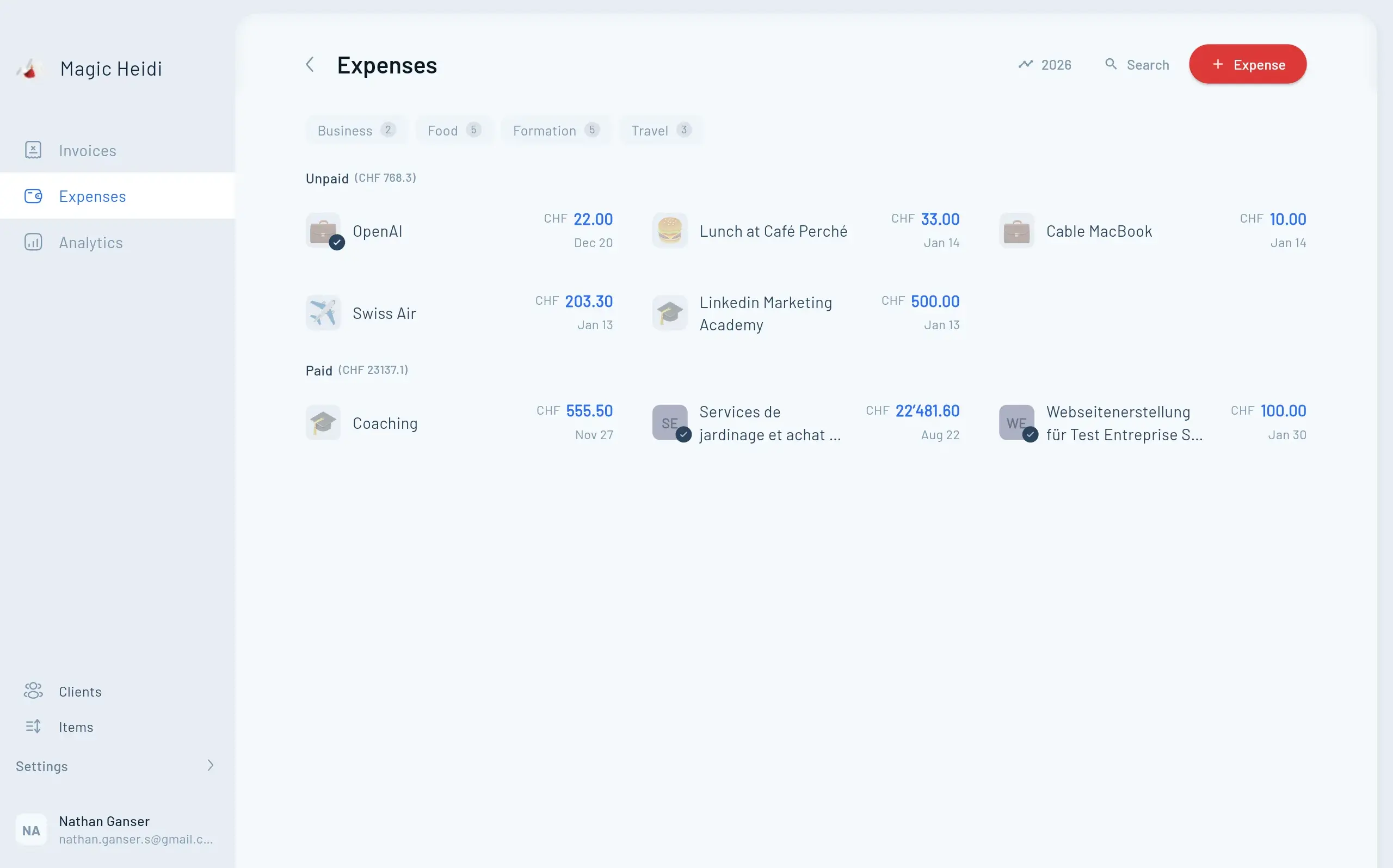
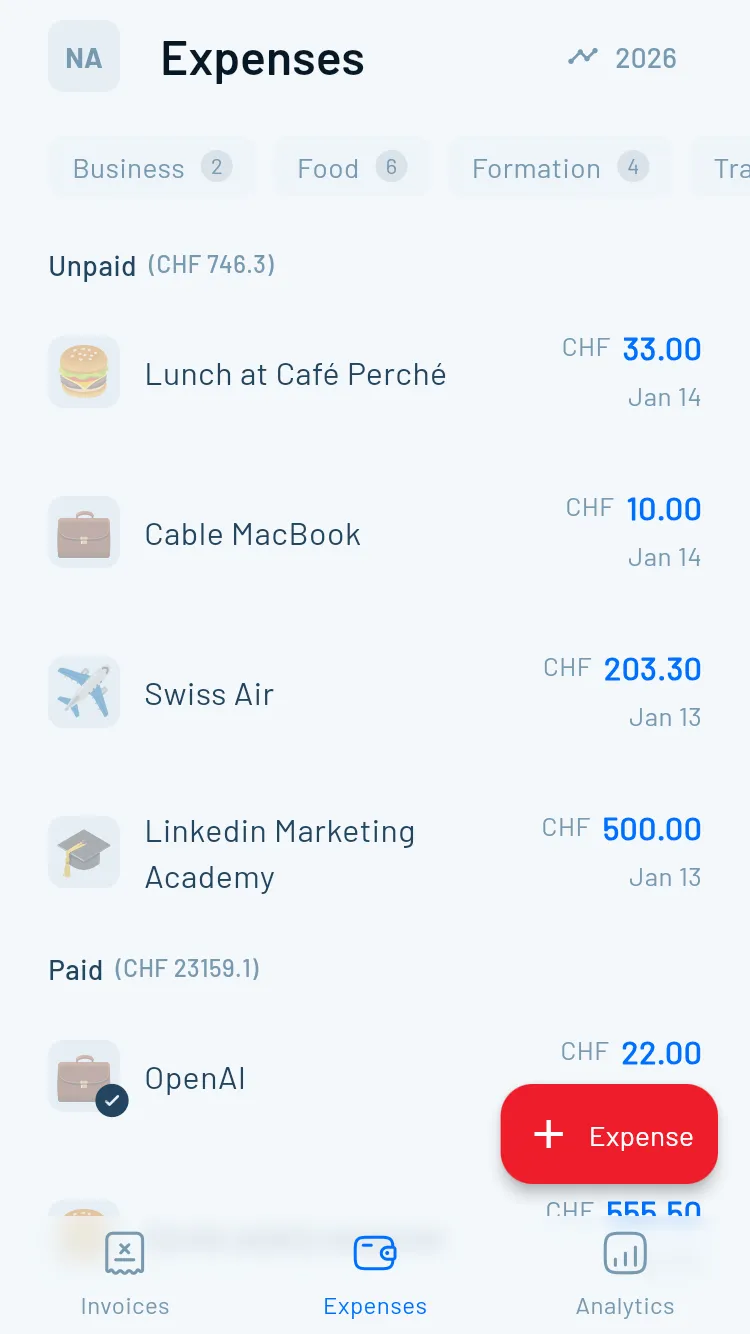
If you no longer want to piece together entertainment expenses, receipts and VAT individually, take a look at Magic Heidi. The software helps Swiss freelancers and sole proprietorships record receipts cleanly and keep business expenses clear in everyday life, especially with restaurant bills and mixed occasions.