 Magic Heidi
 Architect Invoice Switzerland
Architects in Switzerland issue fee notes based on SIA standard 102, carry 8.1% VAT and must include a QR invoice payment part since October 2022. Anyone who wants to issue a correct architect fee invoice switzerland needs to know three fee methods, the SIA 102 phase model and the formal requirements of the VAT Ordinance.
Why correct fee billing matters
for Swiss architects
QR-bills replaced red and orange payment slips in October 2022. A regular IBAN works with a Creditor Reference or no reference; a QR-IBAN must be paired with a QR reference. This change does not make a QR code mandatory on every invoice.
SIA 102 fee model
Three methods (construction cost percentage, time-based fee, lump-sum fee), 6-phase model, ±10% tolerance — without structure you risk losing fees8.1% VAT on all services
Architects are NOT VAT-exempt (unlike healthcare/education) — 8.1% standard rate since January 2024QR-bill payment standard
QR-bills replaced red and orange payment slips in October 2022. A regular IBAN works with a Creditor Reference or no reference; a QR-IBAN must be paired with a QR reference. This change does not make a QR code mandatory on every invoice.7 mandatory elements Art. 26 VAT Ordinance
VAT number, service description, net amount — if one is missing, the FTA refuses the input tax deductionKey Takeaways — Architect Fee Invoice Switzerland
- SIA 102 defines three fee methods: construction cost percentage (% of construction costs), time-based fee (hourly rates per Art. 6.3 SIA 102) and lump-sum fee (fixed fee for clearly defined commissions).
- 8.1% VAT on all architectural services — unlike healthcare or education, architectural services do not fall under Art. 21 VAT Act. There is no exemption.
- QR-bills replaced red and orange payment slips in October 2022. A regular IBAN works with a Creditor Reference or no reference; a QR-IBAN must be paired with a QR reference. This change does not make a QR code mandatory on every invoice.
- SIA 102 phase model with 6 service phases: Study → Preliminary project → Construction project → Tender → Award → Project management. Each phase is billed separately.
- CHF 100'000.00 VAT threshold for mandatory registration; voluntary registration below this enables input tax deduction on CAD software, vehicle and travel costs.
Architects in Switzerland issue fee notes based on SIA standard 102, carry 8.1% VAT and must include a QR invoice payment part since October 2022. Anyone who wants to issue a correct architect fee invoice switzerland needs to know three fee methods (construction cost percentage, time-based fee, lump-sum fee), the SIA 102 phase model with its six service phases and the formal requirements of the VAT Ordinance. The invoice is not just a receipt — it is the legal basis for the client's input tax deduction and the architect's fee realisation.
QR-bills replaced red and orange payment slips in October 2022. A regular IBAN works with a Creditor Reference or no reference; a QR-IBAN must be paired with a QR reference. This change does not make a QR code mandatory on every invoice.
Key takeaways For consistent invoice details and records, use the Swiss invoice template or bookkeeping software. Hypothetical example: amounts illustrate the calculation only. They do not describe a real customer or a guaranteed outcome.
Swiss invoice regulations — 7 mandatory elements per Art. 26 VAT Ordinance
Article 26 of the VAT Act (MWSTG) sets out the required VAT invoice details. The Swiss invoice template helps organise them.
- Name and address of the architect (invoice issuer) — exactly as registered with the FTA.
- Name and address of the client (invoice recipient) — incl. correspondence address if different.
- Invoice date — the reference date for VAT accounting.
- Type and scope of the service — concrete: "SIA 102 Phase 3 Construction project, new build apartment building Seestrasse 12, 8002 Zurich" instead of just "architectural services".
- Net amount of the rendered service in CHF.
- VAT rate and VAT amount — shown separately, at 8.1% standard rate.
- VAT number of the architect — CHE number with the three-digit extension, e.g. CHE-123.456.789 VAT.
If any of these elements is missing, no proper invoice exists in formal terms. This is particularly tricky for architects because clients often forward the fee note directly to their fiduciary — who raises red flags when the VAT number is missing or the service description is too vague ("project management Q1" is not enough, "SIA 102 Phase 6 project management, months January–March 2026" is).
QR-bills replaced red and orange payment slips in October 2022. A regular IBAN works with a Creditor Reference or no reference; a QR-IBAN must be paired with a QR reference. This change does not make a QR code mandatory on every invoice.
SIA 102 fee — three calculation methods
SIA standard 102 ("Fee schedule for architects and engineers") is the industry standard in Switzerland. It is not law, but is bindingly agreed in almost every construction contract. The architect fee invoice switzerland is built on one of three methods — the choice of method is defined in the quotation and fixed in the fee agreement.
Method 1: Construction cost percentage (% of construction costs)
The classic SIA 102 method. The fee results from a percentage of the chargeable construction costs. The range typically lies between 8% and 15%, depending on project complexity, building type and depth of service:
- Simple residential construction, recurring typology: approx. 8–10%
- Standard apartment building, office building: approx. 10–12%
- Complex interior fit-out, conversions, existing-building work: approx. 12–15%
- Specialist buildings (laboratory, hospital, cultural buildings): approx. 13–16%
The chargeable construction costs are defined per SIA standard 506 and exclude item no. 50 (construction ancillary costs) as well as certain positions. Important: the fee based on construction cost percentage develops with the construction costs — if the construction cost estimate (BKB) rises, the fee rises. This is fair because the architect's additional effort usually reflects in higher construction costs.
Method 2: Time-based fee (hourly rates)
For services that are hard to delimit, studies or advisory assignments, billing is by the hour. SIA 102 Art. 6.3 defines average hourly rates as guideline values:
- Fees, surcharges and payment terms are negotiated. Obtain a quote for your situation; example amounts are not market data.
- Fees, surcharges and payment terms are negotiated. Obtain a quote for your situation; example amounts are not market data.
- Fees, surcharges and payment terms are negotiated. Obtain a quote for your situation; example amounts are not market data.
- Fees, surcharges and payment terms are negotiated. Obtain a quote for your situation; example amounts are not market data.
These rates are guideline values, not binding. In simple cases they can be adjusted upward (specialist expertise), downward for high hourly volumes (large contracts). Time-based fee is usually evidenced with a time log — per entry date, activity, hours. SIA 102 allows a tolerance margin of ±10%: if the effective fee based on construction cost percentage (when construction costs are determinable afterwards) deviates by more than 10% from the lump-sum fee, the fee note can be adjusted.
Method 3: Lump-sum fee
For clearly defined, simple projects (garage, simple conversion, standardised construction) an overall lump sum is agreed. Advantage: budget certainty for the client, payment certainty for the architect. Disadvantage: additional effort stays with the architect. Lump-sum fees are expressly permitted in SIA 102, but the standard warns against applying them to complex projects with incalculable risks (contaminated sites, existing-building work without a building survey).
The SIA 102 phase model (6 service phases)
Each of the three methods is rolled out across the six service phases of SIA 102. Each phase has a percentage share of the total fee:
| Phase | Designation | Typical fee share |
|---|---|---|
| 1 | Study (feasibility, settlement study) | 5–10% |
| 2 | Preliminary project (preliminary design, project study) | 10–20% |
| 3 | Construction project (planning application, tender project) | 20–30% |
| 4 | Tender (bill of quantities) | 5–10% |
| 5 | Assistance with award | 3–8% |
| 6 | Project management (site supervision) | 25–40% |
Phase 6 is the biggest chunk — site supervision ties up the architect for months and can generate considerable additional effort over long construction periods.
VAT rules for architects — 8.1% on all services
Architects are not VAT-exempt. This is a common misconception because architects sometimes compare themselves with doctors, therapists or teachers — who all fall under Art. 21 VAT Act (tax-exempt services). Architectural services, however, fall under Art. 18 VAT Act (taxable services) and are billed at the standard rate of 8.1% (since 1 January 2024, previously 7.7%).
CHF 100'000.00 threshold and mandatory registration
Architects must register with the FTA and account for VAT if their worldwide revenue from taxable services reaches or exceeds CHF 100'000.00 per year. The threshold applies per year, not cumulative. If you have CHF 80'000.00 fee revenue in the first year and plan CHF 110'000.00 in the second year, you must register in the second year in good time — at the latest when the CHF 100'000.00 becomes foreseeable.
Voluntary registration and input tax deduction
Below CHF 100'000.00 an architect can register voluntarily. This is almost always worthwhile because it unlocks the input tax deduction:
- Software: CAD licences (Vectorworks, ArchiCAD, Revit), BIM tools, invoicing software like Magic Heidi — all with 8.1% or 2.6% VAT on the invoices.
- Hardware: high-performance workstation, plotter, scanner, monitor, external hard drives.
- Input VAT recovery depends on registration, accounting method and supporting records. Check the VAT on each receipt; Swiss public transport is not generally VAT-exempt.
- Office rent, energy, phone: partly at reduced rate (2.6% on certain energy items).
- Subcontractor services: structural engineer, building services engineer, model maker — their VAT enters your accounts as input tax.
A single CAD licence upgrade can cost CHF 4'000.00 plus 8.1% = CHF 324.00 VAT. With voluntary registration you recover the 324 as input tax deduction. If you opt out, you pay it in full. Voluntary registration is minimal effort but pays off from around CHF 5'000.00–10,000 in annual VAT-relevant expenses. Details in the VAT management guide for freelancers.
Showing VAT correctly on the fee note
VAT is shown on the fee note separately from the net amount:
- Net fee: CHF 12'000.00
- VAT 8.1%: CHF 972.00
- Total: CHF 12'972.00
Article 26 of the VAT Act (MWSTG) sets out the required VAT invoice details. The Swiss invoice template helps organise them.
Partial and final invoices — phase-based billing
SIA 102 promotes phase-based billing: after completion of each service phase a partial invoice is issued. This secures the architect's cash flow and gives the client milestone approval points. Only at the end of the project — or after completion of all phases — does the final invoice follow.
Typical phase shares for partial invoices
The following distribution is a rule of thumb. It must be bindingly fixed in the fee agreement and can vary by project:
| Phase | Designation | Partial share of total fee |
|---|---|---|
| 1 | Study | 10% |
| 2 | Preliminary project | 15% |
| 3 | Construction project | 25% |
| 4 | Tender | 10% |
| 5 | Award | 5% |
| 6 | Project management | 35% |
| Total | 100% |
Phase 6 project management is often split into monthly partial invoices — roughly 35% over 10–14 months of site supervision, i.e. approx. 2.5–3.5% per month. This is cleaner than a single large final invoice at the end.
Final invoice with reconciliation
The final invoice (final fee note) consolidates all partial invoices and shows:
- Total fee (net)
- Partial invoices already issued (with date and invoice numbers)
- Remaining amount (net)
- VAT 8.1% on the remaining amount
- Total payable
For construction cost percentage fees, the final construction cost statement must be taken into account in the final invoice — the chargeable construction costs are re-assessed at the end of the project because the effective construction costs often differ from the construction cost estimate (BKB) by ±5–15%. The SIA 102 ±10% tolerance applies here: if the deviation lies outside the tolerance, the final invoice must be adjusted with a recalculated fee.
Fee note template for Swiss architects
QR-bills replaced red and orange payment slips in October 2022. A regular IBAN works with a Creditor Reference or no reference; a QR-IBAN must be paired with a QR reference. This change does not make a QR code mandatory on every invoice.
FEE NOTE / INVOICE
─────────────────────────────────────────────

[Architecture practice name]
[Street and number]
[Postcode City]
Phone: [+41 XX XXX XX XX]
Email: [info@practice.ch]
VAT no.: [CHE-XXX.XXX.XXX VAT]

Invoice no.: 2026-014
Invoice date: 07.07.2026
Service date: [month/year of delivery]

─────────────────────────────────────────────

INVOICE TO:

[Client name]
[Street and number]
[Postcode City]

─────────────────────────────────────────────

PROJECT:

[Project name, e.g. "New build apartment building Seestrasse 12"]
[Address of the construction project]
Construction cost basis (chargeable per SIA 506): CHF [XXX'XXX]
Agreed fee method: Construction cost percentage [%] per fee agreement dated [date]

─────────────────────────────────────────────

SERVICE (SIA 102 phase):

Phase [number]: [phase designation]
Description: [concrete description of the rendered service]
Period: [from–to]

e.g.
Phase 3: Construction project (planning application + execution project)
Service: Preparation of the planning application project incl. floor plans,
sections, elevations, site plan, material list,
fire protection concept in collaboration with the
fire safety specialist. 4 sessions with client.
Period: 03.03.2026 – 12.06.2026

─────────────────────────────────────────────

LINE ITEMS:

Pos. | Description                                 | Amount CHF
─────────────────────────────────────────────────────────────
1    | Fee Phase 3 Construction project            |   25'000.00
     | (25% of CHF 100'000.00 total fee)
─────────────────────────────────────────────────────────────

─────────────────────────────────────────────

PAYMENT:

Payable within 30 days net.
Payment by QR invoice (see enclosed payment part).

QR-IBAN: [CHxx 0900 0000 XXXX XXXX X]
QR reference: [27-digit QR reference]
Payment recipient: [Architecture practice name]

─────────────────────────────────────────────

PARTIAL INVOICES ALREADY ISSUED (for final invoice):

Invoice no. 2026-007 (Phase 1 Study):      CHF 10'000.00
Invoice no. 2026-009 (Phase 2 Prel. proj.): CHF 15'000.00
Total to date:                             CHF 25'000.00
This invoice (Phase 3):                    CHF 25'000.00
Remaining fee after this invoice:          CHF 60'000.00
(Phases 4–6, will be invoiced in future partial invoices)

─────────────────────────────────────────────

Thank you for your trust.

[Signature / digitally signed]
[Architecture practice name]
[Name of signing architect, SIA/BSA-FSI]
This template is compatible with SIA 102 and the VAT Ordinance. It works for construction cost percentage (with % indication), time-based fee (with time log as attachment) and lump-sum fee (with an unambiguous lump-sum description). Adjust the VAT number, IBAN, QR reference and SIA membership to your details.
Swiss compliance
built for architects
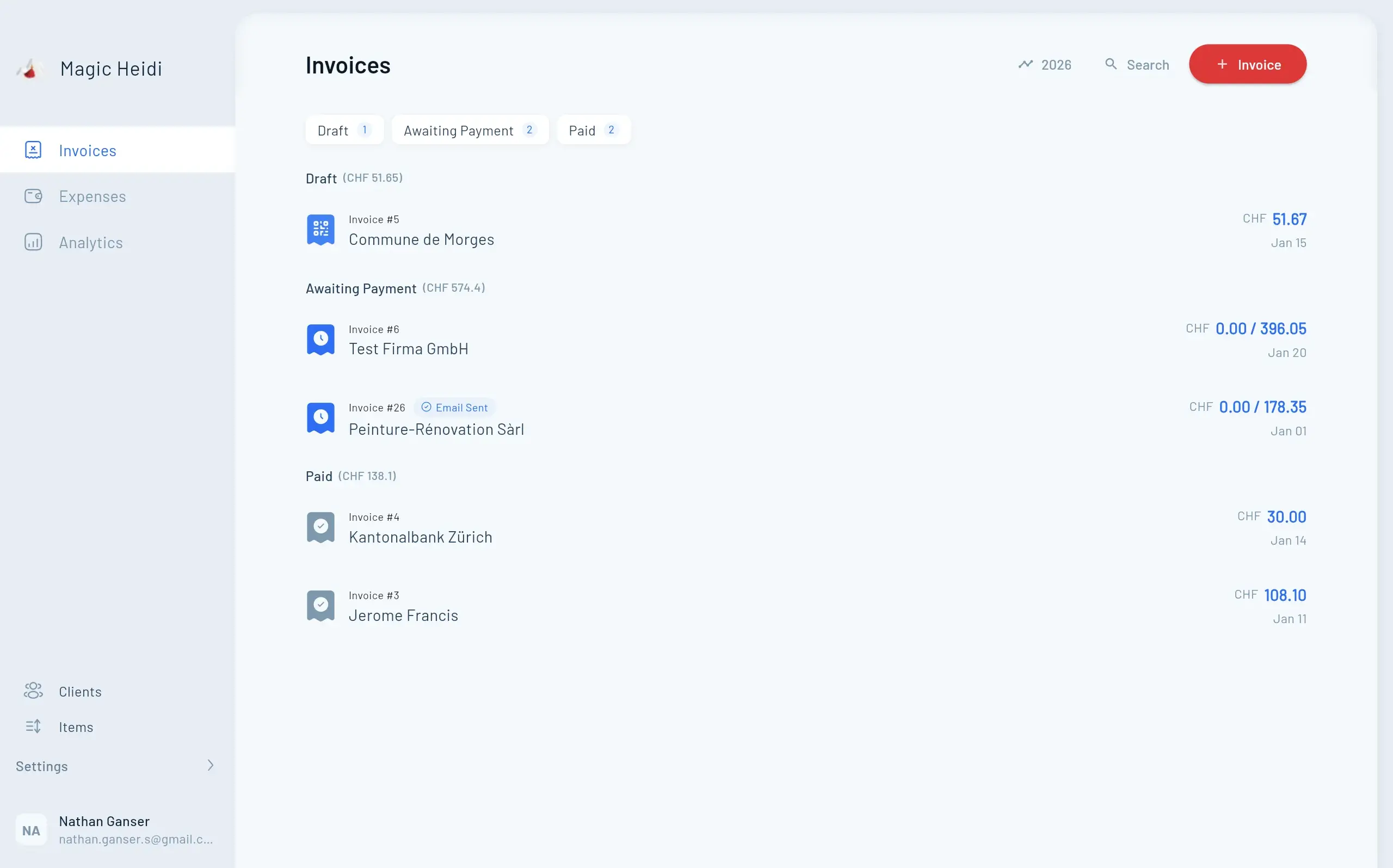
Magic Heidi creates QR-bills and quotes, records expenses and tracks payments. Explore the invoicing software.
QR-bills replaced red and orange payment slips in October 2022. A regular IBAN works with a Creditor Reference or no reference; a QR-IBAN must be paired with a QR reference. This change does not make a QR code mandatory on every invoice.
Standard rate preset — VAT number stored centrally, every fee note correctly stated
Per project: track SIA 102 phases, partial invoices and final invoice
Create a cost estimate, convert it to a fee note with one click on award
How Magic Heidi simplifies architect invoicing
Architects have specific needs: phase-based partial invoices, multiple projects in parallel, fee agreements with % shares, mobile billing from the construction site. Most Swiss invoicing tools are built for general contractors or SMEs — not for the SIA 102 reality of an architect.
bexio — overkill for solo architects
Compare the features your business needs and consult bexio pricing for current prices.
Billify — generic invoicing tool
Billify is solid but built as a generic invoicing tool. The mobile workflow optimisation, the SIA 102 phase logic and the Swiss-first focus are missing. For architects who want to bill from the construction site, the UX is too desk-oriented.
Magic Heidi — Magic Heidi, mobile-first, QR invoice native
Magic Heidi is the Swiss tool for solo freelancers and micro-practices who want to get by without overkill:
- Compare the features your business needs and consult bexio pricing for current prices.
- QR-bills replaced red and orange payment slips in October 2022. A regular IBAN works with a Creditor Reference or no reference; a QR-IBAN must be paired with a QR reference. This change does not make a QR code mandatory on every invoice.
- Mobile-first: fee note in 30 seconds from your smartphone. You're standing on site, open the app, select project and phase, enter the amount, send by email. The QR payment part is on it.
- Project-based invoicing: per project you can track phases, partial invoices and final invoices. The link with customer management makes this clear.
- Quotations and cost estimates: architects usually issue a quotation first. With Quotes from Magic Heidi you create the quotation, and on award it becomes a fee note with one click.
- VAT management: 8.1% standard and 2.6% reduced are preset, VAT number stored centrally, automatically assigned to every invoice.
Prices and details are on the pricing page. There is no minimum term, no setup joke, no add-ons that only kick in from CHF 100.00/month.
FAQ: Architect invoices in Switzerland
How is the architect fee calculated in Switzerland?
Fees, surcharges and payment terms are negotiated. Obtain a quote for your situation; example amounts are not market data.
Are architectural services VAT-exempt?
No. Architectural services do not fall under the tax exemption per Art. 21 VAT Act (unlike medical services, educational offerings or certain cultural services). They are subject to the standard rate of 8.1% (since 1 January 2024). Architects must register with the FTA from an annual revenue of CHF 100'000.00; below that voluntary registration is possible and almost always worthwhile because of the input tax deduction on CAD software, hardware and vehicle costs.
What is a fee note?
QR-bills replaced red and orange payment slips in October 2022. A regular IBAN works with a Creditor Reference or no reference; a QR-IBAN must be paired with a QR reference. This change does not make a QR code mandatory on every invoice.
Do I need to register with the compensation office as an architect?
Self-employed AHV/IV/EO contributions are around 10% of income, with a sliding scale for lower incomes. The compensation office determines the applicable amount.
Which phases does SIA 102 cover?
SIA 102 defines six service phases: (1) Study — feasibility and site studies; (2) Preliminary project — preliminary design and project study; (3) Construction project — planning application, approval and execution project; (4) Tender — bill of quantities and submission; (5) Assistance with award — quotation evaluation and award recommendation; (6) Project management — site supervision and construction monitoring. Each phase is invoiced separately and typically distributed at 10%, 15%, 25%, 10%, 5% and 35% of the total fee.
Can I use Magic Heidi instead of bexio for my architect invoices?
Compare the features your business needs and consult bexio pricing for current prices. Magic Heidi Free includes 3 invoices and 3 expenses. Pro costs CHF 24.99 a month billed annually (CHF 299.00 a year), or CHF 39.00 billed monthly. See pricing.
Conclusion
QR-bills replaced red and orange payment slips in October 2022. A regular IBAN works with a Creditor Reference or no reference; a QR-IBAN must be paired with a QR reference. This change does not make a QR code mandatory on every invoice.
Phase-based billing per SIA 102 secures cash flow — with partial invoices per phase (Study 10%, Preliminary project 15%, Construction project 25%, Tender 10%, Award 5%, Project management 35%) and a clean final invoice reconciling the partial invoices and the final construction costs. Voluntary VAT registration below CHF 100'000.00 is almost always worthwhile for the input tax deduction on CAD licences, hardware and travel costs.
Compare the features your business needs and consult bexio pricing for current prices. Magic Heidi Free includes 3 invoices and 3 expenses. Pro costs CHF 24.99 a month billed annually (CHF 299.00 a year), or CHF 39.00 billed monthly. See pricing.
Start invoicing with Magic Heidi now →
Sources: SIA for SIA 102 standard · FTA for VAT regulations · SME Admin for small business rules.
Create your first fee note in 30 seconds
No credit card needed. QR invoice, 8.1% VAT and project phase logic included — from your phone, right from the construction site.