Swiss Accounting Software Compared: The Top 5 Tested

Swiss accounting software, honestly compared: the top 5 picks for freelancers — plus how sevdesk, Lexware Office & BuchhaltungsButler actually measure up.

Nathan Ganser avatar
Nathan Ganser

Founder of Magic Heidi

The best Swiss accounting software for freelancers is whichever one actually fits your profile: Magic Heidi for most sole proprietorships, bexio for accounting nerds and SMEs, plus Milkee, Infinity.swiss, and Swiss21 for more specific cases. In this comparison, I'll show you which program is built for whom — and why German test winners like sevdesk or Lexware Office don't work in Switzerland.

In the age of AI, ChatGPT, Claude, and all that... I figured I'd do something crazy, something retro, and write this article myself, by hand. Let's go!

I was self-employed in Switzerland for several years and picked up a fair bit of experience in this space along the way. Since starting my company Magic Heidi, I've also talked to hundreds of Swiss freelancers and heard pretty much every story there is about the accounting and invoicing programs out there in Switzerland. That's enough to give me a solid overview and a well-founded, useful opinion on the question: which software should I choose for my business?

The short version

  • Most Swiss freelancers under CHF 500,000 in revenue only need simplified bookkeeping (income / expenses) — no balance sheet, no double-entry accounting required.
  • Magic Heidi is the simplest program in our click test: 33 clicks from signup to a sent QR-invoice, versus 69 for bexio.
  • bexio remains the right choice for SMEs with employees and anyone who wants full financial accounting with a balance sheet.
  • German programs like sevdesk, Lexware Office, WISO MeinBüro, or BuchhaltungsButler are built for German tax law: no Swiss QR-invoice, no VAT filing for the FTA.
  • Free options: Swiss21 (up to 500 invoices a year), Banana (up to 70 entries), CashCtrl FREE, and Magic Heidi (3 invoices & 3 expenses, every feature included).

The 4 categories of freelancers

And you? What kind of freelancer are you? Let's take a rough look together at the 4 categories of freelancers I've come across.

The small, pragmatic freelancer

This is the freelancer earning less than 100k a year who wants to do things properly, but efficiently, without spending hours on it. They don't see themselves as a bookkeeper and get no joy from losing hours in Excel. In the past, they outsourced their bookkeeping to a fiduciary (or at least thought about it), but find it kind of ridiculous to pay that much — especially since they still end up doing most of the work themselves anyway: scanning and organizing expenses, filing invoices, and so on, just to send it all to the fiduciary in the end.

The small freelancer who secretly wanted to be a fiduciary

I love this freelancer. This is the ultra-serious type who absolutely wants to follow an SME chart of accounts, who genuinely enjoys complexity, who wants to depreciate their MacBook — but on a declining-balance basis instead of straight-line, please, to capture the change in value "properly." The freelancer who insists on a direct connection to their business account just to import the 3 payments they receive per month.

This is the freelancer who wants every feature of SME software: double-entry bookkeeping, assets, liabilities, a real balance sheet, and ideally the management of their own home thrown into the program too — but then finds the SME programs a bit too expensive and not quite as simple as they'd like. So they want a program built for freelancers.

The freelancer who's made it

This is the freelancer earning more than 100k but less than 500k, with no employees. Their "team" is other freelancers who invoice them, so they don't have to deal with payroll. Every invoice they receive is simply a new expense. They want something simple and professional to handle their tax return and VAT filings — and that's it. They don't need super complex features for importing goods from a non-EU country, paying customs duties that get refunded later, and so on...

The freelancer who's already an SME

They started out as a freelancer a few years ago, but have since founded a GmbH (Swiss LLC), hired a few employees, and realized that the most important thing about their job... is the job itself! (Not the bookkeeping.)

Their fiduciary has told them they need to switch to serious accounting software, but they hate that software and want to keep using something simple. At this point, they don't really care how profitable they are per client or about that kind of advanced analytics. They just want to keep selling their service, sending their invoices, and getting paid: that's it!

The ideal accounting program for each category

Now let's look at what I consider the ideal program for each of the freelancer types described above. For my selection, I set a few basic criteria — a few non-negotiables that a piece of software has to clear before it's even worth considering for me.

Four criteria, then, nothing wild in itself: available in your language, on the market for a few years, at least a handful of reviews on different sites, and a mobile app to round out the main program... And in practice, you'll see: there really aren't that many options left for Swiss freelancers...

Magic Heidi: ideal for the small, pragmatic freelancer

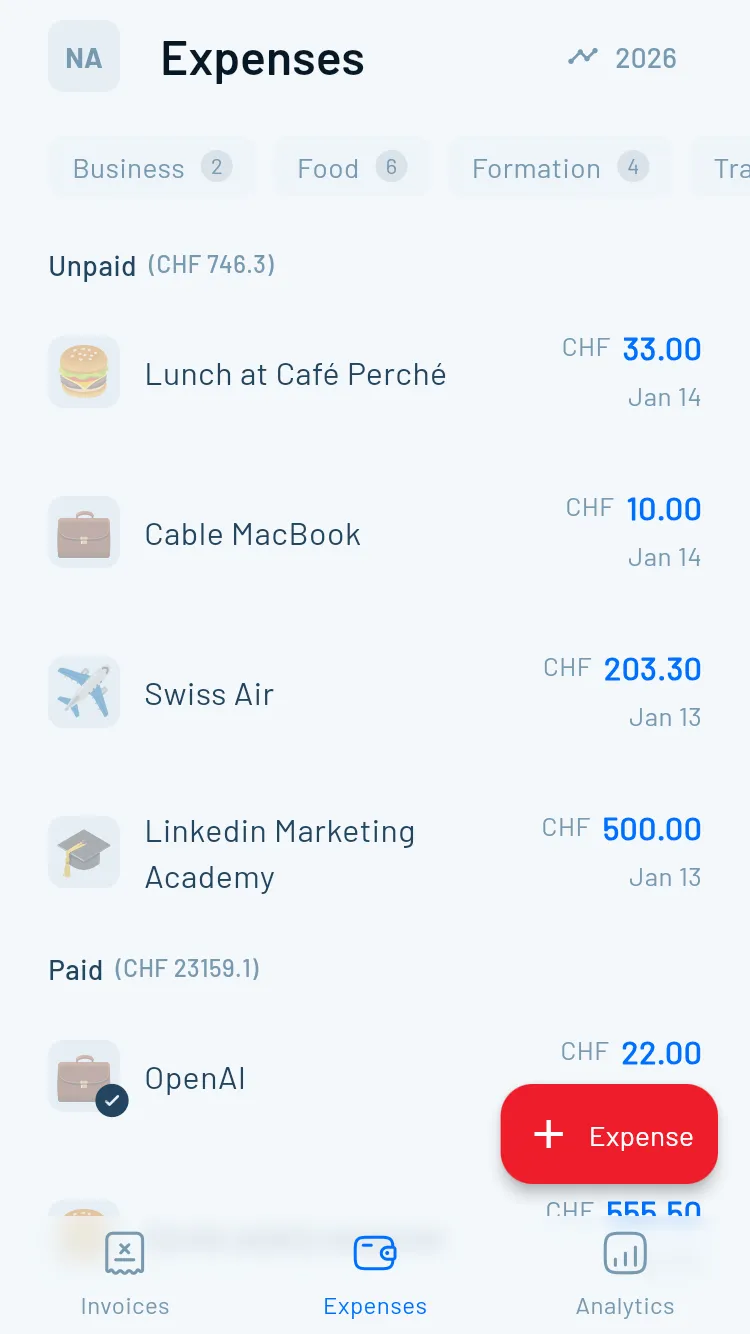
Magic Heidi is the ideal accounting software for pragmatic Swiss freelancers. Designed for ease of use (for example, it takes fewer clicks than any other Swiss program to create an account and send an invoice).

The key features

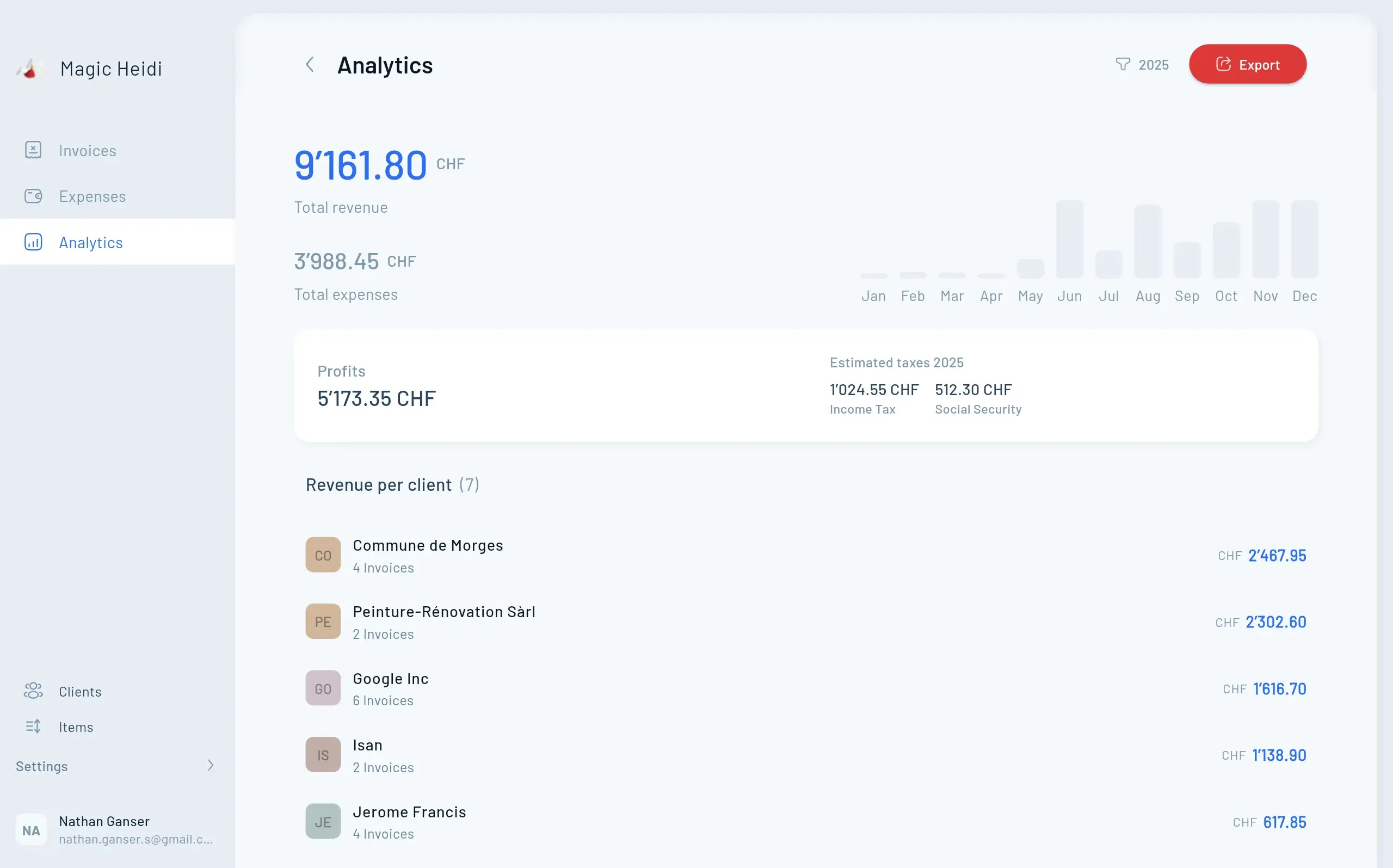
You can do it all: invoices with a compliant Swiss QR-invoice, quotes, payment reminders, recurring invoices, invoices in foreign currencies, time tracking with hourly billing, scanning and categorizing your expenses with AI, importing bank transactions from your business account, a compliant data export for your tax return, a client list... the software does everything a small freelancer needs, simply because it was built exactly for that. Everything syncs in real time between phone, computer, and web.

What it doesn't do: payroll, complex project management, a sales pipeline/CRM, double-entry bookkeeping, complicated accounting procedures, ...

The price

The pricing is deliberately simple: there's a free plan with 3 invoices and 3 expenses (every feature included, no credit card required) and a Pro plan for CHF 25 per month on the annual plan or CHF 39 per month on the monthly plan (as of July 2026). No modules, no add-on costs, one plan with everything in it.

The support

You get support that's reachable by phone around the clock, and of course by email too — so whenever you have a problem or a question, it gets resolved fast. User questions land directly with me, the founder, and a lot of our reviews mention the support specifically.

For a small, pragmatic freelancer, that's perfect. Minimal time spent on bookkeeping, invoices created in seconds, expenses uploaded automatically and scanned by AI, and you can export a clean Excel file with your complete books at any time, plus a full archive of every file. You focus on your actual work, and the automation takes care of the rest.

Magic Heidi

Launched 4 years ago

Available in French, German, Italian, English, Spanish, and Portuguese

Available on Mac, Windows, Web, iPhone & Android

+60 reviews on Google Maps, +20 reviews on Trustpilot, +50 reviews across the app stores, and 10 reviews on G2/Capterra

bexio: ideal for the small freelancer who secretly wanted to be a fiduciary

I've met plenty of these freelancers who love complexity, even when it's not remotely necessary. Like the freelancer who wanted double-entry bookkeeping for her sole proprietorship (so, much more complicated), even though it's not legally required at all, and simplified bookkeeping (income / expenses) is perfectly enough for a sole proprietorship.

Or the freelancer who wanted to categorize his expenses, then sub-categorize them, then sub-sub-categorize them. Then there was the freelancer who'd been assigned two different VAT rates (he was on the net tax rate method) because his business operated in two different industries with very different average profit margins. That was another case where we had to say: "Sorry, this is rare enough that it doesn't make sense for us to build a feature just for you that would make life more complicated for 99% of our customers."

bexio's price and features

These freelancers are often already using bexio, and whenever bexio raises its subscription prices again, they go looking for an alternative that does everything bexio does, just cheaper — and unfortunately, it doesn't exist. Plans range from CHF 35 per month (Basic, annual plan) to CHF 119 per month (Ultimate), with payroll available as an add-on module depending on the plan (as of July 2026). In return, you get the full functionality of an SME system: financial accounting with a balance sheet and profit and loss statement, e-banking connection to your business account, fiduciary access, and support through a hotline and help center — features that a genuine "accounting nerd" really appreciates. These freelancers should stick with bexio (and, in the end, most of them do).

🏢 bexio

  • Founded 20 years ago
  • Available in French, German, Italian, English
  • Available on Web, iPhone & Android
  • Price: CHF 35 to 119 per month (annual plan, as of July 2026)
  • +1000 reviews on Google Maps, +300 reviews on Trustpilot, +100 reviews across the app stores, and 40 reviews on G2/Capterra (unfortunately, a lot of bad reviews)

The ideal program for the freelancer who's made it

This freelancer is VAT-registered and wants to hold onto the simplicity of their earlier life (back when they earned less than 100k a year), without breaking any rules — meaning they pay their VAT correctly.

Magic Heidi has every feature you need to take in money and invoice with VAT (you can even combine multiple VAT rates on the same invoice), everything for tracking the VAT you've paid (you can add VAT to expenses and even flag expenses or invoices that aren't VAT-liable), and at the end, you get a table with all the information you need to copy your VAT data from Magic Heidi straight into the Federal Tax Administration's ePortal.

🥇 Magic Heidi

  • Launched 4 years ago
  • Available in French, German, Italian, English, Spanish, and Portuguese
  • Available on Mac, Windows, Web, iPhone & Android
  • Price: Free (3 invoices & 3 expenses) or CHF 25 per month on the annual plan
  • +60 reviews on Google Maps, +20 reviews on Trustpilot, +50 reviews across the app stores, and 10 reviews on G2/Capterra

The ideal program for the freelancer who's already an SME

The freelancer who's grown into an SME faces two challenges when it comes to keeping their bookkeeping as simple as it was in the good old days, back when they were still completely on their own in their business:

  1. GmbHs need double-entry bookkeeping: so you need to understand what assets, liabilities, a balance sheet, and so on actually are...
  2. Every employee wants their salary: that's no longer just a paid expense, it's a salary with contributions, taxes, social insurance, and so on, that you have to pay.

The upside of running an SME is that the freelancer has a bit more budget and can afford to work with a fiduciary for their company's books. The fiduciary will, of course, recommend bexio (the software enables every complex process a bookkeeper dreams of), but since it's still the business owner, the freelancer, who uses the software every day, it's simpler to use Magic Heidi.

But this time, instead of doing the tax return themselves (which is no longer possible now that a balance sheet, double-entry bookkeeping, and so on are required), the freelancer gives their bookkeeper access to Magic Heidi. The bookkeeper exports the accounts to Excel and takes care of converting the simplified bookkeeping into double-entry (they usually charge CHF 1,000–1,500 for that; our AI does it for 500).

And for payroll, there are several programs that handle all the paperwork. The freelancer then simply imports the gross salary paid as an expense in Magic Heidi — or the bookkeeper takes care of that too, alongside the tax return.

🥇 Magic Heidi

  • Launched 4 years ago
  • Available in French, German, Italian, English, Spanish, and Portuguese
  • Available on Mac, Windows, Web, iPhone & Android
  • Price: Free (3 invoices & 3 expenses) or CHF 25 per month on the annual plan
  • +60 reviews on Google Maps, +20 reviews on Trustpilot, +50 reviews across the app stores, and 10 reviews on G2/Capterra

The other programs, compared

Here are three more programs that unfortunately don't meet my basic criteria, but that I think are worth mentioning — and that I'm proud to have as competitors.

Milkee: ideal for the freelancer running a micro-business in German-speaking Switzerland

Milkee is built by a good friend of mine (only in Switzerland can you be a friend and a competitor at the same time!) and targets the German-speaking Swiss market exclusively. It's a solid solution for freelancers and small businesses, since the program tries to stay as simple as possible while still offering customers double-entry bookkeeping. Payroll creation was added recently, so a small SME can use this tool and handle everything by hand.

🐮 Milkee

  • Founded 5 years ago
  • Available in German
  • Available on Web, iPhone & Android
  • +80 reviews on Google Maps

Infinity.swiss: ideal for startups in German-speaking Switzerland

Besides bexio and Magic Heidi, this is the only other program with a website in all the Swiss languages, but the software itself is unfortunately only in German. There's no mobile app, and on the various platforms like Google Maps, Trustpilot, Capterra, and so on, there are almost no reviews...

A program that surprises me: they seem to have a lot of customers, they've gone through several funding rounds, they show up at every startup event in Switzerland, they have well-known partners — but almost no user reviews online. And every single time I try their software, I just can't manage to do simple things like create an invoice or upload an expense, have the AI scan it, and save it. They position themselves as the modern alternative to bexio for growing companies, and I wish them all the success in the world (I think it's great that they have a TikTok account!), but honestly, I just don't get the product right now :/

♾️ Infinity.swiss

  • Founded 4 years ago
  • Available in German
  • Available on Web
  • +5 reviews on Google Maps

Swiss21: ideal for the freelancer on a tight budget

Swiss21 has the most complicated branding in the world, and moments like this remind me that I'm still fairly young, because the users who've told me about this program still call it AbaNinja (apparently the old name, before it got acquired). It stands out because it offers a generous free version (up to 500 invoices a year), which lets a lot of freelancers and associations use it without paying anything. Anyone who needs more books a paid plan in the Swiss21 suite.

Being embedded in a bigger product suite makes the software more complicated to use, and I suspect (based on the reviews) that support isn't really there when you need it (which makes sense for a free product!). And overall, the solution seems more geared toward SMEs — they describe themselves as an ERP, three letters that should make any freelancer nervous.

But as a free solution, it beats Magic Heidi, whose free version only gives you 3 invoices and 3 expenses :)

🆓 Swiss21 (AbaNinja)

  • Founded 9 years ago
  • Available in German, French, and Italian
  • Available on Web
  • +200 reviews on Google Maps, 15 reviews on Trustpilot (very negative reviews on Trustpilot)
Comparison

The 5 programs at a glance

Same criteria, side by side: you decide which one fits your profile. Prices last checked: July 2026.

CriterionMagic HeidibexioMilkeeInfinity.swissSwiss21
Ideal forMost freelancers“Accounting nerds” & SMEsGerman-Swiss micro-businessesGerman-Swiss startupsAnyone who wants free
Founded4 years ago20 years ago5 years ago4 years ago9 years ago
LanguagesFR, DE, IT, EN, ES, PTFR, DE, IT, ENDEDEDE, FR, IT
Mobile App
PlatformsMac, Windows, Web, iPhone, AndroidWeb, iPhone, AndroidWeb, iPhone, AndroidWebWeb
Google Maps reviews+60+1000+80+5+200

The Click Test: Usability in Numbers

Every piece of software claims to be "simple" — but what actually matters to the user is how fast an invoice really gets out the door. So we measured it: in January 2026, we counted the clicks across six Swiss tools for three recurring tasks — onboarding (from signup to ready for your first invoice), creating a compliant QR-invoice, and uploading an expense with a receipt. Every test is documented with a screen recording (links in the appendix below). You don't have to take usability on faith — you can count it.

Click study

The result: Every click counted

Fewer clicks means less friction — and at 10 to 20 invoices a month, that adds up fast.

RankSoftwareOnboardingInvoiceExpenseTotal
1Magic Heidi1215633
2Simplino30101555
3bexio35151969
4CashCtrl35152777
5Infinity20552095
6Smallinvoice*354033108

*Smallinvoice: we couldn't activate the QR-invoice in our test scenario. That's a result of this specific test, not a blanket statement about the product as a whole.

German accounting software tests: why the German winners don't work in Switzerland

If you search for "accounting software test" or "bookkeeping software comparison," you'll almost always land on German comparison sites. There, sevdesk, Lexware Office, WISO MeinBüro, BuchhaltungsButler, or Papierkram come out on top. All solid software — for Germany. As a Swiss freelancer, though, you won't get far with these programs: the features aren't the problem, the tax law is. What Germany calls a Freiberufler, we call a freelancer — the difference is the tax system: VAT here, not Germany's Umsatzsteuer. German users love these tools, and rightly so, but even the cheapest plan won't help you if you don't end up with a QR-invoice at the end, and support can't answer your VAT questions.

How to spot software that's built for Germany

Before we look at the individual tools, here's the checklist. Software is built for the German market if you spot these terms on its website:

  • EÜR (Einnahmen-Überschuss-Rechnung): the German method for calculating profit — Swiss profit calculation for your tax return works differently.
  • ELSTER interface: the direct line to the German tax office. In Switzerland, you need the VAT filing for the FTA's ePortal instead.
  • GoBD-compliant: German bookkeeping regulations. In Switzerland, the Swiss Code of Obligations applies instead.
  • DATEV export: the format German tax advisors use. Swiss fiduciaries don't work with it.
  • Prices only in euros: if you can't find CHF on the pricing page, you already have your answer.
  • Umsatzsteuer at 19% / 7%: the German rates. Swiss VAT runs at 8.1%, 2.6%, and 3.8% — and, more importantly, comes with the QR-invoice payment slip, which no German program can generate.
  • Support trained on German tax law: support teams are trained on Umsatzsteuer and ELSTER, not VAT and QR-invoices.

sevdesk shows up near the top of nearly every German comparison, and its plans (including "sevdesk Rechnung" and "sevdesk Buchhaltung") are fair by German standards. But the company says so itself, quite openly, on its own Swiss website: "sevdesk is designed for self-employed people and businesses based in Germany or Austria." No QR-invoice, no Swiss VAT rates, no filing for the FTA. Support is based in Germany too, and doesn't know Swiss VAT. If someone recommends this program for your Swiss sole proprietorship, they've read the test results, but not the fine print.

Lexware Office (formerly lexoffice): the German market leader

Lexware Office is probably the best-known online accounting software in Germany — the old name, lexoffice, still shows up in a lot of tests. The functionality is impressive: automatic receipt capture, a business account connection (Lexware even offers its own), payroll, tax advisor access. But support can't help you with Swiss VAT questions — it's simply not built for that. And most importantly: Lexware Office runs in euros and under German tax law, with ELSTER and EÜR. You won't get a compliant Swiss QR-invoice or a VAT filing for the FTA out of Lexware. My take: great program, wrong country.

WISO MeinBüro: the old guard from Germany

WISO MeinBüro, from Buhl, has been around forever, as both a desktop and a web version, with everything and the kitchen sink: invoicing, cash book, inventory management, tax forms. The same rule applies here: WISO MeinBüro is built around the German tax office. A proven solution for German freelancers, but simply not made for Swiss ones. If you spot WISO MeinBüro in a German test, feel free to skip straight past it as a Swiss reader.

BuchhaltungsButler: automation for German businesses

BuchhaltungsButler has an interesting focus: maximum automation. Receipts get automatically matched to bank transactions, and booking suggestions come from AI. Honestly, I really like the concept — at Magic Heidi, we're building on the same idea, just for Switzerland. But BuchhaltungsButler is clearly built for German businesses (GoBD, DATEV export, German Umsatzsteuer). Worth a look for small businesses in Germany, not an option in Switzerland.

Papierkram: great time tracking, missing Switzerland

Papierkram (yes, the tool is really called that — it literally means "paperwork" in German) targets German freelancers and is especially strong on time tracking: log hours, assign them to projects, pull them straight into an invoice. Pricing is fair too, and there's even a free version. But like the others: Papierkram runs on the German EÜR and German Umsatzsteuer. Fittingly, the name says it all — the exact paperwork this tool handles for Germans is what Magic Heidi handles for the Swiss.

BillingEngine and other pure invoicing tools

There are also pure invoicing tools out there like BillingEngine: lean, affordable, but strictly invoicing — no bookkeeping, no VAT filing, no expense tracking. For a Swiss freelancer who needs a clean profit calculation for their tax return at year-end, a pure invoicing tool only gets you halfway there: you'll end up doing the other half (expenses, receipts, VAT) in Excel anyway.

In short: a German test winner is about as useful to you as a Swiss reader as a German tax advisor — nice, but missing the point entirely. That's exactly why I wrote this comparison: so there's finally an accounting software test that actually applies to Switzerland.

More Swiss accounting solutions: Banana, CashCtrl, and Pebe Live

Beyond the top 5, there are a few more Swiss programs worth knowing about — they didn't make my final selection (usually because of a missing mobile app or a different target group), but depending on your profile, they're a valid accounting solution.

Banana Buchhaltung: the classic for accounting pros

Banana, from Lugano, has been a household name for decades and is even used to teach bookkeeping in Swiss schools. At its core, it's spreadsheet-style double-entry bookkeeping: powerful and very affordable (free up to 70 entries, then from CHF 89 a year, as of July 2026 — the cash book and time tracking are even unlimited and free). The features cover everything a classic bookkeeping setup needs — but you'll need actual accounting knowledge for it: you should understand chart of accounts, debit and credit, balance sheets, and profit and loss statements. Plenty of small businesses and associations use Banana too, because they want clean books without high subscription costs. If you just want to write invoices and scan expenses, you're better served elsewhere.

CashCtrl: double-entry bookkeeping at a low price

CashCtrl, from the Basel region, offers full financial accounting with a surprisingly generous free version and an affordable PRO plan. Its target audience skews more technical, plus fiduciaries — the API and documentation are excellent, but there's no mobile app and no AI receipt scanning. In our click test, CashCtrl came in 4th place (77 clicks): solid features, but not for anyone counting clicks.

Pebe Live: cloud accounting for fiduciaries

Pebe Live, the cloud solution from Swiss provider Pebe, is a classic financial accounting system aimed mainly at SMEs and fiduciaries. If you have a fiduciary who already works with it, you're in good hands — but as a solo freelancer, you won't be happy here.

Klara and Smallinvoice: lots of functionality, different target group

Klara positions itself as a business operating system for SMEs, with invoicing, point of sale, an online shop, and payroll — for a solo freelancer, that's more organization than you'll ever need. And Smallinvoice offers a lot of features at a low price, but it landed in last place in our click test (108 clicks). All three are genuine Swiss programs with QR-invoices and VAT — they're just not my recommendation for freelancers.

What to look for when comparing accounting software

If you still want to test things out yourself after reading this (good call!), here's my checklist. This is how you spot good accounting software for your situation — no matter which provider ends up being your personal winner.

Features: do you really need it all?

Write down what you actually need: QR-invoices, quotes, expense scanning, VAT, maybe recurring invoices or time tracking. Then cross out everything that's just "nice to have." Most freelancers use less than 20% of the features they're paying for. What you need also depends on your industry: a tradesperson needs quotes, a consultant is more likely to need hourly tracking. More functionality doesn't automatically mean more value — often it just means more clicks. Payroll, inventory management, a cash book, project controlling: if you don't need it, don't pay for it.

Price: calculate it over three years

Don't compare the entry-level price — compare the real monthly cost over three years, including every add-on module. A plan for CHF 35 a month where payroll and receipt scanning cost extra ends up more expensive than a CHF 39 plan with everything included. And check what the free version actually includes: for some providers, "free" is just another word for "demo."

Support: test it before you pay

Send support a real question during your trial period, ideally on a Friday afternoon. Response time is the most honest feedback you can get about a provider. Is there phone support? In your language? When your VAT filing is stuck in January, you don't want a ticket number, you want an answer. Good support is worth its weight in gold for accounting questions — you only notice the difference once things are on fire.

Usability and ease of use

Measure usability instead of just trusting the marketing: use invoice creation as your benchmark — create a real invoice during your test and time it. Also check what other users are writing in the reviews. Our click study above shows how big the differences are — anywhere from 33 to 108 clicks for the same three tasks. At 10 to 20 invoices a month, usability decides whether your accounting program costs you 20 minutes or half a day every month.

Export, integrations, and security

Your data belongs to you. Before you buy, check: is there a full export (Excel plus all receipts)? Access to your business account, or at least a bank data import? Clean documentation? And where does your data actually live — security and Swiss hosting are not a minor detail when it comes to financial data. A tool that won't let you leave hasn't earned your loyalty.

One honest limit to close on: software doesn't replace tax advice. For special cases, a visit to a fiduciary is still worth it — with clean data from your software, it just gets a lot cheaper.

Conclusion: the best Swiss accounting software is the simplest one that does it all

That's it — my little hand-written article, no AI involved (well, almost — the AI in Magic Heidi still scans your receipts 😉).

If I had to sum it up: most Swiss freelancers make their lives unnecessarily complicated. Under CHF 500,000, keep it simple. Pick the simplest software that still has every feature you need — QR-invoices, VAT, expenses, tax-ready exports — and invest the time you save into your actual work. And don't let German tests confuse you: sevdesk, Lexware, and WISO MeinBüro are good programs, but the best accounting software for Switzerland in 2026 has to handle QR-invoices, Swiss VAT, and the FTA.

For the vast majority of Swiss freelancers, that software is Magic Heidi. But now you also know when bexio, Milkee, Swiss21, or Banana are the better choice for your situation — and that's what really matters.

The easiest way to find out is to see for yourself: try it out, create your first invoice, and see if it saves you time. And if you have a question, write to me — I really do reply.

More interesting reads on accounting

You'll find more like this on our blog — for example on VAT for freelancers or on how to set up a sole proprietorship.

FAQ

Frequently Asked Questions

Which accounting software is the best?

The best accounting software for Swiss freelancers is whichever one fits your profile: Magic Heidi for most sole proprietorships without employees (the simplest to use in our click test), bexio for SMEs with payroll and double-entry bookkeeping, Banana for accounting pros on a small budget. There's no single absolute winner for everyone — but German programs like sevdesk or Lexware Office are completely off the table for Switzerland.

Which is the simplest accounting program?

In our click test from January 2026, Magic Heidi was the simplest program: 33 clicks from signup to a sent QR-invoice, including an expense upload, versus 69 clicks for bexio and 108 for Smallinvoice. Every measurement is documented on video — count them yourself if you're not convinced.

What simple accounting programs are available in Switzerland?

For freelancers with simplified bookkeeping (income / expenses): Magic Heidi and Milkee. For double-entry bookkeeping: CashCtrl and Banana. As a free starting point: Swiss21 (up to 500 invoices a year) or Magic Heidi's free version. Important: all the programs mentioned here are built for Switzerland — with QR-invoices and Swiss VAT rates (8.1%, 2.6%, 3.8%).

Which bookkeeping program is best for a sole proprietorship?

A sole proprietorship under CHF 500,000 in revenue only needs simplified bookkeeping — so the best bookkeeping program is one that handles exactly that kind of profit calculation cleanly, instead of putting you through debits and credits: Magic Heidi or Milkee. Only once you have a GmbH (or hit CHF 500,000 in revenue) do you need double-entry bookkeeping with a balance sheet, and with it, programs like bexio, CashCtrl, or Banana.

Do I really need accounting software as a freelancer?

Not strictly, but it saves you an enormous amount of time. Legally, a sole proprietorship under CHF 500,000 in revenue is allowed to keep simplified accounts (income, expenses, financial position) — see Art. 957 of the Swiss Code of Obligations. Good software handles exactly this kind of simplified bookkeeping for you, cleanly, without a Sunday-night Excel scramble.

Does a freelancer have to keep double-entry books?

No, not as a sole proprietorship under CHF 500,000 in revenue: simplified bookkeeping (income / expenses) is enough. Double-entry bookkeeping with a balance sheet only becomes mandatory from CHF 500,000 upward, and for GmbHs and AGs regardless of revenue.

What's the best free accounting software in Switzerland?

Swiss21 (formerly AbaNinja) has the most generous free version on the Swiss market (up to 500 invoices a year). Banana is free up to 70 entries, CashCtrl FREE covers basic bookkeeping, and Magic Heidi offers a free plan with every feature included to get you started. Just be careful: “free” always has limits, often around features or support, so check what's really included before you decide.

Can I use sevdesk or Lexware Office in Switzerland?

I'd advise against it. sevdesk states itself that the software is designed for businesses based in Germany or Austria, and Lexware Office runs in euros under German tax law (EÜR, ELSTER). Neither generates a Swiss QR-invoice or a VAT filing for the FTA. The same goes for WISO MeinBüro, BuchhaltungsButler, and Papierkram — for a Swiss business, choose Swiss software.

Do I have to charge VAT as a freelancer?

Only from CHF 100,000 in annual revenue. Below that, you don't need to register for VAT (you'll find the details on the Federal Tax Administration's website). Once you're registered, good software adds VAT automatically and takes care of preparing your filing too.

Is the QR-invoice mandatory in Switzerland?

Yes. Since September 30, 2022, the QR-invoice has replaced the old red and orange payment slips. Any serious software generates compliant QR-invoices in 2026 — it's actually a good test for weeding out outdated tools (and German programs along with them).

Can I do my own bookkeeping without a fiduciary?

Yes, and most freelancers under CHF 500,000 manage this without any trouble. As long as you keep your invoices and receipts organized throughout the year (use Magic Heidi!), your tax return goes smoothly. A fiduciary really pays off once you switch to a GmbH, hire people, or double-entry bookkeeping with a balance sheet enters the picture.

See for yourself

Create your first invoice and see if Magic Heidi saves you time. Got a question? Write to me, I really do reply.