Sole Proprietorship Year-End Closing
in 5 minutes, ready for the tax office
Receipts as ZIP, income-expense statement as Excel, VAT summary as Excel. Three clicks, five minutes, done. No accounting degree, no accountant required.

When December 30th becomes a nightmare.
For most Swiss freelancers, year-end closing eats between 8 and 20 hours, plus a three-figure accountant bill, because the receipts stayed scattered all year long.
Shoebox of receipts
Three quarters of paper to sort through on a January Sunday.Excel untouched since September
Your expense sheet is outdated, amounts are missing, the big picture too.Accountant wants the numbers
Tomorrow morning, or the year-end bill goes up.What you actually have to submit as a Swiss sole proprietorship
Before we talk software, a quick word on the obligation. As a sole proprietorship in Switzerland, you must keep accounts under Article 957 of the Swiss Code of Obligations (OR). But if your annual turnover stays below CHF 500,000, simplified accounting is enough — also known as the "Milchbüechli-Rechnung" (literally "milk-book accounting"). You only have to prove three things:
- Income: every invoice you issued during the year.
- Expenses: every business receipt — meals, materials, software subscriptions, office costs.
- Asset position: what was still open on 31 December (unpaid invoices, pending expenses) and any business assets.
That gives you the income-expense statement (I&E), the central document of your year-end closing. It's the basis for your cantonal tax filing (Schedule A for self-employed individuals in Zurich, equivalent forms in other cantons).
On top of that, you need the VAT summary for the Swiss Federal Tax Administration (ESTV) portal if you're VAT-registered (annual turnover above CHF 100,000), and archived receipts, retained for at least 10 years per kmu.admin.ch.
That's it. No balance sheet, no formal P&L, no double-entry bookkeeping.
What Magic Heidi gives you
at year-end.
Three files for the tax office, all one click, no retyping.
All receipts as ZIP
A ZIP archive with every receipt and every expense slip you photographed across the year.
- Named cleanly with date, vendor, and amount
- Reference numbers linked to the I&E statement
- 10-year retention requirement met digitally
- No mouldy shoebox in the attic
Income-expense statement as Excel
All income, all expenses, profit (or loss). Excel instead of PDF, so you can recalculate, sort, or regroup yourself.
- Sorted by category
- Ready for your cantonal Schedule A
- Your accountant can adjust figures without retyping
- Asset position as of 31 December included
VAT summary as Excel
All four quarters on one Excel sheet. Works for the effective method and the net tax rate (Saldosteuersatz) method.
- Turnover, output VAT, input VAT, balance
- Every number traceable back to the invoice
- Ready to transfer into the ESTV portal
- Also for voluntarily VAT-registered freelancers
From receipt to year-end in one tool.
The trick to year-end closing isn't 30 December. It's what happens during the year.
Invoice at lunch
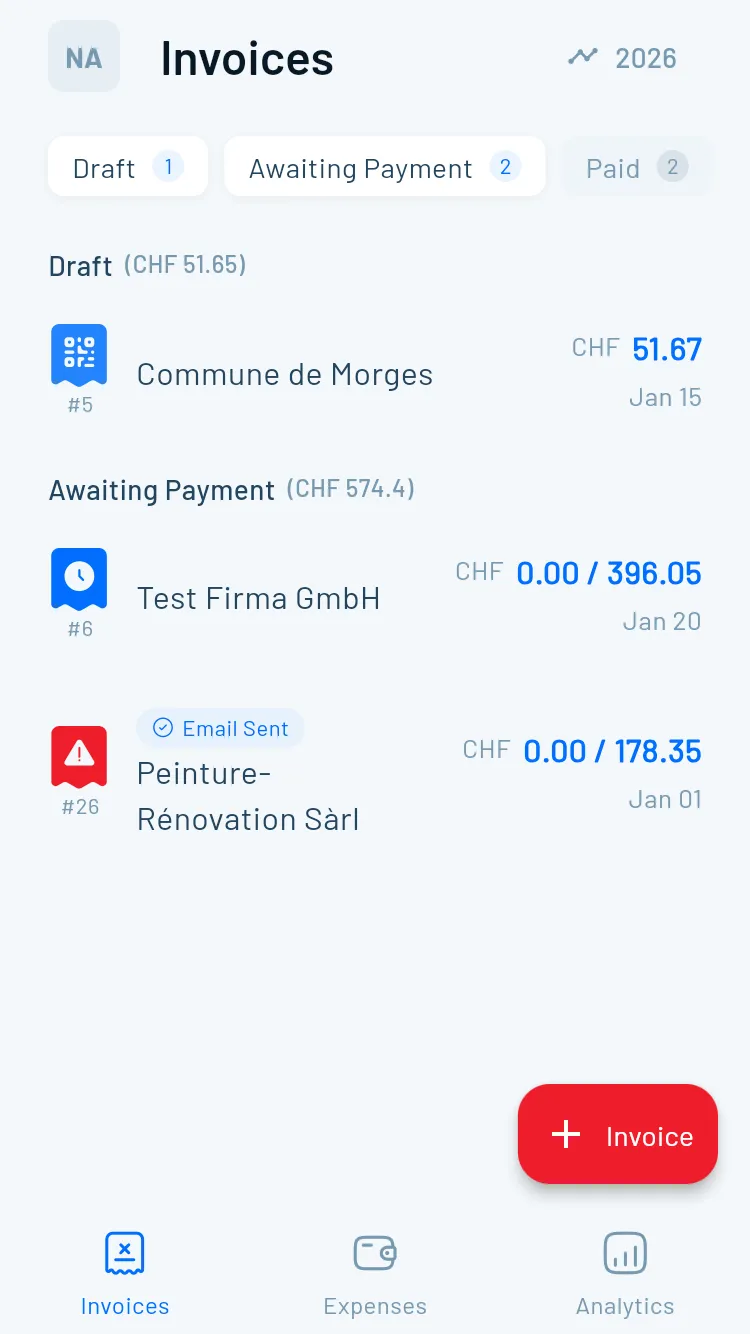
Type the client's name and amount on your iPhone. The Swiss QR-bill is generated automatically.
Receipt when you pay
Photo of the restaurant receipt. The AI scan pulls date, amount, and VAT.
Quarter-end
Three clicks and you have the VAT return as Excel for the ESTV portal.
Year-end
Click 'Year-end closing', pick the tax year, download ZIP, I&E-Excel, and VAT-Excel.
Even on 30 December from your iPhone.
Magic Heidi has native apps for iPhone, Android, Mac, Windows, and Web — all synced. You can do your year-end closing from the sofa, on 30 December, right after dinner. Bexio, Banana, and most Swiss competitors are primarily web apps. When your WiFi acts up, you're stuck. Magic Heidi also runs offline on the native apps and syncs the moment you're back online.
When does simplified accounting actually do the job?
The honest answer: for the vast majority of Swiss freelancers, it does — far more often than accountants admit. Three conditions need to apply.
Sole proprietorship or partnership
Not GmbH or AG — those automatically trigger double-entry bookkeeping.
Annual turnover under CHF 500,000
Above this threshold, OR Article 957 mandates full accounting.
No inventory to track
A few supplies are fine. A real stock of goods requires double-entry.
Picture Lena, a fictional Swiss graphic designer in Zurich, billing CHF 95,000 a year, working from her Mac, with 18 clients. She doesn't need double-entry bookkeeping. She needs a clean I&E statement and 23 archived receipts. That's exactly what Magic Heidi is built for. If you cross CHF 500,000 in turnover or operate as a GmbH, an SME solution like bexio fits better — and probably an accountant too.
Do you still need an accountant?
Depends on you. Three realistic scenarios where Magic Heidi either replaces your accountant or makes them dramatically cheaper.
You don't need one
Solo, turnover under CHF 100,000, clear income and expenses. You export the I&E and copy the figures into your cantonal tax form. Time saved: one to two hours in January.
Just the finished exports
VAT-registered or complex deductions. Instead of a box of receipts, you hand the accountant the ZIP, the I&E-Excel, and the VAT-Excel. The bill typically drops from CHF 800–1,500 to CHF 200–400.
Keep the accountant, clean data
Switching to a GmbH, international mandates, or active tax optimisation. Keep the accountant — but hand over clean Excel files instead of paper receipts.
Checklist: your sole proprietorship year-end closing in 7 steps
If you've used Magic Heidi during the year, this flow takes about 5 minutes. If you're migrating from another tool, plan 60–90 minutes, once.
- All invoices captured? Check in the app that every invoice for the year is issued and dated.
- All receipts photographed? Skim your bank statements for expenses that don't yet have a receipt in Magic Heidi. Photo, done.
- Reconcile the bank. Import your bank statement (CSV) and match open payments to invoices, so you know which invoices are still unpaid at year-end.
- Check VAT (if relevant). Look at the Q1–Q4 returns. Does the balance match? On the net tax rate method: is the right rate set?
- Export the year-end closing. Click "Year-end closing", pick the tax year, download the three files (receipts ZIP, I&E-Excel, VAT-Excel).
- Transfer data to the tax form. Copy the I&E figures into the cantonal Schedule A for self-employed. If your accountant handles this, you send them the three files.
- Archive the receipts. Save the ZIP locally or in a private cloud folder. Magic Heidi keeps the originals for 10 years, but a personal copy never hurts.
This sequence works for 95% of the Swiss freelancers we know.
Magic Heidi vs. the alternatives
Fair and factual. Magic Heidi is the solution if you want to run your solo business cleanly, without an accounting course.
| Feature | Magic Heidi | bexio | Banana | Milkee, Milchbüechli |
|---|---|---|---|---|
| Built for | Solo, sole proprietorship | SMEs with a team | Accountants, double-entry | Sole proprietorship |
| Receipts as ZIP | ✓ One click | ⚠ Partial, manual | ✗ | ✓ |
| I&E as Excel | ✓ One click | ✗ P&L only | ✗ Journal only | ✗ PDF, not Excel |
| VAT as Excel | ✓ Both methods | ⚠ CSV | ⚠ CSV | ⚠ Limited |
| Price for sole proprietorship | CHF 25–39/month | from CHF 45/month | from CHF 79/year | CHF 10–20/month |
Simple pricing. No surprises.
Year-end closing export is included in the Pro plan at no extra cost.
Free
- 3 invoices
- AI receipt scanning included
- Automatic VAT calculation
- No credit card
Pro annual
- Everything in Free
- Unlimited invoices, expenses, clients
- Full year-end export (ZIP, I&E-Excel, VAT-Excel)
- Automatic bank reconciliation
- Priority support in DE, FR, IT, EN
- Zapier and API access
Pro monthly
- Everything in Free
- Unlimited invoices, expenses, clients
- Full year-end export
- Automatic bank reconciliation
- Priority support in DE, FR, IT, EN
Frequently asked questions about year-end closing
What has to go into a sole proprietorship's year-end closing?
For sole proprietorships under CHF 500,000 in annual turnover, an income-expense statement with an asset position is enough (simplified accounting). It covers: all income from issued invoices, all business expenses with receipts, and a summary of receivables and payables as of 31 December. Magic Heidi generates the I&E as an Excel file in one click, so you or your accountant can check and adjust the figures directly.
What are the deadlines for year-end closing in Switzerland?
The cantonal tax filing deadline is usually 31 March of the following year, with extensions available until September or November (varies by canton — e.g. Zurich, Bern, Vaud). For VAT, the final quarterly return (Q4) is due within 60 days of quarter-end, so by the end of February.
Do I need an accountant as a sole proprietorship?
No, if your turnover is under CHF 500,000 and you're not a GmbH. With Magic Heidi you export the I&E and VAT summary yourself. If you still hire an accountant, you hand them the finished Excel exports instead of a box of receipts — typically cutting the bill by roughly two-thirds.
How long do I have to keep receipts?
10 years from the end of the financial year, per Article 958f of the Swiss Code of Obligations. Digital retention is explicitly allowed as long as the receipts remain unaltered and legible. Magic Heidi keeps your receipts available for the full retention period, and you can export ZIPs at any time for additional local backup.
Do I have to produce a balance sheet as a sole proprietorship?
No, not below CHF 500,000 in turnover. You only need the income-expense statement and a simple asset position (open items at 31 December). A full balance sheet with assets and liabilities is only required above CHF 500,000, per OR Article 957.
What happens if I'm VAT-registered?
As soon as your rolling 12-month turnover crosses CHF 100,000, you become VAT-liable. Magic Heidi tracks your turnover and flags it. Both methods (effective and net tax rate) are built in, and quarterly returns export as Excel so you can transfer the numbers straight into the ESTV portal.
Can I do the prior year's closing in January?
Yes. You can enter receipts retroactively and create invoices with prior-year dates. The only thing that matters: everything has to be entered before you export the year-end. In practice, most Magic Heidi users do their closing between 5 and 25 January.
How much does Magic Heidi's year-end export cost?
The export is included in the Pro plan (CHF 25–39/month) at no extra cost. It's not available on the Free plan because Free is capped at 3 invoices. If you upgrade, you can immediately export the full year-end for the current year, including retroactively.
Ready for a quiet January?
Picture this: your 2026 year-end closing is done on 15 January 2027, in five minutes on a Sunday evening. You've got the I&E and VAT summary as Excel on your desk, a ZIP of every receipt in your cloud folder, and the rest of January is yours.