 Magic Heidi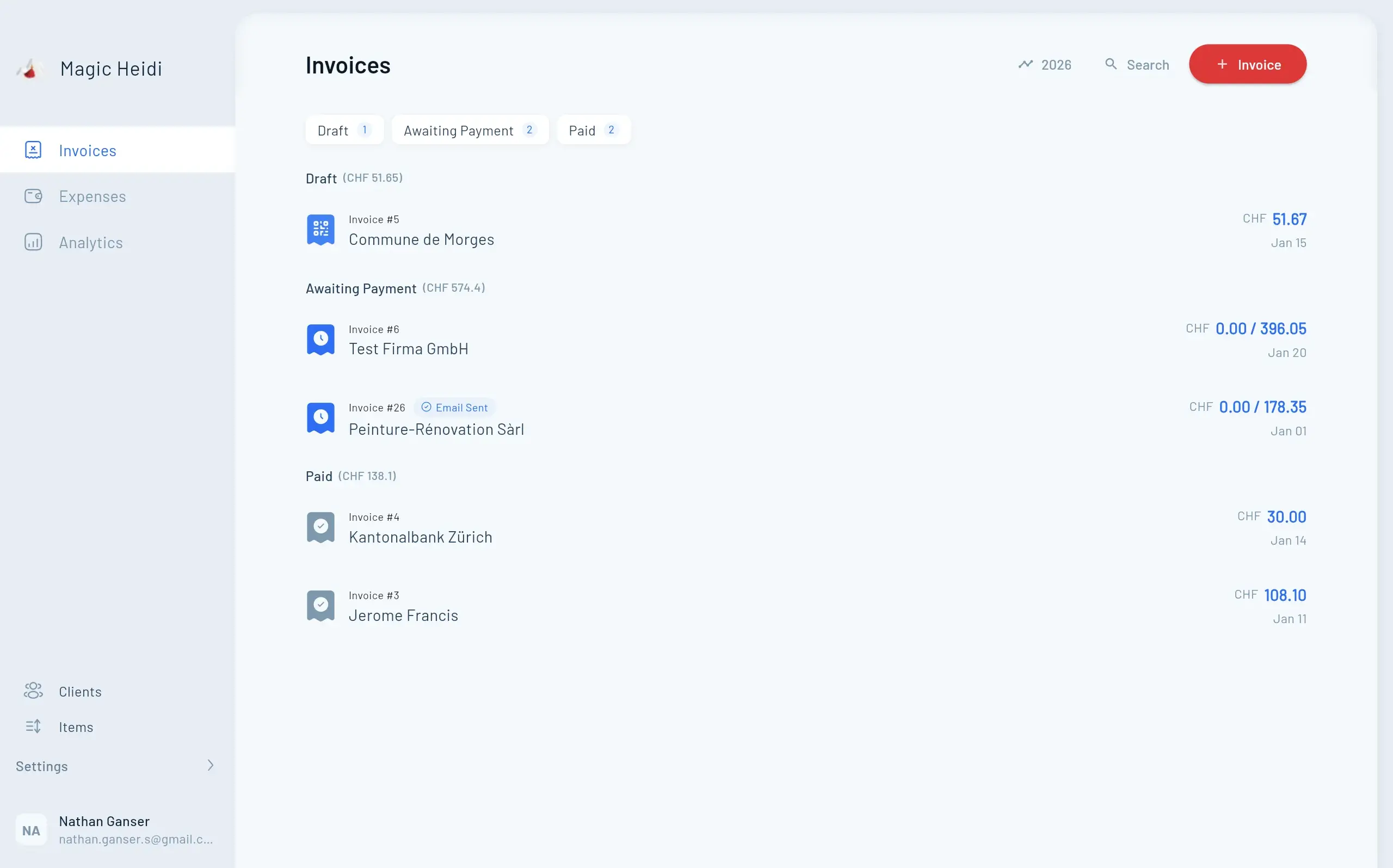
Swiss Cross-Border Commuter Taxes 2026: Where You Really Pay
Where cross-border commuters pay taxes, how the home office trap works, and what the B permit and withholding tax mean — with examples.

Founder of Magic Heidi
As a cross-border commuter (Grenzgänger) in Switzerland, you earn Swiss francs but live across the border — in Germany, France, or Italy. That has more tax implications than just a longer commute. Where you pay your taxes isn't decided by gut feeling, but by the double taxation agreement (DBA), your permit, and — increasingly decisive since 2023 — how many days you work from home.
In this article, I'll walk through the question "cross-border commuter Switzerland taxes — where do you pay?" step by step: from the G permit to the workplace principle in the Switzerland–Germany DBA, to the home office trap that can shift taxing rights. Plus: withholding tax with the B permit, the 90% rule, and what happens if you invoice Swiss clients as a self-employed cross-border commuter.
The most important points up front:
- Cross-border commuters from Germany generally pay their income tax where they work — so in Switzerland (DBA CH–DE, Art. 15).
- Since 2023, Art. 15a DBA CH–DE applies: working from home can shift taxing rights to your country of residence, fully or partially. The mutual agreement between the tax authorities allows a tolerance of up to 39 home office days per year — beyond that, taxing rights shift day by day.
- Cross-border commuters with a B permit (frontaliers from France/Italy) generally pay withholding tax in Switzerland; Switzerland retains primary taxing rights over France.
- A cross-border commuter with residence in Germany and a weekly stay in Switzerland can, under certain conditions, be taxed like a Swiss resident under the 90% rule (quasi-residency).
- Self-employed on the side? A sole proprietorship in Switzerland is possible as a cross-border commuter — but it doesn't change the rules for your cross-border salary.
What is a cross-border commuter — and which permit do you need?
A cross-border commuter is someone who lives in one country and works in another, while returning home regularly. In Switzerland, the term matters mainly for administrative purposes: anyone entering from an EU/EFTA state needs a work permit — and that permit distinguishes whether you commute daily or stay for the week.
The G permit (cross-border commuter permit)
Nationals of EU/EFTA states receive the G permit if they work in Switzerland and live abroad. Requirement: as a rule, they must return to their place of residence at least once a week. Anyone who does that counts administratively as a cross-border commuter — though they may have to live in an eligible border municipality (France and Italy maintain lists; the bilateral treaties set out the details, readable on admin.ch).
The G permit itself says nothing about where you become tax liable. It only regulates that you're allowed to work. The tax question is answered by the double taxation agreements — and that's where the wheat separates from the chaff.
Why your place of residence doesn't automatically carry the taxes with it
Many cross-border commuters assume they pay taxes where they're registered. In most international DBAs, that's exactly the norm: the country of residence taxes worldwide income. But Switzerland has agreed special rules for employees with its neighboring countries. To understand your situation, you always need the combination of three building blocks: country of residence, employment contract, and place of work — and recently also the commute into your own living room.
Where do cross-border commuters pay taxes? The workplace principle in the DBA
The short answer to "cross-border commuter Switzerland taxes — where do you pay?": Germany: in Switzerland. France and Italy: in Switzerland via withholding tax, credited in your country of residence. The long answer has details that can move several thousand francs.
Germany–Switzerland: salary is taxed in Switzerland
The double taxation agreement between Germany and Switzerland assigns income from employment to the state where the work is performed (Art. 15 DBA CH–DE — the workplace principle). So if you work in Basel or Zurich and live in Lörrach, you pay income tax on your Swiss salary in Switzerland.
That applies not only to federal tax: the tax equalization between Switzerland and Germany ensures that German church tax and solidarity surcharge claims on that salary don't apply either. In practice: your Swiss employer withholds the taxes directly from your salary and remits them to Switzerland.
Example: Martin from Lörrach. Martin is a mechanical engineer, works in Basel, and earns CHF 96,000.00 a year. On his payslips he sees the tax deduction of the canton of Basel-Stadt every month: about CHF 14,000.00 in taxes per year, withheld directly by the employer. Martin's gross-to-net ratio ends up similar to that of a Basel colleague with the same salary — except he crosses the border every day and gets paid in CHF.
In Germany, Martin still declares his Swiss salary: he's fully tax liable there (residence principle), but the salary is credited against the Swiss taxation. Result: no double taxation, but a clean split. Anyone who's sloppy here gets mail from the German tax office first and from Switzerland later — a dual procedure that's more stressful than the Black Forest-adjacent traffic jams at customs.
France–Switzerland and Italy–Switzerland: withholding tax with special rules
For France–Switzerland cross-border commuters (frontaliers) and Italy–Switzerland cross-border commuters, separate treaties and additional protocols apply that differ from the standard pattern: Switzerland generally retains primary taxing rights on employment income for cross-border commuters from France and Italy and deducts it as withholding tax (Quellensteuer) directly from the salary. France and Italy then tax according to their own rules and credit the Swiss withholding tax — the details of the crediting and the affected border zones are finely regulated by treaty and change again and again. Don't rely on blog posts here (not even this one): the authoritative treaty texts are in the Systematic Collection of Laws on admin.ch.
Example: Céline from Saint-Louis
Example: Céline from Saint-Louis. Céline lives in Saint-Louis, France, eight kilometers from Basel, and works as a nursing specialist in a Basel hospital. Her salary of CHF 78,000.00 is taxed in Switzerland with withholding tax — her employer withholds the tax monthly and transfers it to the tax authority. In France she declares the salary, and the Swiss withholding tax is credited under the rules of the bilateral agreement. What's left net is a bit more than if she had the same job in Saint-Louis — reason enough to cross the border every day.
The home office tax trap since 2023 (Art. 15a DBA CH–DE)
And now the part that has changed the lives of many cross-border commuters since 2023 — and the reason why "cross-border commuter Switzerland taxes" has to be rethought.
What Art. 15a DBA CH–DE regulates
The revised agreement between Switzerland and Germany brings a new logic with Art. 15a: employment exercised in the country of residence — plain home office on the German side of the border — can shift taxing rights for those days to Germany. In Art. 15a para. 4, Switzerland reserves the right to waive taxing such days as long as those affected maintain their regular return to the workplace.
The authorities of both countries have agreed on a mutual agreement: anyone who works from home a maximum of 39 days per year has those home office days disregarded for now — Switzerland continues to tax the full salary. Anyone who works from home beyond that shifts taxing rights day by day to Germany: each home office day beyond the tolerance is then taxed in Germany and backed out of the Swiss tax calculation.
Why 39 days matter so much
Example: Daniel from Kandern. Daniel is a software developer at a Bern company, earns CHF 110,000.00, and enjoys working from home since Corona. His team has scheduled two home office days per week — that's quickly over 90 days a year. The effect: a large part of his salary is shifted to Germany, at German rates. At his income, that means about CHF 4,000.00 to 6,000.00 more tax burden per year, depending on the federal state and church tax. Daniel's company has therefore throttled the home office rule for cross-border commuters down to one day per week — it doesn't want to run two tax procedures for every employee.
The lesson: if you're a Germany–Switzerland cross-border commuter, keep a home office log. Days not documented in writing won't help you when the tax office asks. And a rule of thumb: under 40 days per year, you're on the safe side of the mutual agreement — your tax advisor or the competent authority checks the exact effects in your individual case.
What applies to France and Italy
France and Italy have comparable discussions about remote work, but their treaty situations are different and in flux. Anyone who, as a frontalier or cross-border commuter from Italy, shifts significantly into home office risks — depending on the treaty — a requalification of the entire situation. The rule here: check every single home office week against your withholding tax basis and ask the ESTV if in doubt.
Withholding tax and the B permit: the 90% rule and quasi-residency
Two terms come up constantly with cross-border commuters — and are constantly confused.
Withholding tax: tax straight from the salary
The withholding tax is a tax the employer withholds directly from your salary and transfers to the tax authority — so you never see it in your account. For cross-border commuters from France and Italy it's the norm; for those from Germany it effectively applies through Swiss payroll tax at the workplace. If you want to dig deeper, read the detailed guide on withholding tax in Switzerland.
The B permit: residence with a weekly stay
Anyone who doesn't return every week, but lives in Switzerland during the week and only goes home on weekends, receives — depending on the situation — the B permit (residence permit). What becomes tax relevant: anyone who spends more than the usual tolerance of days in Switzerland can become tax liable there. For cross-border commuters from France and Italy, the difference between the G and B permit is therefore not just an administrative but a tax issue — the B permit and withholding tax go together like invoice and payment.
Quasi-residency: the 90% rule
Anyone who, as a Germany-based cross-border commuter, earns more than 90% of worldwide income from Switzerland is considered quasi-resident in Switzerland under Art. 15a and the applicable rules — and is then taxed on their employment like a Swiss resident, no longer under the cross-border commuter regime. That sounds like a detail, but it can noticeably change your tax burden, because Swiss rates then apply to your entire employment income.
If you want to know how much net remains from the gross salary before all these rules kick in, use the gross-to-net calculator for Switzerland.
Self-employed as a cross-border commuter: invoicing Swiss clients
So far this has been about employment — the normal cross-border commuter job. But what if you invoice clients as a self-employed cross-border commuter?
The sole proprietorship as a cross-border commuter
The basic rule: self-employment is always taxed where the actual business activity takes place, not where you live. Anyone who founds a sole proprietorship in Switzerland as a cross-border commuter — with a registered seat and real business activity — taxes the profit in Switzerland. The country of residence takes the profit into the crediting under the DBA. Caution: a mere letterbox address isn't enough; what matters is where the work is actually done.
Important for the compatibility check: self-employment alongside your cross-border commuter job can affect your permit. The G permit covers the employed position with one employer; if you want to work self-employed on the side, you may need a separate permit depending on your status.
What changes for invoices and VAT
Anyone invoicing Swiss clients can't avoid two topics: Swiss VAT (MWST) and professional invoicing. VAT is 8.1% on most services; from CHF 100,000.00 annual revenue it becomes mandatory to register — this threshold also applies to cross-border commuters with a Swiss sole proprietorship. Once VAT-liable, invoices must meet the statutory requirements, including the QR-bill for Swiss payments. With Magic Heidi's invoicing software you create QR-bills and send them in minutes — including the VAT account you need for your tax return.
The AHV (Swiss state pension) is the second topic: as a self-employed cross-border commuter, you're generally AHV-liable in Switzerland — the details are governed by the social security agreements, with an overview at ahv.ch. Get this wrong and you'll pay back contributions later that can quickly run into four figures.
Example: Luca from Como, self-employed in Lugano
Example: Luca. Luca lives in Como and works as a UX designer, self-employed, for Swiss clients. He has a sole proprietorship based in Lugano and invoices in CHF. His revenue is CHF 85,000.00 per year — still below the VAT threshold, but only just. In 2026 he crosses CHF 100,000.00 and must register with the ESTV for VAT within 30 days. Luca now calculates 8.1% on his invoices — before, his clients preferred the price without VAT; now the VAT amount is simply a line on the QR-bill they're used to.
Luca's tax situation: the profit is taxed in Switzerland (business activity in Lugano), credited in Italy under the DBA rules. His home country remains responsible for his personal tax liability — but the self-employment follows the place of business. What's unusual for cross-border commuters in permanent jobs is routine for the self-employed: taxes follow the work, not the bedroom.
Practical tips for cross-border commuters: receipts, exchange rate, tax equalization
To finish, the practical part — the things you can actually do this year.
1. Keep a home office log
Note every home office day, with the date. At year's end, that gives you the decisive document if the tax office or the Swiss authority asks whether you're still a cross-border commuter in the sense of the mutual agreement. A simple calendar page is enough — the point is that it exists.
2. Watch the CHF/EUR exchange rate
As a Germany–Switzerland cross-border commuter, you earn in CHF but partly live in EUR. In your tax return, CHF amounts have to be converted to EUR — and vice versa for Swiss purposes. For all tax conversions, use the official monthly or annual average rates of the ESTV or the German authorities, not the daily rate of your bank. Anyone who works with mental-math rates gets follow-up questions.
3. Keep your receipts on both sides
You need receipts for Switzerland and your country of residence. Retention period in Switzerland: 10 years. Digital filing is your friend — with Magic Heidi you have invoices and receipts in one place, including the VAT categories you need for both returns. And if you need help with deductions, it's worth checking the guide on fiduciary costs in Switzerland — a good fiduciary often pays for itself faster than you'd think in cross-border situations.
4. Understand the tax equalization
The tax equalization between Switzerland and Germany regulates who taxes what — including the question of whether German levies like church tax apply to the Swiss salary. Once you understand the basic mechanics, the German tax assessment showing your Swiss salary but coming out at 0 EUR in tax won't scare you anymore. That's not an error — that's the equalization.
5. Review your retirement planning
As a cross-border commuter, you pay into the Swiss AHV and probably into a pension fund. Pillar 3a is often open to cross-border commuters — but deductibility depends on your tax liability. This is worth individual advice; blanket statements from Facebook groups shouldn't be the basis for retirement decisions. We cover other tax topics that are often misunderstood by cross-border commuters in the article on Verrechnungssteuer (Swiss withholding tax on investments).
Conclusion: being a cross-border commuter means knowing the rules
The question "cross-border commuter Switzerland taxes" doesn't have a one-sentence answer — but it does have a clear structure:
- Live in Germany? Then Switzerland collects your income tax at the workplace (Art. 15 DBA CH–DE) — as long as you keep your home office days under control.
- Live in France or Italy? Then Switzerland collects primary taxing rights via withholding tax; the bilateral treaties set the details.
- Home office beyond 39 days shifts taxing rights day by day to your country of residence — a log is your best protection.
- Self-employed? Then the tax follows the business activity, and VAT from CHF 100,000.00 revenue is mandatory — including QR-bills and 8.1%.
If you know the rules, you save twice: on taxes paid too much, and on stress with two tax authorities at once. And if you invoice as a self-employed cross-border commuter, you don't want to lose your admin in two countries and three tools. Magic Heidi gives you invoices, receipts, and VAT in one tool — for CHF 25.00 per month on the monthly plan, cheaper on the annual plan. Exactly what's included is in the pricing overview. Try it out — your first invoice goes out in minutes.
Frequently Asked Questions about Swiss Cross-Border Commuter Taxes
How many home office days are allowed for cross-border commuters?
Under the mutual agreement between Switzerland and Germany, up to 39 home office days per year are disregarded — Switzerland continues to tax the full salary. Anyone working from home more than 39 days shifts taxing rights day by day to their country of residence (Art. 15a DBA CH–DE). The basis is a home office log documenting every day. Separate treaty rules apply to France and Italy.
Where does a cross-border commuter pay taxes?
Cross-border commuters from Germany pay income tax on their Swiss salary at the workplace, i.e. in Switzerland (Art. 15 DBA CH–DE). Cross-border commuters from France and Italy pay via Swiss withholding tax, deducted directly from the salary; the country of residence credits it under the bilateral agreement. The country of residence remains responsible for other income and handles the crediting.
Does a cross-border commuter have to file a tax return in Switzerland?
That depends on your permit and income situation. Cross-border commuters from Germany with purely payroll taxation in Switzerland pay via their employer and file the return with their country of residence. Cross-border commuters with a B permit or quasi-residency (90% rule) are fully tax liable in Switzerland and file a Swiss tax return. For the self-employed with a sole proprietorship, tax liability at the place of business applies anyway.
What does a tax advisor for cross-border commuters cost?
A cross-border commuter tax return involving Germany typically costs CHF 500.00 to CHF 1,500.00 per year with a tax advisor, depending on complexity — more for complex situations with home office shifts or self-employment. A fiduciary is especially worthwhile for clarifying your situation the first time; after that, the ongoing return can often be prepared yourself.
Can a cross-border commuter found a sole proprietorship in Switzerland?
Basically yes — a sole proprietorship with its seat and actual business activity in Switzerland is possible for people living abroad too. The profit is then taxed in Switzerland, and the country of residence credits it under the DBA. Important: self-employment can affect your G permit, and from CHF 100,000.00 annual revenue there's VAT liability (standard rate 8.1%) including QR-bills.
What is quasi-residency for a cross-border commuter?
Quasi-residency means a cross-border commuter is taxed on their employment like a Swiss resident. One requirement is, among others, that more than 90% of worldwide income comes from Switzerland. In that case, additional deductions and Swiss rates apply to the employment — that can noticeably change your tax burden and is a classic case for individual advice.