Physiotherapy Invoicing Switzerland

Physiotherapeut Rechnung Schweiz

Physiotherapists in Switzerland must issue invoices that comply with Swiss law (7 mandatory elements under Art. 26 MWSTV, QR-Rechnung) and apply the correct MWST treatment — exempt for medically prescribed therapies, 8.1% for wellness. Here's how to do it correctly.

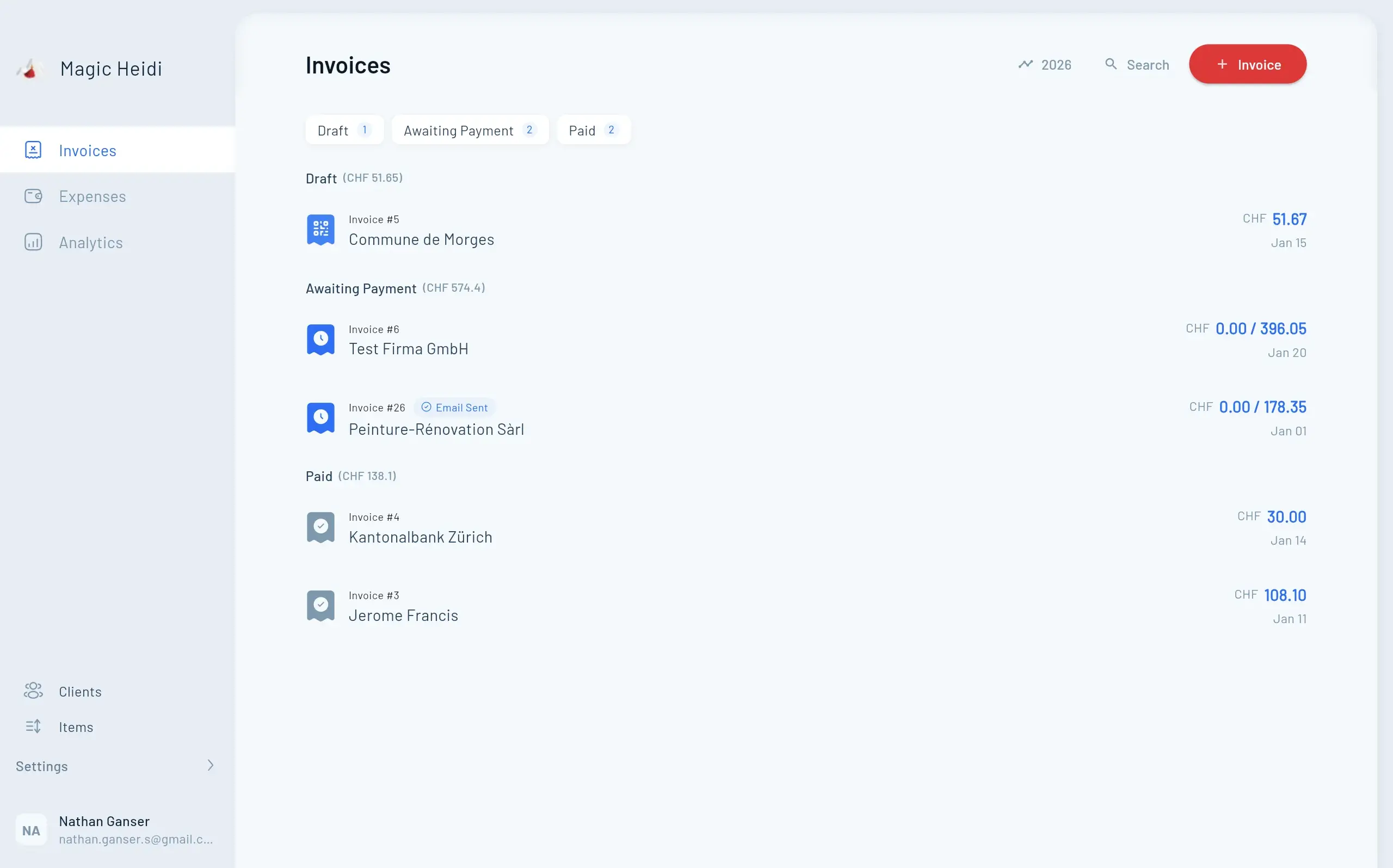
Magic Heidi Invoice List

Why Proper Invoicing Matters
for Swiss Physiotherapists

Since October 2022, the QR-Rechnung is mandatory — the old ESR payment slips are gone. Physiotherapists face the MWST split between prescribed (exempt) and wellness (8.1%) treatments, four different billing paths (KVG, UVG, private, Selbstzahler), and seven mandatory elements under Art. 26 MWSTV. Get any of these wrong and you risk rejected Krankenkasse claims, ESTV audit headaches, or patients who refuse to pay.

QR-Rechnung Mandate

Old ESR slips gone since Oct 2022 — QR code with QR-IBAN now required
💰

MWST Prescription Split

Exempt for prescribed therapy, 8.1% for wellness — per invoice
🏥

Four Billing Paths

KVG, UVG, private, and Selbstzahler each have different rules

Art. 26 MWSTV Elements

Seven mandatory fields including MWST number and service description

Key Takeaways

  • Medically prescribed physiotherapy is MWST-exempt (Art. 21 MWSTG). Wellness treatments without a doctor's prescription are MWST-pflichtig at 8.1%. This distinction defines how you write every Rechnung.
  • QR-Rechnung is mandatory since October 2022. The old red/orange ESR slips are gone — every invoice needs a Swiss QR code for payment.
  • Seven mandatory invoice elements under Art. 26 MWSTV apply if you're MWST-registered: name/address, recipient, date, quantity/description, net amount, MWST rate and amount, and your MWST number.
  • MWST threshold is CHF 100,000 annual revenue. Below that, you're not MWST-liable and state "Mehrwertsteuer nicht ausgewiesen, da nicht steuerpflichtig."
  • Four billing paths exist: KVG (health insurance), UVG (accident insurance), private patients, and Selbstzahler (self-payer). Each has different tariff rules and invoice recipients.

If you're a self-employed physiotherapist in Switzerland — or planning to become one — invoicing is where compliance, tax law, and daily practice collide. One wrong line on your Rechnung can mean a rejected claim from the Krankenkasse, an MWST correction from the ESTV, or a patient who refuses to pay. This guide walks through everything you need to know about physiotherapie rechnung erstellen in Switzerland: the legal requirements, the MWST distinction that trips up most therapists, the four billing scenarios, tariff structures, and a ready-to-use invoice template.

We'll also show how Magic Heidi's invoicing workflow handles the Swiss-specific quirks — QR-Rechnung generation, MWST-exempt vs. MWST-pflichtig lines, and patient-prescription tracking — without the bloat of enterprise software.

Swiss Invoice Requirements: 7 Mandatory Elements (Art. 26 MWSTV)

Every Physiotherapeut Rechnung Schweiz must meet formal requirements. If you're MWST-registered, Art. 26 of the Mehrwertsteuerverordnung (MWSTV) defines seven mandatory elements your invoice must contain:

  1. Your name and address — full practice name, street, postal code, city.
  2. The recipient's name and address — patient or insurance payer.
  3. Invoice date — the day you issue the Rechnung.
  4. Quantity and description of services — e.g., "Physiotherapeutische Behandlung, 50 min, ärztlich verordnet" with the prescription number.
  5. Taxable amount — the net amount before MWST (if MWST applies).
  6. MWST rate and MWST amount — 8.1% and the resulting tax, shown separately.
  7. Your MWST number (MWST-Nr.) — the UID-based number the ESTV assigns when you register.

If your treatment is MWST-exempt (prescribed physiotherapy), you don't show MWST, but you still identify the exemption. A common line reads: "Mehrwertsteuerfrei gemäss Art. 21 Abs. 2 Ziff. 19 MWSTG — ärztlich verordnete Heilbehandlung."

Below the CHF 100,000 threshold? You're not MWST-liable at all. State clearly: "Mehrwertsteuer nicht ausgewiesen, da nicht steuerpflichtig." This tells the patient — and the ESTV — that you're under the threshold and haven't opted in.

The QR-Rechnung: Non-Negotiable Since 2022

Since October 1, 2022, the QR-Rechnung is the only accepted payment slip format in Switzerland. The old ESR (orange/red) and BESR (red) slips are retired. Every invoice you issue — KVG, UVG, private, or Selbstzahler — should include a QR-Rechnung payment part with the Swiss QR code.

The QR code encodes your IBAN (QR-IBAN), the amount, your name, and the reference number. Patients scan it with their banking app. The Krankenkasse can process it automatically. No QR code = manual payment friction.

Thomas, a physiotherapist in Aarau, learned this the hard way. He sent paper invoices without the QR payment part in early 2023. Three patients paid late, and one Krankenkasse rejected the claim entirely because the format didn't meet the new standard. He switched to Magic Heidi's invoicing workflow, which generates the QR-Rechnung payment part automatically on every invoice — no manual formatting, no rejected claims.

MWST Rules for Physiotherapists: Prescribed vs. Wellness

This is the core confusion point for Swiss physiotherapists. Get this wrong, and you'll either overcharge patients or face an MWST back-payment to the ESTV.

The Rule

Under Art. 21 Abs. 2 Ziff. 19 MWSTG, ärztlich verordnete physiotherapeutische Heilbehandlungen are MWST-exempt. "Ärztlich verordnet" means a licensed physician has issued a medical prescription (ärztliche Verordnung) for the treatment. The prescription must name you (or be transferable under cantonal rules), name the patient, specify the diagnosis and treatment type, and be within its validity period.

Wellness, fitness, prevention, and self-payer treatments without a medical prescription are MWST-pflichtig at 8.1% (the standard rate since January 1, 2024). This includes sports massage, posture coaching, general mobility training, and anything billed directly to a patient who didn't get a doctor's referral.

Why This Trips People Up

A patient comes in for back pain. You treat them. If they have a prescription, the treatment is MWST-exempt. If they don't — even if the treatment is identical — it's MWST-pflichtig. Same hands, same techniques, different tax outcome based on whether a piece of paper exists.

Lisa runs a small practice in Lausanne. She offers both prescribed KVG treatments and a wellness program (posture classes) for Selbstzahler. For the first, she issues MWST-exempt invoices. For the second, she charges 8.1% MWST. Before she understood the distinction, she issued wellness invoices without MWST — and had to absorb the tax herself when the ESTV audited her. Now she tracks prescription status on every patient file and lets Magic Heidi's MWST management toggle the correct rate automatically.

The CHF 100,000 Threshold

You only register for MWST if your annual taxable revenue exceeds CHF 100,000. Below that, you're a "nicht steuerpflichtig" small business. But here's the catch: if most of your revenue is MWST-exempt (prescribed treatments), you may still want to register voluntarily to reclaim input tax on rent, equipment, and supplies. Voluntary registration is allowed — talk to a tax advisor about whether it makes sense for your practice.

Once registered, you file MWST returns with the ESTV (Eidgenössische Steuerverwaltung) — typically quarterly or annually, depending on your revenue.

Billing Scenarios: KVG, UVG, Private, Self-Payer

Swiss physiotherapy billing splits into four scenarios, each with different payers, tariffs, and invoice formats.

1. KVG (Krankenversicherungsgesetz) / LAMal

When a doctor prescribes physiotherapy, the patient's Krankenkasse (health insurance) covers most of the cost after the patient's franchise and deductible. You bill either:

  • Directly to the Krankenkasse — using the KVG tariff (regulated), with the prescription number, diagnosis code, and treatment session details. The Krankenkasse pays you.
  • To the patient, who claims reimbursement — the patient pays you, then submits to their Krankenkasse.

KVG rates are regulated — you can't charge above the tariff set by the cantonal health authority. The tariff typically covers a 50-minute treatment session, with specific position numbers for assessment, therapy, and follow-up.

The Physioswiss professional association publishes the current tariff positions and treatment codes.

2. UVG (Unfallversicherungsgesetz)

Workplace or non-occupational accidents fall under UVG — accident insurance. Suva, CSS, Allianz, and other carriers handle these claims. UVG billing uses a separate tariff structure from KVG, often with higher rates (since accident insurance doesn't cap the same way).

Your invoice must reference the accident claim number (Unfallnummer), the date of accident, and the prescribing physician. UVG invoices go directly to the insurance carrier, not the patient.

3. Private Patients

Private patients — those with supplementary private insurance or paying out of pocket for non-KVG services — receive a private Rechnung. Here you have more pricing flexibility, but you must still include all seven Art. 26 MWSTV elements (if MWST-registered) and the QR-Rechnung payment part.

Private physiotherapy often bills at higher rates than KVG, especially for specialized services (sports rehabilitation, manual therapy, lymph drainage). If the treatment isn't medically prescribed, it's MWST-pflichtig at 8.1%.

4. Selbstzahler (Self-Payer)

Selbstzahler patients pay directly for treatments the Krankenkasse doesn't cover — wellness, prevention, fitness-oriented therapy, or sessions beyond what the prescription allows. These invoices go to the patient, include the QR-Rechnung, and are MWST-pflichtig at 8.1% unless the patient later produces a retroactive prescription (rare and complicated — don't count on it).

Thomas in Aarau bills about 40% of his sessions to Selbstzahler. He uses a flat CHF 130 rate for a 50-minute wellness session, plus 8.1% MWST, clearly itemized. His invoices say "Keine ärztliche Verordnung — Wellnessbehandlung, MWST-pflichtig" so there's no ambiguity.

Swiss Compliance
Built for Physiotherapists

Magic Heidi handles every Swiss-specific requirement for physiotherapy invoices automatically — QR-Rechnung generation, MWST-exempt vs. MWST-pflichtig toggles, prescription tracking, and KVG/UVG/private/Selbstzahler templates.

🇨🇭 Swiss Made
🔒 Zürich Servers
📋 MWST Ready
QR-Bill Compliant
📱
QR-Bill Generation

Compliant QR code with QR-IBAN on every Swiss invoice

💰
MWST Toggle

Exempt for prescribed, 8.1% for wellness — per invoice

📋
Prescription Tracking

Store Verordnungsnummer, prescribing physician, and validity date per patient

🏥
Four Billing Paths

KVG, UVG, private, and Selbstzahler invoice templates — switch without retyping

Pricing and Tariff Structures for Swiss Physiotherapists

Pricing depends on your billing path and canton.

KVG Tariffs

KVG rates are cantonal — each canton sets its own tariff within the federal framework. A typical 50-minute prescribed treatment ranges from CHF 90 to CHF 130, with the exact position determined by the Physioswiss tariff catalog (Tarifpositionen). Assessment sessions (Befund) have their own codes. Group therapy is billed differently from individual sessions.

You can't negotiate KVG rates. You bill the tariff, the Krankenkasse pays. If you disagree with the tariff, your recourse is through Physioswiss and cantonal negotiations — not individual invoicing.

Private and Selbstzahler Rates

Here you set your own prices. Common ranges:

  • Individual session (50 min): CHF 120–180
  • Manual therapy specialist session: CHF 140–200
  • Lymph drainage: CHF 110–150
  • Sports rehabilitation: CHF 130–190

Higher rates apply in Zurich, Geneva, and Lausanne. Smaller towns trend toward the lower end. Position yourself based on your specialization, not just your canton.

UVG Tariffs

UVG billing uses the Medidata or Suva tariff structures. Rates are typically 10–20% higher than KVG for equivalent treatments, reflecting the absence of KVG cost caps. Check the current Suva tariff list or your cantonal UVG agreement.

For a full pricing comparison of how Magic Heidi stacks up against bexio (CHF 52/month) and Billify, see our breakdown — Swiss physios don't need enterprise ERP to send a Rechnung.

Cross-Border Physiotherapy Work

Some Swiss physiotherapists treat patients across the border — in France, Germany, or Italy — or work with cross-border commuters (Grenzgänger). Cross-border invoicing adds complexity:

  • MWST on cross-border services: If you treat a patient physically located in Switzerland, Swiss MWST rules apply regardless of the patient's nationality. If you treat them in France (e.g., a home visit across the border), French TVA rules may apply — and you may need to register for TVA in France.
  • KVG coverage for foreign residents: Swiss KVG doesn't cover non-residents. French, German, or Italian patients pay privately or through their own insurance, which may or may not reimburse Swiss physiotherapy.
  • Prescription validity: A French Ordonnance or German Rezept isn't automatically valid under Swiss KVG rules. The patient needs a Swiss-licensed physician's prescription for MWST exemption.

If you regularly treat cross-border patients, keep separate invoice series and track which treatments are MWST-exempt vs. MWST-pflichtig by jurisdiction. This is where most cross-border physios make errors.

Invoice Template for Swiss Physiotherapists

Here's a ready-to-use template for a Swiss physiotherapy Rechnung. Adapt the fields to your practice.

INVOICE — RECHNUNG

[Practice Name]
[Street Address]
[Postal Code, City]
Phone: [phone] | Email: [email]
MWST-Nr.: [CHE-XXX.XXX.XXX MWST]  (if registered)

Bill to:
[Patient Name or Krankenkasse Name]
[Address]

Invoice No.: 2026-0142
Date: 03.07.2026
Prescription No.: [Verordnungsnummer]  (if applicable)

Services rendered:
- Physiotherapeutische Behandlung, 50 min, ärztlich verordnet
  Date: 28.06.2026 | Position: [Tarifcode]
                                        CHF 120.00
- Physiotherapeutische Behandlung, 50 min, ärztlich verordnet
  Date: 01.07.2026 | Position: [Tarifcode]
                                        CHF 120.00

Subtotal:                              CHF 240.00
MWST (8.1%):                           CHF 0.00
(Mehrwertsteuerfrei gemäss Art. 21 Abs. 2 Ziff. 19 MWSTG)

Total due:                             CHF 240.00

Payment terms: 30 days
[QR-Rechnung payment part with Swiss QR code]

For Selbstzahler wellness invoices, swap the MWST line:

Subtotal:                              CHF 130.00
MWST (8.1%):                           CHF 10.53
Total due:                             CHF 140.53

Notice the difference: prescribed = MWST 0.00 with the Art. 21 citation. Wellness = 8.1% on top. Same invoice layout, different tax treatment. Magic Heidi's MWST management handles both automatically based on the prescription flag you set per patient.

How Magic Heidi Simplifies Physiotherapy Invoicing

Most Swiss invoicing tools are built for general freelancers — they don't understand the prescription-driven MWST split that defines physiotherapy billing. Magic Heidi does.

Built for Swiss Physiotherapists

  • QR-Rechnung generation on every invoice — no manual formatting, no rejected payments.
  • MWST-exempt vs. MWST-pflichtig toggles per line item — set the prescription flag, and the correct MWST treatment applies automatically.
  • Patient prescription tracking — store Verordnungsnummer, prescribing physician, and validity date on each patient file.
  • KVG, UVG, private, and Selbstzahler invoice templates — switch billing paths without retyping.
  • Mobile-first — issue invoices from your phone between sessions. No laptop required.

Lisa in Lausanne used to spend Sunday evenings catching up on invoices. Now she sends them from her phone, right after each session, while the patient is still in the practice. Payments arrive faster, and she never forgets a session.

Pricing Without the Overkill

Bexio charges CHF 52/month for features most physiotherapists never use. Billify has a physiotherapy page, but the pricing still adds up. Magic Heidi starts at CHF 25/month — everything you need for compliant Swiss physiotherapy invoicing, nothing you don't. See the full pricing comparison.

AI Expense Scanning

Track practice expenses — rent, equipment, continuing education — with AI expense scanning. Snap a photo of a receipt, and Magic Heidi extracts the amount, MWST, and category. Useful when you're juggling 20 patient sessions a week and don't have time for manual bookkeeping.

Video Walkthrough

Want to see it in action? Watch our invoicing demo on YouTube: Magic Heidi Invoicing Demo — a 5-minute walkthrough of creating a physiotherapy Rechnung from start to finish, including QR-Rechnung and MWST handling.

FAQ

FAQ: Physiotherapist Invoices in Switzerland

Is physiotherapy MWST-exempt in Switzerland?

Yes, if medically prescribed. Ärztlich verordnete physiotherapeutische Heilbehandlungen are MWST-exempt under Art. 21 MWSTG. Wellness and self-payer treatments without a prescription are MWST-pflichtig at 8.1%.

What's the MWST threshold for physiotherapists?

CHF 100,000 annual taxable revenue. Below that, you're not MWST-liable. Above, you must register with the ESTV and file returns.

Do I need a prescription to bill the Krankenkasse?

Yes. Under KVG, physiotherapy requires an ärztliche Verordnung from a licensed physician. Without it, the Krankenkasse won't cover the treatment, and the patient becomes a Selbstzahler — meaning MWST applies.

Can I bill the Krankenkasse directly, or must the patient pay first?

Both paths exist. You can bill the Krankenkasse directly using the KVG tariff, or bill the patient, who then claims reimbursement. Check your cantonal agreement and your contract with the specific Krankenkasse.

What's the difference between KVG and UVG billing?

KVG covers health insurance treatments (prescribed by a doctor). UVG covers accident insurance treatments (workplace or non-occupational accidents). UVG uses separate tariff structures and a different claim number (Unfallnummer). Rates are typically higher than KVG.

Do I need to register with the Ausgleichskasse?

Yes. Every self-employed physiotherapist in Switzerland must register with the Ausgleichskasse for AHV/AVS contributions, even below the MWST threshold. You may also need Handelsregister registration depending on your legal form (sole proprietorship vs. GmbH).

Conclusion

Writing a compliant Physiotherapeut Rechnung Schweiz comes down to three things: the seven Art. 26 MWSTV elements, the QR-Rechnung payment part, and the correct MWST treatment based on prescription status. Get those right, and your invoices pass Krankenkasse scrutiny, ESTV audits, and patient payment apps without friction.

The MWST split — exempt for prescribed, 8.1% for wellness — is where most physiotherapists slip. Track prescriptions per patient. Toggle the MWST flag per invoice. Use a tool that understands the difference.

Magic Heidi handles all of this at CHF 25–39/month, mobile-first, without the enterprise bloat of bexio. Try it free — your first Rechnung goes out in under five minutes.

Start invoicing with Magic Heidi →

References: Physioswiss for tariff and professional guidance · KMU Admin for MWST regulations · ESTV for tax authority information.

Create Your First Physiotherapy Invoice in 30 Seconds

No credit card required. Start invoicing your patients professionally today — QR codes, MWST, and expense tracking all included.