Translator & Interpreter Invoicing

Invoicing for Translators in Switzerland

Translators and interpreters in Switzerland must issue invoices that comply with Swiss law (7 mandatory elements, QR-Rechnung where applicable) and include industry-specific details like per-word pricing, language pair, and cross-border VAT treatment. Here's how to do it correctly.

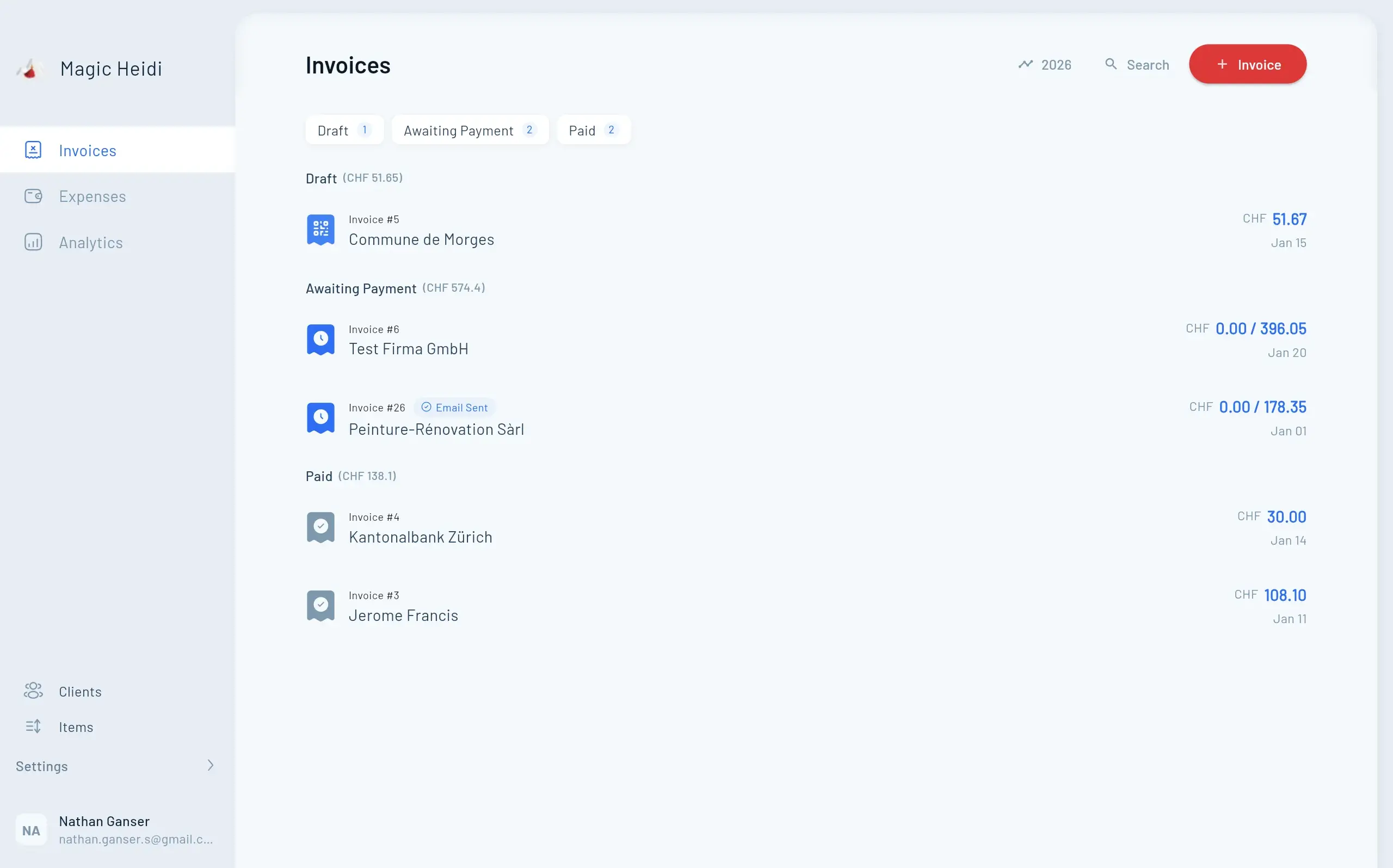
Magic Heidi Invoice List

Why Proper Invoicing Matters
for Swiss Translators & Interpreters

Since October 2022, Swiss QR-invoices are mandatory β€” the old orange and red payment slips (ESR) are no longer valid. Translators and interpreters face MWST thresholds, cross-border reverse charge rules, and seven mandatory elements under Art. 26 MWSTV. Get any of these wrong and you risk delayed payments, client confusion, or ESTV audit headaches.

⚑

QR-Invoice Mandate

Old ESR slips gone since Oct 2022 β€” QR code with QR-IBAN now required
πŸ’°

MWST at CHF 100k

8.1% on all translation and interpreting services once you hit the threshold
🌍

Cross-Border Reverse Charge

Zero-rate Swiss MWST for foreign clients β€” but document it correctly
βœ…

Art. 26 MWSTV Elements

Seven mandatory fields including language pair and per-word pricing

Key Takeaways

  • Swiss invoices must include 7 mandatory elements under Art. 26 MWSTV β€” including your UID/MWST number, sequential invoice numbering, and a clear service description with language pair and per-word/per-hour pricing.
  • The MWST standard rate is 8.1% since January 2024. The small business exemption applies if your annual revenue is under CHF 100,000 β€” you invoice net and state "Mehrwertsteuer nicht ausgewiesen, da nicht steuerpflichtig."
  • Under Art. 7 MWSTV place-of-supply rules, translations delivered to recipients abroad are taxed where the recipient is located β€” meaning zero-rated for Swiss MWST when your client is in the EU or beyond.
  • ASTTI reference rates for translation run roughly CHF 70–150 per hour (or per-word/per-line equivalents); interpreter travel time is commonly billed at around CHF 120/hour per juslingua.ch guidance.
  • Every Swiss invoice since October 2022 needs a QR-Rechnung with a QR-IBAN (starts with CH followed by 19 characters) β€” the old orange/red ESR slips are gone.

Whether you're a freelance Übersetzer turning out certified legal translations from a home office in Bern, or a Dolmetscker commuting to conference gigs in Geneva, the invoicing rules are the same β€” but the details that trip you up are specific to your craft. Per-word pricing doesn't look like hourly interpreting. A translation sent to a German agency doesn't look like a court interpreting assignment billed to a Swiss law firm. Get the structure right once, and every subsequent invoice takes about 30 seconds from your phone.

This guide walks through the seven mandatory invoice elements under Art. 26 MWSTV, the MWST rules that actually apply to translation work (including the small business exemption and place-of-supply rules for foreign clients), interpreter-specific costs like travel and per-diem, and a ready-to-use template. No fluff, no generic Europe-wide advice β€” just what Swiss translators and interpreters need to get paid correctly.

Swiss Invoice Requirements: The 7 Mandatory Elements

Article 26 of the MWSTV (Mehrwertsteuerverordnung) defines what makes an invoice legally valid in Switzerland. Miss any of these elements and the invoice may not be recognized for VAT purposes β€” which matters when the ESTV (EidgenΓΆssische Steuerverwaltung) comes asking questions, and it matters even more for your client's input tax deduction.

The seven mandatory elements

Every translator and interpreter invoice in Switzerland must include:

  1. Your full business details β€” name (or company name), address, and contact information. If you're registered in the commercial register (Handelsregister), your Handelsregisternummer.
  2. The recipient's full name and address β€” for private clients, their home address; for agencies or law firms, the company name and billing address.
  3. Invoice date β€” when the invoice was issued.
  4. A unique, sequential invoice number β€” no gaps. Rechnung #001, #002, #003, not random numbers. The ESTV checks for sequencing during audits.
  5. Description of services β€” this is where translators and interpreters need to be specific (more on this below).
  6. Total amount β€” before and after MWST, with the VAT rate and VAT amount listed separately.
  7. Your MWST number (UID) β€” if you're MWST-registered, your UID/MWST number must appear on every invoice.

The service description: translator-specific

For translators, a clear service description means more than "Translation services rendered." It should include:

  • Language pair (e.g., EN β†’ DE, FR β†’ EN, IT β†’ DE)
  • Pricing model (per word, per line, per hour, per page)
  • Quantity (word count, line count, hours, pages)
  • Unit price (CHF per word / line / hour)
  • Document title or reference (e.g., "Annual report 2025, chapters 3–7")
  • Delivery date if different from invoice date

A good line item looks like this:

Translation, EN β†’ DE, annual report 2025 β€” 12,400 words Γ— CHF 0.28 = CHF 3,472.00

For interpreters, the equivalent is:

Consecutive interpreting, FR β†’ DE, court hearing Bern β€” 4 hours Γ— CHF 120 = CHF 480.00

The service description is also where you justify your pricing to the client. An agency that gets a vague "Translation β€” CHF 3,472" will email you asking what it covers. An agency that sees the word count and per-word rate in the line item pays without questions.

The QR-Rechnung requirement

The QR code isn't technically an Art. 26 MWSTV element β€” it's a payment-processing requirement. But in practice, every Swiss invoice needs one. The QR-Rechnung replaced the old orange (ESR) and red (BESR) payment slips entirely on October 1, 2022. No Swiss bank processes the old slips anymore.

The QR code on a Swiss QR-invoice encodes:

  • QR-IBAN β€” starts with CH followed by 19 characters (not a regular IBAN β€” it contains a specific QR-IID)
  • Payee details β€” your name or business name and address
  • Amount in CHF
  • Reference number β€” structured (QR reference) or unstructured
  • Additional information (optional) β€” like a message or billing reference

You don't need to generate the QR code yourself. A proper invoicing tool like Magic Heidi's invoicing workflow handles QR-IBAN formatting and generates the scannable code automatically β€” you just pick the client, add the translation job, and the QR section appears ready to print or send as PDF.

Simplified invoices (under CHF 400)

For small jobs paid immediately β€” say, a certified translation of a single birth certificate that the client pays on the spot via Twint β€” you can issue a simplified invoice (receipt-style) with fewer elements. You still need date, amount, and a description, but you can skip the full recipient details and structured invoice numbering. Anything over CHF 400, or anything billed to a business, needs the full seven elements.

Pricing Models for Translators: Per Word, Per Line, Per Hour

Translation and interpreting have industry-specific pricing models that don't show up in most invoicing guides. Getting the model right on the invoice matters for transparency, for client trust, and for MWST calculations.

Per-word pricing (most common for translation)

The standard pricing model for written translation in Switzerland is per word (pro Wort). Typical rates depend on language pair, subject matter, and turnaround:

  • Common pairs (EN ↔ DE, FR ↔ DE, IT ↔ DE): CHF 0.20–0.35 per word
  • Specialised pairs (e.g., EN β†’ IT, FR β†’ EN for legal/medical): CHF 0.30–0.50 per word
  • Certified translations (beglaubigte Übersetzungen): CHF 0.35–0.60 per word, often with a minimum fee

On the invoice, show it as: "12,400 words Γ— CHF 0.28 = CHF 3,472.00" β€” not just the total. The client needs to see the unit price to verify the calculation.

Per-line pricing (still common in DACH)

Many Swiss-German translators and agencies still use per standard line (pro Normzeile). A Normzeile is typically 55 characters (including spaces). Rates run:

  • CHF 2.50–5.00 per Normzeile for common pairs
  • CHF 4.00–7.00 for specialised or certified work

On the invoice: "1,840 Normzeilen Γ— CHF 3.20 = CHF 5,888.00." Some agencies require this format β€” check your contract before invoicing.

Per-hour pricing (interpreting and editing)

Interpreting is almost always per hour or per day. Per-hour is standard for court interpreting, business meetings, and shorter assignments. Per-day (typically 8 hours) is common for conferences.

  • Conference interpreting: CHF 700–1,500 per day, or CHF 100–200 per hour
  • Court/legal interpreting: CHF 100–150 per hour per juslingua.ch reference rates
  • Whispered interpreting (chuchotage): similar hourly rates, often with minimums

For editing and proofreading (Lektorat/Korrektorat), per-hour is also common: CHF 70–120 per hour depending on the material.

Per-page pricing (certified documents)

For certified translations of official documents β€” birth certificates, diplomas, court rulings β€” per page is standard. Rates: CHF 50–120 per page, often with a minimum charge of CHF 100–150.

ASTTI reference rates

The ASTTI (Association Suisse des Traducteurs, Traductrices et Interprètes) publishes reference rates for Swiss translators and interpreters. These aren't binding, but they're useful when justifying your invoice to a client or negotiating with an agency. The general range:

  • Translation: CHF 70–150 per hour equivalent (depending on pair and specialisation)
  • Interpreting: CHF 100–200 per hour, with conference day rates of CHF 700–1,500
  • Minimum fees: most ASTTI members apply a minimum charge of CHF 100–150 per assignment

Quote your rate clearly on the invoice. If a client disputes the amount, the ASTTI reference rates give you an objective benchmark.

Rush surcharges and minimum fees

Translation work often involves rush surcharges (Eilzuschlag) β€” typically +30% to +50% for overnight or weekend turnaround. Put this on the invoice as a separate line item, not buried in the total:

Rush surcharge (+30%) β€” CHF 1,041.60

Minimum fees (Mindesthonorar) also belong as a line item if the job is small. Don't just round up the total β€” the client needs to see the breakdown.

MWST and Translators: When to Charge 8.1%

Swiss MWST (Mehrwertsteuer) is the value-added tax. The standard rate has been 8.1% since January 1, 2024 (up from 7.7%). There's also a reduced rate of 2.6% for certain goods β€” but translations and interpreting services are always taxed at the standard 8.1% rate. The 2.6% rate applies to things like food and books, not professional services.

The CHF 100,000 small business exemption

You only become MWST-liable when your annual revenue hits CHF 100,000. Below that, you're not required to register for MWST β€” you invoice net, and you must state on the invoice:

"Mehrwertsteuer nicht ausgewiesen, da nicht steuerpflichtig" (VAT not shown, as not subject to VAT)

You can't just silently leave MWST off. The ESTV requires this explicit statement. Without it, a client or auditor might assume you forgot to add MWST, not that you're exempt.

Let's do the math: a translator billing CHF 0.28 per word, doing 8,000 words per week, generates about CHF 9,000/month β€” CHF 108,000/year. That's already past the threshold. A part-time translator doing 3,000 words per week at CHF 0.25 earns about CHF 39,000/year β€” well below. If you're approaching CHF 100,000, MWST registration and management becomes essential, not optional.

Voluntary registration below the threshold

Below CHF 100,000, you can opt for voluntary MWST registration. This is useful if you have significant business expenses β€” CAT tool subscriptions, a new laptop, continuing education β€” and want to claim the input tax (Vorsteuer) back. The trade-off: you now charge MWST on every invoice, which means your Swiss clients pay 8.1% more. For B2B clients who can also reclaim MWST, this is neutral. For B2C clients, it makes you 8.1% more expensive.

The place-of-supply rules: Art. 7 MWSTV

This is where translation work diverges from most other freelancers. Under Art. 7 MWSTV, the place of supply for services is generally where the recipient is located β€” not where you, the translator, sit.

For translations delivered to a recipient abroad, the place of supply is the recipient's location. This means:

  • Translation for a client in Germany: place of supply is Germany β†’ not taxable in Switzerland β†’ you invoice without Swiss MWST (zero-rated)
  • Translation for a client in France: same β†’ zero-rated
  • Translation for a client in the UK, US, or anywhere outside Switzerland: same β†’ zero-rated

This is a massive advantage for Swiss translators working internationally. You can serve clients worldwide without inflating your prices by 8.1%. But you need to handle it correctly on the invoice:

  • Don't charge Swiss MWST on these invoices
  • State the reverse-charge mechanism if applicable (see cross-border section below)
  • Keep evidence of the client's location (address, contract, payment records)

When the place of supply stays in Switzerland

If your client is Swiss β€” a law firm in Zurich, an agency in Basel, a private individual in Geneva β€” the place of supply is Switzerland, and the standard 8.1% MWST applies (assuming you're MWST-liable). There's no special rate for translation work.

Input tax recovery for translators

Once you're MWST-registered, you can claim back the MWST you pay on business purchases. For translators, that includes:

  • CAT tool subscriptions (SDL Trados, memoQ, OmegaT premium plugins)
  • Hardware (laptop, second monitor, ergonomic chair)
  • Software (Office, Adobe, dictionaries, terminology databases)
  • Continuing education (ASTTI courses, certification exams)
  • Home office expenses (pro-rata, if you have a dedicated workspace)

Snap a photo of each receipt, and Magic Heidi's AI expense scanning extracts the MWST automatically. A translator spending CHF 2,000/year on Trados, a laptop refresh, and ASTTI membership can reclaim CHF 150+ in input tax. It adds up.

Swiss Compliance
Built for Translators & Interpreters

Magic Heidi handles every Swiss-specific requirement for translator and interpreter invoices automatically β€” QR-bill generation, correct MWST rates, Art. 26 MWSTV mandatory fields, and ESTV-compliant records.

πŸ‡¨πŸ‡­ Swiss Made
πŸ”’ ZΓΌrich Servers
πŸ“‹ MWST Ready
⭐ QR-Bill Compliant
πŸ“±
QR-Bill Generation

Compliant QR code with QR-IBAN on every Swiss invoice

πŸ’°
MWST 8.1% Default

Standard rate pre-configured for translation and interpreting services

βœ…
Art. 26 MWSTV Fields

All seven mandatory elements including language pair and pricing model

πŸ‡¨πŸ‡­
ESTV Compliance

Sequential numbering and VAT-ready records for audits

Cross-Border Translation Work: EU and International Clients

Many Swiss translators earn a significant portion of their income from clients abroad β€” agencies in Germany, law firms in London, NGOs in Brussels. The cross-border MWST rules are different from domestic billing, and they're one of the most common sources of invoicing errors.

B2B services to EU clients: reverse charge

When you deliver a translation to a business client (B2B) in the EU β€” an agency, a law firm, a corporate communications department β€” the reverse charge mechanism applies. The client accounts for the VAT in their own country; you don't charge Swiss MWST.

On the invoice, you should include:

  • A clear note: "Reverse Charge β€” VAT liability shifts to the recipient" (or equivalent in German: "Steuerschuldnerschaft des LeistungsempfΓ€ngers")
  • The client's VAT ID (USt-IdNr. in Germany, TVA in France, etc.) β€” this proves it's a B2B transaction
  • No Swiss MWST line β€” the total is net

Example line items for a translation for a German agency:

Translation, EN β†’ DE, technical manual β€” 18,000 words Γ— CHF 0.30 = CHF 5,400.00 Reverse Charge β€” VAT liability shifts to the recipient (USt-IdNr: DE123456789) Total: CHF 5,400.00 (net)

B2C services to clients abroad

For private clients (B2C) outside Switzerland, the place-of-supply rule under Art. 7 MWSTV still applies β€” the service is taxed where the recipient is located. So a translation for a private individual in Germany is also outside Swiss MWST scope. You invoice net.

However, if your client is a private individual in an EU country, and you deliver more than €10,000/year of digital services to EU consumers, you may need to register for the EU's OSS (One-Stop-Shop) scheme and charge EU VAT. Translations are generally not "digital services" in the OSS sense (they're custom professional services), so this rarely applies β€” but if you sell templated translation products or machine-translation post-editing at scale, check with a tax advisor.

Documenting cross-border transactions

For the ESTV, you need to be able to prove that a given invoice was a cross-border service. Keep:

  • The client's full address (abroad) β€” on the invoice
  • The contract or purchase order showing the client location
  • Payment records β€” ideally showing the funds coming from a foreign bank account
  • The client's VAT ID for B2B reverse charge

Without this documentation, the ESTV may argue the service was domestic and demand 8.1% MWST retroactively. Good invoicing software keeps this evidence attached to each invoice β€” see Magic Heidi's invoicing workflow.

UK clients post-Brexit

UK clients work the same way as other foreign clients: B2B is reverse charge (with the UK VAT number), B2C is outside Swiss MWST scope. Nothing changes post-Brexit from the Swiss side.

Swiss clients with foreign parent companies

A common edge case: you translate for the Swiss branch of a German company. The Swiss branch is a Swiss entity β€” so the place of supply is Switzerland, and you charge 8.1% MWST. Don't assume "foreign company" means "foreign place of supply." Check who the contracting party is on the purchase order.

Interpreter-Specific Costs: Travel, Per-Diem, and SBB Rates

Interpreting has billing patterns that translation doesn't β€” primarily around travel, waiting time, and per-diem. If you're a conference interpreter flying to a gig in Lugano, or a court interpreter taking the train to a hearing in Chur, your invoice needs to reflect the real costs of being on-site.

Travel time billing

Interpreters commonly bill travel time β€” the time spent getting to and from the assignment β€” at a reduced hourly rate. Reference rates from juslingua.ch and ASTTI guidance put this at roughly CHF 120/hour for travel time, sometimes with a cap (e.g., max 4 hours per direction).

On the invoice:

Travel time, Bern β†’ Chur and return β€” 4 hours Γ— CHF 120 = CHF 480.00

Some interpreters bill travel time at 50% of the interpreting rate; others have a flat per-kilometre rate (CHF 0.70–1.00/km for driving). Pick a model, state it in your terms and conditions, and apply it consistently on the invoice.

Actual travel costs (SBB, flights, taxis)

In addition to travel time, you bill actual travel costs:

  • SBB / public transport: full fare, including 1st class if your client's policy allows it. Keep the receipts.
  • Flights: for international assignments, full cost including baggage.
  • Taxi/Uber: from hotel to venue, etc.
  • Parking: if driving

On the invoice, list these as separate line items with the actual cost:

SBB 2nd class return, Bern β†’ Chur: CHF 78.00 Taxi Chur station β†’ courthouse: CHF 18.50

Per-diem and accommodation

For multi-day assignments, you bill accommodation (hotel, actual cost) and per-diem (Spesen/VerpflegungsentschΓ€digung). The Swiss federal per-diem rates (Bundesspesenreglement) are the standard reference:

  • Breakfast: CHF 14
  • Lunch: CHF 30
  • Dinner: CHF 44
  • Full day (CHF 88) if all meals are not provided

Many interpreters use these rates; some clients (particularly international organisations) have their own per-diem scales. Check the contract. On the invoice:

Per-diem (full day, Lugano assignment, 2 days) β€” 2 Γ— CHF 88 = CHF 176.00

Waiting time

Courts and conferences run late. Interpreters often bill waiting time beyond a certain threshold β€” e.g., after 30 minutes of unplanned waiting, at the full interpreting rate. State this in your terms and conditions and on the invoice:

Waiting time (court delay) β€” 1.5 hours Γ— CHF 120 = CHF 180.00

Minimum fees and cancellation

Most interpreters have a minimum fee (typically CHF 300–600 per assignment day) and a cancellation policy β€” if the client cancels within X days, you bill a percentage (50% within 14 days, 100% within 48 hours is common). Cancellation fees are taxable revenue; invoice them with 8.1% MWST.

MWST on interpreter expenses

Travel and per-diem expenses are generally pass-through β€” you bill them at cost, and the MWST treatment depends on whether the underlying cost included MWST. SBB tickets are MWST-exempt (Swiss public transport is not subject to MWST), so you bill them net. Hotel nights include MWST at 3.7% (reduced rate for accommodation), which you reclaim as input tax if you're MWST-registered. Keep it clean: list expenses at cost, and apply MWST only to your service fees.

Invoice Template for Swiss Translators

Here's what a complete translator or interpreter invoice in Switzerland should include, in order. Use this as a checklist for your template.

  • Your business details (name, address, phone, email)
  • Your UID/MWST number (if registered) or the "nicht steuerpflichtig" statement (if exempt)
  • Client's full name and address (company name for B2B)
  • Client's VAT ID (for cross-border B2B reverse charge)
  • Invoice number (sequential: 2026-001, 2026-002…)
  • Invoice date and delivery date (if different)
  • Reference (purchase order number, project code, document title)

Service description (the core)

For translation:

DescriptionQtyUnitUnit priceTotal
Translation, EN β†’ DE, annual report 2025, ch. 3–712,400wordsCHF 0.28CHF 3,472.00
Proofreading, EN β†’ DE, same document12,400wordsCHF 0.08CHF 992.00
Rush surcharge (+30%)β€”β€”β€”CHF 1,339.20

For interpreting:

DescriptionQtyUnitUnit priceTotal
Consecutive interpreting, FR β†’ DE, court hearing Bern4hoursCHF 120CHF 480.00
Travel time, Bern β†’ Bern (local)0.5hoursCHF 120CHF 60.00
SBB 2nd class return, Bern β†’ Bern1tripCHF 0CHF 0.00
Per-diem (lunch)1dayCHF 30CHF 30.00

Totals and MWST

  • Subtotal (net)
  • MWST 8.1% β€” calculated on the service fees (not necessarily on pass-through expenses)
  • Total in CHF
  • For cross-border B2B: "Reverse Charge" note and no MWST line
  • For sub-threshold: "Mehrwertsteuer nicht ausgewiesen, da nicht steuerpflichtig"

Payment section (QR-Rechnung)

  • QR code with QR-IBAN, payee details, amount, and reference
  • Payment terms (e.g., "Zahlbar innerhalb 30 Tagen")
  • Bank details for international clients (regular IBAN + SWIFT/BIC, since QR-Rechnung only works for Swiss payments)
  • Thank-you note (optional but professional)
  • Terms and conditions reference (e.g., "AGB unter magicheidi.ch/agb")
  • Contact for questions

How to set this up without pain

You can build this template in Word or Excel, but you'll manually maintain the QR code, sequential numbering, and MWST calculations. The alternative: a Swiss-built invoicing tool that handles all of this automatically. Magic Heidi generates the full invoice β€” QR-Rechnung, MWST, line items, sequential numbering β€” in about 30 seconds from your phone. The pricing comparison breaks it down: CHF 25–39/month versus bexio's CHF 52/month for features translators never use.

FAQ

FAQ: Translator & Interpreter Invoices in Switzerland

Can I write an invoice as a translator without MWST?

Yes β€” if your annual revenue is below CHF 100,000, you're not MWST-liable and can issue invoices without VAT. You must state on the invoice: "Mehrwertsteuer nicht ausgewiesen, da nicht steuerpflichtig" (VAT not shown, as not subject to VAT). You can't just silently leave MWST off. Many part-time translators stay below the threshold and opt out of voluntary registration, since charging MWST makes you 8.1% more expensive for B2C clients who can't reclaim it.

Do I charge MWST on translations for clients outside Switzerland?

Under Art. 7 MWSTV place-of-supply rules, translations delivered to recipients abroad are taxed where the recipient is located β€” meaning no Swiss MWST. For B2B clients in the EU, you apply the reverse charge mechanism and include the client's VAT ID. For B2C clients abroad, you also invoice net (with some edge cases for digital services at scale under the EU OSS scheme β€” check with a tax advisor if that applies to you).

What MWST rate applies to translation and interpreting services?

Both translation and interpreting are taxed at the standard rate of 8.1% (since January 2024). The reduced rate of 2.6% applies to food, books, and a few other categories β€” not to professional services. There is no special MWST rate for translators or interpreters. If you're MWST-registered, charge 8.1% on all Swiss-client invoices.

How do I price a translation on my invoice?

Show the unit price and quantity explicitly β€” don't just put a total. For per-word pricing: "12,400 words Γ— CHF 0.28 = CHF 3,472.00." For per-line: "1,840 Normzeilen Γ— CHF 3.20 = CHF 5,888.00." For per-hour interpreting: "4 hours Γ— CHF 120 = CHF 480.00." The ASTTI reference rates (CHF 70–150/hour equivalent for translation, CHF 100–200/hour for interpreting) give you a benchmark. Rush surcharges (+30–50%) and minimum fees belong as separate line items, not buried in the total.

Do I need a QR-Rechnung for foreign clients?

The QR-Rechnung is a Swiss payment standard β€” it only works for payments from Swiss bank accounts. For Swiss clients, yes, every invoice needs a QR-Rechnung with a QR-IBAN (since October 2022, the old ESR slips are gone). For foreign clients, the QR-Rechnung doesn't apply β€” you provide a regular IBAN and SWIFT/BIC instead. If you use Magic Heidi, the app generates the QR section for Swiss invoices automatically and lets you toggle it off for international clients.

Can I use bexio for my translation invoicing?

You can, but bexio is built for SMEs with employees, inventory, and payroll β€” features most solo translators never touch. At CHF 52/month, you're paying for functionality you don't need. Magic Heidi covers QR-Rechnung generation, MWST management, AI expense scanning, and cross-border invoicing for CHF 25–39/month, with unlimited AI receipt scans and a mobile-first workflow designed for freelancers who work on the go.

Conclusion

Writing an invoice as a translator or interpreter in Switzerland isn't complicated once you know the rules: seven mandatory elements under Art. 26 MWSTV, the 8.1% MWST standard rate for all translation and interpreting services, the CHF 100,000 small business exemption with its required "nicht steuerpflichtig" statement, and the Art. 7 MWSTV place-of-supply rules that zero-rate your cross-border work. Price per word, per line, or per hour β€” but always show the unit price and quantity on the line item, not just the total. For interpreters, bill travel time (around CHF 120/hour per juslingua.ch), actual SBB/travel costs, per-diem, and waiting time as separate line items. And every Swiss-client invoice needs a QR-Rechnung with a QR-IBAN β€” the old ESR slips are gone since October 2022.

The real question is whether you want to maintain this template in Word, manually calculate MWST, and hand-generate QR codes β€” or whether you'd rather spend 30 seconds per invoice from your phone. Magic Heidi handles QR-Rechnung generation, automatic MWST at the correct rate, sequential invoice numbering, and AI expense scanning for your CAT tool subscriptions and hardware purchases. At CHF 25–39/month it's 42% cheaper than bexio and built mobile-first for Swiss freelancers. Start your free trial today β€” no credit card required β€” and send your next translator invoice before you finish your coffee.

Create Your First Translator Invoice in 30 Seconds

No credit card required. Start invoicing your translation and interpreting clients professionally today β€” QR codes, MWST, and expense tracking all included.