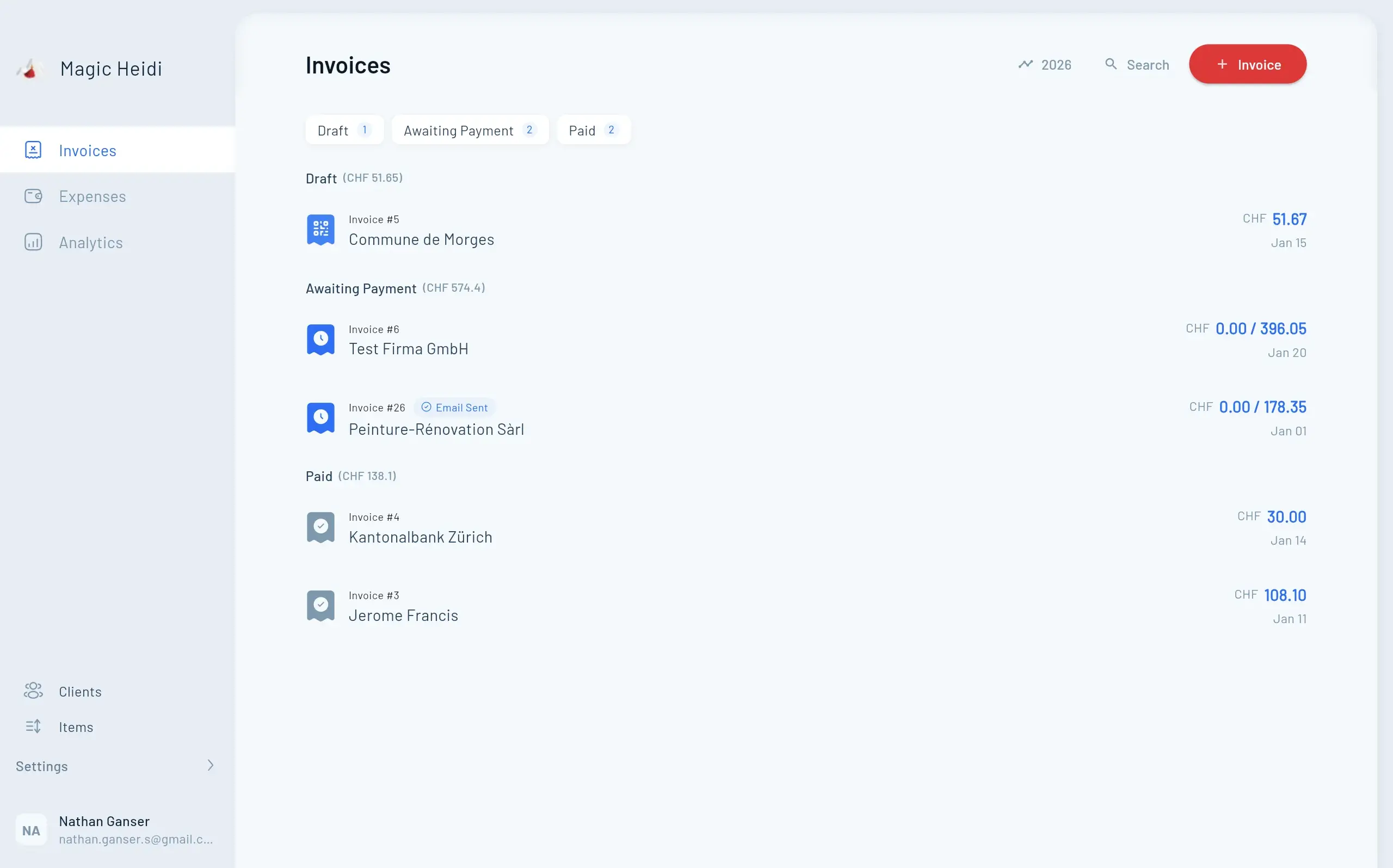
Heilpraktiker Invoice Switzerland
Heilpraktiker in Switzerland need a cantonal permit for MWST (Swiss VAT) exemption, a QR-Rechnung (Swiss QR-bill) since October 2022, and seven mandatory elements under Art. 26 of the Swiss VAT Ordinance (MWSTV). This guide shows you how to bill correctly β with a template, MWST rules, and real practice examples.

Why correct billing matters
for Swiss Heilpraktiker
Heilpraktiker in Switzerland juggle cantonal permits, MWST (Swiss VAT) exemption under Art. 21 of the Swiss VAT Act (MWSTG), and the QR-Rechnung mandate. One wrong note on your invoice β and the ESTV (Swiss Federal Tax Administration) demands MWST back, or the patient refuses to pay. Four pitfalls trip up self-employed practitioners time and again.
QR-Rechnung Mandate
Mandatory since Oct. 2022 β old ESR payment slips are gone, you need a QR-IBANCheck MWST Exemption
Healing treatments are exempt under Art. 21 MWSTG β but only with a cantonal permitCantonal Permit
Without a cantonal practitioner permit, no MWST exemption and no legitimate practiceArt. 26 MWSTV Elements
Seven mandatory fields per invoice β miss one and you risk ESTV auditsKey takeaways
- Healing treatments are MWST-exempt under Art. 21 para. 2 no. 18 MWSTG β but only if you hold a cantonal permit. Wellness, coaching, and product sales are subject to MWST at 8.1%.
- The MWST threshold is CHF 100,000 in annual revenue (Art. 10 MWSTG). Below that, you're not tax-liable and write "MWST not charged, not tax-liable."
- AHV (Swiss old-age insurance) contributions are mandatory from the very first franc of revenue β the Ausgleichskasse (compensation fund) charges approx. 10.1% of your net income as a self-employed earner.
- The QR-Rechnung is mandatory since October 2022. Without a Swiss QR-code with a QR-IBAN, banks no longer process your invoice automatically.
- There's no GebΓΌH in Switzerland β you set your fees freely. Typical rates are CHF 120β180 per session, depending on canton and discipline.
If you work as a Heilpraktiker in Switzerland β or you're planning the leap into self-employment β the invoice is where tax law, professional law, and daily practice collide. A missing mandatory field can trigger an ESTV audit. A wrong MWST treatment costs you real money. An invoice without a QR-code means delayed payments and frustrated patients.
This guide walks you through everything you need for a correct Heilpraktiker invoice in Switzerland: the seven mandatory elements under Art. 26 MWSTV, the MWST exemption for healing treatments, the AHV obligation for self-employed earners, the QR-Rechnung since October 2022, and a copy-ready invoice template. You'll get concrete CHF amounts, real practice examples, and references to the relevant laws.
We'll also show you how Magic Heidi's billing workflow handles the Swiss specifics for Heilpraktiker β QR-Rechnung generation, MWST-exempt vs. MWST-liable line items, Ausgleichskasse reporting β without needing a tax advisor diploma.
Swiss invoice requirements: 7 mandatory elements under Art. 26 MWSTV
Every Heilpraktiker invoice in Switzerland must meet formal requirements. If you're MWST-registered, Art. 26 of the Swiss VAT Ordinance (MWSTV) defines seven mandatory elements your invoice must contain:
- Your name and address β full practice name, street, postal code, city. For an Einzelfirma (Swiss sole proprietorship), your name suffices; for other legal forms, you need the company designation from the commercial register.
- Recipient's name and address β the patient or, where applicable, an insurer.
- Invoice date β the day you issue the invoice.
- Quantity and description of services β e.g., "Classical Homeopathy, initial consultation, 90 min" or "TCM Acupuncture, 60 min." Precise descriptions protect you during ESTV audits.
- Taxable amount β the net amount before MWST, if applicable.
- MWST rate and MWST amount β 8.1% and the resulting tax, shown separately.
- Your MWST number (MWST-Nr.) β the UID-based number the ESTV assigns upon registration.
If your treatment is MWST-exempt β which applies to most Heilpraktiker healing treatments β you don't show MWST, but you identify the exemption with a note like: "MWST-exempt under Art. 21 para. 2 no. 18 MWSTG β healing treatment under cantonal permit."
Below the CHF 100,000 threshold? Then you're not MWST-liable at all. State clearly: "MWST not charged, not tax-liable." This signals to the patient and the ESTV that you're below the threshold and haven't registered voluntarily.
In addition to the MWSTV, Art. 469 of the Swiss Code of Obligations (OR) also governs invoice contents in commercial transactions. The provisions complement each other: the OR provides the civil-law basis, the MWSTV the tax obligations. If you comply with both β which in practice is identical β you're on the safe side. Details are in the official collection of the Swiss Code of Obligations.
The QR-Rechnung: indispensable since 2022
Since October 1, 2022, the QR-Rechnung is the only accepted payment-slip format in Switzerland. The old orange and red ESR (Einzahlungsschein mit Referenznummer) slips have been retired. Every invoice you issue should include a QR-Rechnung payment section with the Swiss QR-code.
The QR-code encodes your QR-IBAN, the amount, your name, and a reference number. Patients scan it with their banking app; banks process it automatically. Without a QR-code, you risk manual payment delays and follow-up queries. If you want to know exactly how to create such a payment section, read our guide on creating a QR-Rechnung.
MWST for Heilpraktiker: exempt or liable?
This is the central point where Swiss Heilpraktiker slip up. Get it wrong here and you either pay back MWST you don't actually owe β or you leave money on the table because you charged MWST when you were exempt.
The exemption: Art. 21 para. 2 no. 18 MWSTG
Under Art. 21 para. 2 no. 18 MWSTG, healing treatments are MWST-exempt when provided by persons who hold a cantonal permit for the practice of the relevant activity. For Heilpraktiker, that means: you need the cantonal permit from your canton of residence or practice β then your healing treatments are MWST-exempt.
The permit is issued by the cantonal health department, usually after a competency exam. Each canton has its own requirements, but all recognize the Heilpraktiker profession. Without this permit, you can't declare your treatment as a healing treatment β and the MWST exemption doesn't apply.
Detailed information is available from the ESTV MWST Info: Healthcare.
What's exempt, what's liable?
MWST-exempt are typical Heilpraktiker services:
- Classical Homeopathy
- TCM (Acupuncture, Herbal Therapy)
- Phytotherapy
- Osteopathy (with cantonal permit)
- Manual therapy as part of a healing treatment
- Nutritional counseling as part of a therapy
MWST-liable at 8.1% are services outside of healing treatments:
- Wellness massages without a therapeutic connection
- Life coaching, business coaching
- Sale of supplements, ointments, tinctures
- Lectures, workshops, courses (except continuing education with a therapeutic connection)
- Online courses, books, digital products
The distinction hinges on the concept of healing treatment. A massage that serves to treat a complaint and takes place in a therapeutic context is exempt. An identical massage offered as wellness without a therapeutic indication is liable. Note in the patient record why the service is a healing treatment β diagnosis, treatment goal, therapy plan. This documentation protects you during an ESTV audit.
The CHF 100,000 threshold
You only register for MWST if your annual taxable revenue exceeds CHF 100,000 (Art. 10 MWSTG). Below that, you're a "non-tax-liable" small business. But be careful: if most of your revenue is MWST-exempt, you may still want to register voluntarily to reclaim input tax on rent, equipment, and practice materials. Voluntary registration is possible β discuss with a tax advisor whether that makes sense for your practice. Learn more in our overview of MWST for freelancers.
After registration, you submit MWST returns to the ESTV β usually quarterly or annually, depending on revenue.
Fees and pricing: free rate-setting in Switzerland
Here's a key difference from the German Heilpraktiker profession: In Switzerland, there's no GebΓΌH β no fee schedule that prescribes what you can charge for which service. You have free rate-setting. You set your own fees.
That's both a curse and a blessing. Nobody tells you what you can charge β but nobody protects you from charging too little, either. Typical fees in Switzerland:
| Service | Typical hourly rate |
|---|---|
| Initial consultation Homeopathy (90 min) | CHF 180β250 |
| Follow-up treatment Homeopathy (45 min) | CHF 90β140 |
| TCM Acupuncture (60 min) | CHF 120β180 |
| Osteopathic treatment (60 min) | CHF 150β220 |
| Phytotherapy consultation (60 min) | CHF 120β160 |
| Nutritional counseling (60 min) | CHF 100β150 |
The ranges vary by canton, experience, specialization, and practice type (Einzelfirma, group practice). Zurich and Geneva tend toward the upper end; rural cantons toward the lower.
When you go self-employed, you'll typically found an Einzelfirma β the simplest legal form for Heilpraktiker. No share capital, no commercial register entry (under CHF 100,000 revenue), full control. The Einzelfirma is the legal form of the overwhelming majority of Swiss Heilpraktiker.
Mini-Story 1: Sarah from Zurich
Sarah, a Heilpraktiker for homeopathy in Zurich, hesitated a long time before going self-employed. She didn't want to set her fees too low because she knew: once you're low, you stay low. She calculated her practice expenses β rent CHF 1,800.00/month, materials CHF 400.00/month, AHV approx. CHF 350.00/month β and landed at CHF 220 for the initial consultation and CHF 140 for the follow-up. She planned to raise her prices by 10% after a year, once the practice was established. It worked: patients accepted the adjustment because they valued the quality. Her gross annual revenue is now CHF 92,000 β just under the MWST threshold, which saves her from MWST returns. She bills cleanly, knows her numbers, and can plan ahead.
AHV and social insurance: obligations for self-employed earners
If you work as a Heilpraktiker in self-employment, you fall under the AHV obligation for self-employed earners. This applies from the very first franc of revenue β not from the MWST threshold. That's a common misconception.
AHV registration: how it works
- Register with the Ausgleichskasse β the cantonal or a recognized industry-specific compensation fund. You can do this online or in writing.
- Submit your business details β legal form (Einzelfirma), address, activity, commercial register number if applicable.
- The Ausgleichskasse determines your contribution β based on your AHV-liable income from self-employment. The current contribution rate is approx. 10.1% for AHV/IV/EO, plus cantonal admin costs and FAK (family compensation fund) at approx. 1β3%.
- You pay advance contributions β the Ausgleichskasse requests advance payments in the first year, which are later settled against the final accounting.
- Submit your annual accounts β after each year, you submit a profit and loss statement. The Ausgleichskasse reconciles the advance payments and requests top-ups or refunds surpluses.
The AHV obligation applies to self-employed activity as defined in Art. 2β3 of the Swiss AHV Act (AHVG). Criteria include personal initiative, entrepreneurial risk, freedom to shape the activity, and issuing your own invoices. If you meet these criteria β which applies to most Heilpraktiker with their own practice β you're a self-employed earner and AHV-liable.
Detailed information is available in the leaflet AHV/IV contributions for self-employed earners.
Mini-Story 2: Markus from Bern
Markus, a Heilpraktiker for TCM in Bern, didn't know after founding his practice that he had to register with the Ausgleichskasse. He'd only registered the cantonal permit and the business β AHV he forgot. After 18 months, he got mail from the Ausgleichskasse: a CHF 5,400.00 back payment for the first two years, plus late-interest charges. He registered retroactively, submitted the annual accounts, and the Ausgleichskasse recalculated his contributions. His AHV-liable income was CHF 54,000.00/year, so approx. CHF 5,450.00 in contributions per year. He set up a monthly accrual of CHF 460.00 to avoid future back payments. Today he pays on time and has peace of mind. He tells every new colleague: "Register with the Ausgleichskasse before you send your first invoice."
QR-Rechnung for Heilpraktiker: how it works
The QR-Rechnung has replaced all old payment slips since October 2022. It consists of two parts: the payment section with QR-code at the bottom right and the receipt at the top, which the patient detaches and submits to the bank.
What the QR-Rechnung contains
The QR-code encodes the following data:
- QR-IBAN β a special IBAN with the CH-QR identifier that your bank issues. It's not the same as your regular business IBAN.
- Payee β your name and address.
- Payment reference β a QR reference (26 digits) or a free reference. You'll usually use the QR reference, which ends with a check digit.
- Amount β if entered, the amount is encoded; otherwise the patient can fill it in.
- Additional information β e.g., invoice number, customer number, message.
Your patient's bank scans the QR-code with the banking app or at the counter. The payment goes to you automatically β no typos in the IBAN, no forgotten subject line.
Practical tips
- Request your QR-IBAN early β your bank needs 1β2 weeks. Without a QR-IBAN, no QR-Rechnung.
- Use software with a QR generator β manually creating the QR-code is error-prone and time-consuming. Magic Heidi's invoice software for Heilpraktiker generates the QR-code automatically.
- Keep reference numbers consistent β use the invoice number as the reference. That way you can match payments automatically.
- Label deposits and final invoices correctly β on a deposit invoice, note "Deposit"; on the final invoice, note "Final invoice" and credit the deposit payment. That way the patient knows what they still owe.
Mini-Story 3: Lena from Basel (part-time)
Lena works part-time as a Heilpraktiker for phytotherapy in Basel β three evenings a week, while holding a day job. Her annual revenue is CHF 24,000, well below the MWST threshold. Billing used to take her ages: Excel spreadsheet, Word template, manually copying the QR-code from an online generator, assembling the PDF. One invoice took 25 minutes. She switched to Magic Heidi: now she selects the patient, enters the service, and the software generates the QR-Rechnung and PDF in under 30 seconds. The time saved β about three hours per month β goes into treatments instead of paperwork. She pays CHF 25.00/month for the software and says: "For three hours saved per month, that pays for itself effortlessly."
Invoice template for Heilpraktiker
Here's a copy-ready template that meets all seven mandatory elements under Art. 26 MWSTV and is ready for QR-Rechnung embedding.
βββββββββββββββββββββββββββββββββββββββββββββββββββββββββββββββββββ
PRACTICE [NAME]
[Street No.]
[ZIP City], Canton [XX]
Tel: [Number] Β· Email: [Email]
UID: CHE-XXX.XXX.XXX Β· MWST-Nr.: CHE-XXX.XXX.XXX MWST
βββββββββββββββββββββββββββββββββββββββββββββββββββββββββββββββββββ
INVOICE No. 2026-001
Date: [DD.MM.YYYY]
Billed to:
[Patient name]
[Street No.]
[ZIP City]
Patient ID: P-00123 Β· Diagnosis: [Code / short description]
Referring physician: [if applicable, name + GLN]
βββββββββββββββββββββββββββββββββββββββββββββββββββββββββββββββββββ
Pos. β Description β Amount CHF
βββββββββββββββββββββββββββββββββββββββββββββββββββββββββββββββββββ
1 β Classical Homeopathy, initial consultation, 90 min β 220.00
2 β Organ examination, comprehensive β 45.00
βββββββββββββββββββββββββββββββββββββββββββββββββββββββββββββββββββ
Subtotal: 265.00
MWST: β
(exempt under Art. 21 para. 2
no. 18 MWSTG β healing treatment
under cantonal permit)
Total: 265.00
βββββββββββββββββββββββββββββββββββββββββββββββββββββββββββββββββββ
Payable by: [Date + 30 days]
Bank details: [Bank name] Β· QR-IBAN: [CH.. .. ..]
Reference: [26-digit QR reference]
Thank you for your trust.
Kind regards, [Signature / Name]
βββββββββββββββββββββββββββββββββββββββββββββββββββββββββββββββββββ
[QR-Rechnung payment section with Swiss QR-code]
βββββββββββββββββββββββββββββββββββββββββββββββββββββββββββββββββββ
If you have MWST-liable services on the same invoice β say, a workshop or a product β list them separately:
3 β Workshop "Stress Management with TCM," 4h β 180.00
(MWST-liable service, not a healing treatment)
MWST 8.1%: 14.58
MWST-liable
Total: 194.58
βββββββββββββββββββββββββββββββββββββββββββββββββββββββββββββββββββ
Grand total: 459.58
βββββββββββββββββββββββββββββββββββββββββββββββββββββββββββββββββββ
Separate healing treatments and other services clearly. The ESTV needs to see which amounts are MWST-exempt and which aren't. If you mix both in one line item, auditors will demand a re-statement β which in the worst case leads to a formal audit finding.
Software for Heilpraktiker β or Excel?
Many Heilpraktiker start with Excel and Word: a spreadsheet for fees, a Word template for the invoice, QR-code copied from an online generator. That works for 5β10 invoices per month. At 20+ invoices β or as soon as you have MWST-liable services β it gets tedious.
Excel: the pros
- Free or already included in your Office subscription
- Full control over every cell
- Flexible, customizable
Excel: the cons
- QR-code generated and embedded manually β error-prone
- MWST calculated by hand β re-do the math on every invoice
- No automatic reference-number generation
- No patient management β re-entering patient data every time
- No expense tracking β assembling everything by hand at year-end for AHV
- No automatic due-date and payment-reminder alerts
Software: what Heilpraktiker really need
Magic Heidi starts at CHF 25.00/month and brings exactly what Heilpraktiker need β and nothing they don't:
- QR-Rechnung generation on every invoice β no manual formatting, no rejected payments.
- MWST-exempt vs. MWST-liable per line item β set the "healing treatment" flag, and the correct MWST treatment is applied automatically.
- Patient management β store patient data, treatment history, and referrals in a central record.
- Expense tracking with AI scan β snap a photo of a receipt, Magic Heidi extracts the amount, MWST, and category. Saves hours at year-end for AHV accounting.
- Mobile-first β issue invoices from your phone between sessions. No laptop needed.
- Deposit and final-invoice logic β the software automatically credits deposit payments on the final invoice.
If you're not yet sure whether to sign up, explore the workflow: here's how Magic Heidi's billing works step by step. If you want to check the cost, you'll find pricing from CHF 25.00 per month online.
If you're digging into "part-time self-employment" β say, because you want to transition from employment to self-employment β the guide to part-time self-employment in Switzerland will help. And physiotherapists have similar MWST rules β their guide provides a useful comparison of how other health professions bill.
FAQ: Heilpraktiker invoices in Switzerland
Are Heilpraktiker in Switzerland exempt from MWST?
Yes β for healing treatments. Under Art. 21 para. 2 no. 18 MWSTG, healing treatments are MWST-exempt if the Heilpraktiker holds a cantonal permit. Without a permit, the exemption doesn't apply. Wellness massages, coaching, product sales, and workshops are MWST-liable at 8.1%.
What mandatory information must a Heilpraktiker invoice contain?
Seven mandatory elements under Art. 26 MWSTV: your name and address, recipient's name and address, invoice date, quantity and description of services, taxable amount, MWST rate and MWST amount, and your MWST number. For MWST-exempt services, you show the exemption under Art. 21 MWSTG instead of the MWST rate and amount.
Does a Heilpraktiker have to pay AHV contributions?
Yes. Anyone self-employed in Switzerland must register with the Ausgleichskasse and pay AHV/IV/EO contributions β from the very first franc of revenue, not from the MWST threshold of CHF 100,000. The current contribution rate is approx. 10.1% of AHV-liable income, plus cantonal admin costs and FAK.
Is there a fee schedule like Germany's GebΓΌH in Switzerland?
No. Unlike Germany, Switzerland has no binding fee schedule for Heilpraktiker. You have free rate-setting β you set your own fees. Typical rates are CHF 120β180 per hour, depending on discipline, canton, and experience. Documenting the service in the patient record is still recommended to keep everything traceable.
What cantonal permit do I need as a Heilpraktiker?
Each canton maintains its own Heilpraktiker permit, usually issued by the cantonal health department after a competency exam. Requirements vary, but all recognize the Heilpraktiker profession. Without this permit, you can't perform healing treatments β and the MWST exemption under Art. 21 MWSTG doesn't apply either.
Can I issue invoices as a part-time Heilpraktiker?
Yes β part-time self-employment is allowed. You must register with the Ausgleichskasse and pay AHV contributions as soon as you're self-employed. The MWST threshold of CHF 100,000 in revenue also applies to part-timers: below that, you're not MWST-liable. Many Heilpraktiker start part-time and build up their practice gradually.
Conclusion
A compliant Heilpraktiker invoice in Switzerland comes down to four things: the seven Art. 26 MWSTV elements, the QR-Rechnung since October 2022, the MWST exemption for healing treatments with a cantonal permit, and the AHV obligation for self-employed earners. Get these right and your invoices pass the scrutiny of patients, banks, and the ESTV without friction.
The MWST distinction β exempt for healing treatments, liable for wellness and products β is where most Heilpraktiker slip up. Document per patient why the service is a healing treatment. Toggle the MWST flag per invoice. Use a tool that knows the difference.
Register with the Ausgleichskasse early β before your first invoice, not when the mail arrives. And calculate your fees so that practice expenses, AHV contributions, and your income all come together. Free rate-setting means: you can β but you also have to do the math.
Magic Heidi handles the billing workflow for Heilpraktiker for CHF 25.00β39.00/month: QR-Rechnung, MWST management, patient records, expense tracking. Mobile-first, without the bloat of enterprise software. Try it for free β your first invoice goes out in under 30 seconds.
Start billing with Magic Heidi now β
References: ESTV β MWST Info Healthcare Β· AHV/IV β Contributions for Self-Employed Earners Β· Art. 469 OR β Invoice Contents.
Create your first Heilpraktiker invoice in 30 seconds
No credit card required. QR-Rechnung, MWST management, and expense tracking β all included.