Business Account for Swiss Freelancers: What Actually Matters in 2026
The best account is not always the cheapest one. It has to match how you invoice, which currencies you use, and how you keep your books clean.

The short answer is simple: a separate business account is not always a hard legal requirement for every freelancer from day one, but it becomes useful very quickly once your activity is real.
As soon as you invoice regularly, track expenses, pay QR-bills, or want cleaner tax prep, a dedicated setup saves time and reduces confusion.
Right now, this topic is covered online mostly by players like Wise, Revolut Business, PostFinance, YAPEAL, and N26, each from a different angle. Magic Heidi does not yet have a focused page for this keyword space.
So instead of forcing a fake ranking, this guide answers the question people actually have: which kind of account makes sense for which kind of Swiss freelancer?
What Makes a Good Freelancer Business Account
A good account should support your real workflow, not just look attractive on a pricing table.
Swiss Fit
If most of your work is in Switzerland, you usually care more about CHF payments, clean separation between private and business money, and local payment comfort than flashy extras.
- Straightforward CHF account
- Clean local payment flow
- Readable statements
- Support that understands Swiss use cases
International Work
If you invoice abroad, you may need multi-currency support, cross-border payments, and transparent FX pricing.
- Multiple currencies or local account details
- Clear FX costs
- Useful cards for travel and software spend
- Exports or integrations that save time
Bookkeeping Compatibility
For freelancers, this is often the real deciding factor: how easily can you connect payments, invoices, and receipts later?
- Electronic statements
- Clear payment references
- Import into bookkeeping tools
- Less manual cleanup
Do You Really Need a Business Account as a Swiss Freelancer?
In practice, the answer is less about theory and more about clarity, professionalism, and lower admin friction.
Several comparison guides correctly point out that sole proprietors and freelancers in Switzerland do not always need a dedicated business account from the very beginning. At the same time, Swiss banks such as PostFinance make it clear that business accounts are the basis for accessing business-related services.
In practice, that means:
- tiny side activities may manage without one for a while;
- serious freelance work usually benefits from one fast;
- GmbH or AG structures normally belong in a proper business-account setup.
So the real question is not just legal compliance. It is operational clarity. The more real your freelance business becomes, the more valuable clean account separation gets.
Which Type of Account Fits Which Freelancer?
Different account models are built for different realities.
| Account Type | Strengths | Weaknesses | Best Fit |
|---|---|---|---|
| Classic Swiss business account | Strong CHF logic, local structure, clean separation | Usually weaker on FX and international flexibility | Freelancers working mostly with Swiss clients |
| Swiss fintech account | Digital onboarding, modern UX, local-first feel | May have a narrower product scope | Solo freelancers who want everything online |
| International multi-currency account | Strong for EUR/USD and cross-border workflows | Not always ideal as your only Swiss account | Freelancers with international revenue |
| Freelancer-only mobile account | Fast, simple, often low-cost | Sometimes limited to your personal name | Sole traders with simple needs |
What competitors are emphasising in this topic
Looking across the pages already ranking in this space, four recurring themes show up.
1. Swiss banks sell structure and separation
PostFinance positions its business account around clean separation between private and business spending, lists CHF 5 per month for a CHF business account, and highlights add-ons plus a founder offer for new businesses.
2. International players sell flexibility
Revolut Business focuses on global payments, multi-currency accounts, and spend management, with Swiss pricing shown from CHF 10 per month. That is naturally appealing for freelancers who invoice internationally.
Wise performs well in this topic because its comparison content clearly helps self-employed people decide between branch banks, fintechs, and international account models depending on how they work.
3. Swiss fintechs sell “digital, but local”
YAPEAL’s business pages highlight a Swiss business account, Swiss support, and local features such as QR Bill and eBill for Business. That is a different promise from both branch banks and global fintechs.
4. Very lean freelancer accounts often come with narrower rules
N26 clearly states that its business account is for freelancers and self-employed people, but also notes that the account is opened under your own name, not under your business name. For some freelancers that is fine. For others it is exactly the limitation.
The useful takeaway: there is no universally best business account. There is only the best account for your actual freelance model.
Three Freelancer Profiles, Three Smart Setups
This is how you avoid paying for the wrong features.
The Local Freelancer
You work mostly in CHF with Swiss clients and mainly want clean incoming payments, tidy expenses, and simple bookkeeping. A Swiss business account or Swiss fintech account usually makes the most sense.
The International Freelancer
You invoice in EUR or USD, travel often, or spend a lot with foreign tools. A multi-currency account can be valuable here, often alongside a Swiss base account.
The Practical Starter
You want to start lean, but still work cleanly. That makes separation, understandable fees, and easy exports more important than long feature lists.
How to Choose Your Business Account in 15 Minutes
Before opening anything, answer these three questions.
Where does your revenue come from?
A CHF-only freelancer needs something different from someone paid in multiple currencies.
- Mostly Swiss clients?
- Frequent international transfers?
- Foreign card spend?
- Do you truly need multi-currency?
How do you get paid?
It is not just about receiving money. It is about recognising and reconciling it later.
- Clear payment references
- Comfort with local payment standards
- Readable statements
- Easy match with invoices
How does it reach your bookkeeping?
The real benefit is admin efficiency, not just banking.
- Electronic statements available
- Import into your accounting flow
- Easy matching of expenses and revenue
- Little manual cleanup
The account is only half the system
The real win appears when your bank account works smoothly with your invoicing, receipts, and bookkeeping.
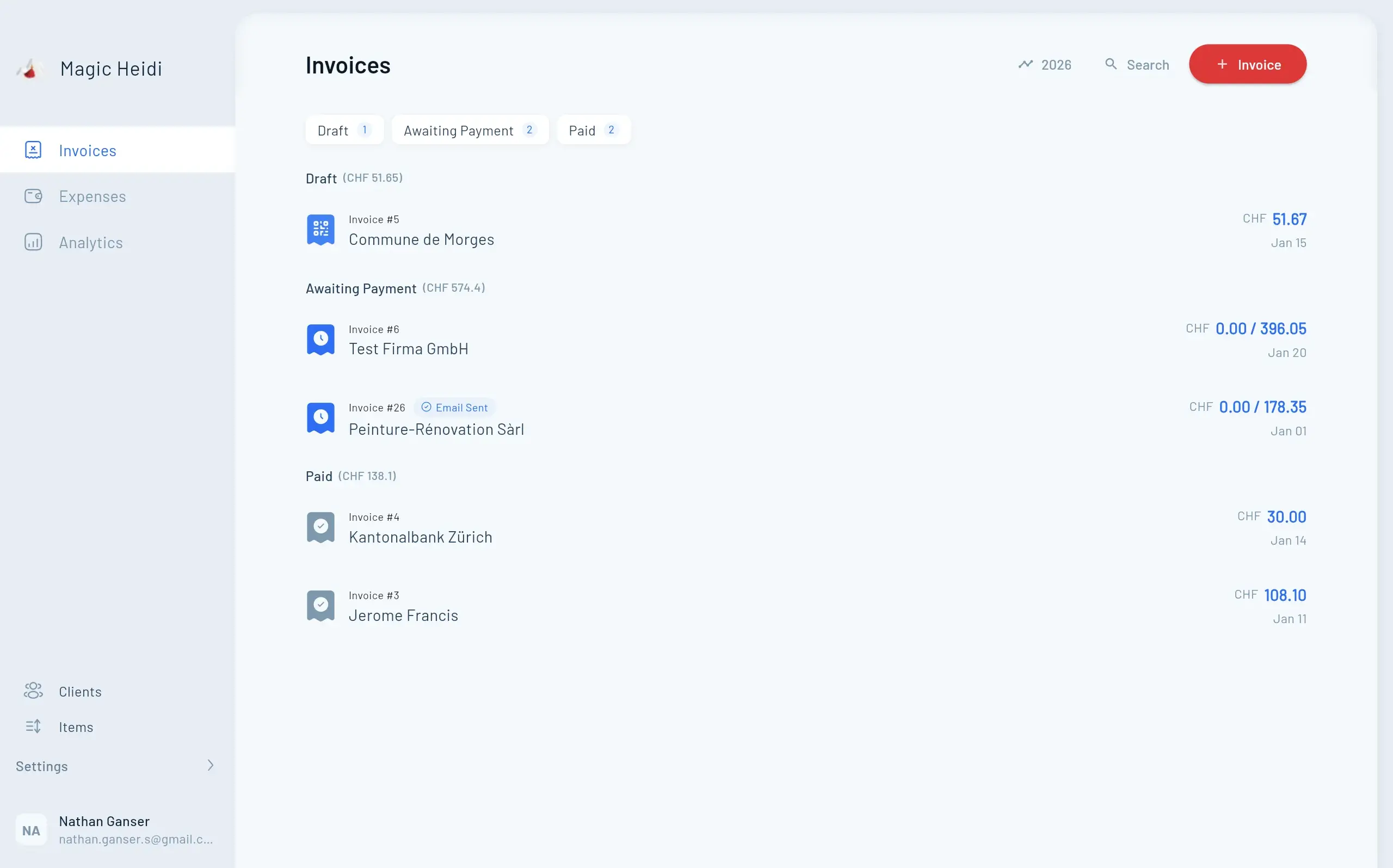
Many freelancers choose an account first and only later discover that:
- payments are hard to match back to invoices;
- receipts live in too many places;
- reminders still happen manually;
- tax prep turns into cleanup work.
That is where Magic Heidi matters. It does not replace your bank. It makes your chosen account easier to run as part of a clean freelance workflow.
With Magic Heidi for freelancers, bank statement import, bookkeeping, and Swiss invoicing, you can build one working system instead of stitching together isolated tools.
For freelancers, the real question is not just “where does the money sit?” but also “how much work does it create after it arrives?”
Common Questions About a Freelancer Business Account
Do Swiss freelancers absolutely need a business account?
Not always from day one. But once your work becomes regular, a separate account usually gives you cleaner bookkeeping, better visibility, and a more professional setup.
Should I choose a Swiss bank or a multi-currency provider?
It depends on your business model. If you work mainly in CHF, a Swiss-first account is usually more logical. If you invoice internationally, a multi-currency setup can add real value, often as a complement.
Can I choose based only on the monthly fee?
No. You should also look at FX costs, local payment comfort, export quality, and how much admin time the account saves or creates.
Can I keep things simple and still look professional?
Yes. What matters most is a clean payment flow, professional invoices, and bookkeeping that stays organised. The strongest setup is often the simplest one that fits your real work.
How do I avoid account chaos at tax time?
Separate private and business money early, import statements regularly, and use a tool that links invoices, receipts, and payments. That is exactly the kind of friction Magic Heidi helps reduce.
The best account is the one that fits your real work
For Swiss freelancers, the strongest setup is the one that reduces friction across the whole admin flow.
If you work mostly in Switzerland and in CHF, local clarity and bookkeeping hygiene usually matter most.
If you work across borders, it often makes sense to think in layers: a clean Swiss base plus a multi-currency tool when you truly need it.
And if your main goal is less admin, never choose the account in isolation. Choose the full workflow: account, invoicing, reconciliation, receipts, and bookkeeping together.
Practical recommendation: start with your real operating model, then make sure Magic Heidi can connect that account to a cleaner and more sustainable workflow.
Ready for a cleaner freelance finance setup?
Magic Heidi helps you connect account activity, invoices, statements, and expenses into one much simpler workflow.